CAS 64790-15-4
:Glucagone (19-29) (umano, bovino, suino)
Descrizione:
Il glucagone (19-29) è un frammento peptidico derivato dalla molecola di glucagone più grande, che svolge un ruolo cruciale nel metabolismo e nella regolazione del glucosio. Questo frammento specifico è composto dagli aminoacidi 19 a 29 della sequenza di glucagone ed è noto per la sua attività biologica nel stimolare la glicogenolisi e la gluconeogenesi nel fegato, aumentando così i livelli di glucosio nel sangue. Il numero CAS 64790-15-4 identifica questo particolare peptide, che è rilevante sia nella fisiologia umana che animale, comprese le specie bovine e suine. Caratteristicamente, il glucagone (19-29) è una molecola idrofila, che tipicamente mostra un alto grado di solubilità in soluzioni acquose, essenziale per la sua funzione biologica. Viene spesso utilizzato in ricerche e contesti clinici per studiare processi metabolici e potenziali applicazioni terapeutiche in condizioni come l'ipoglicemia e il diabete. La stabilità e l'attività di questo peptide possono essere influenzate da fattori come pH, temperatura e la presenza di altri ioni o molecole nella soluzione.
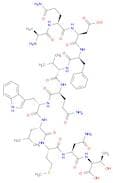
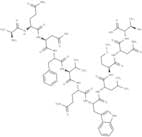
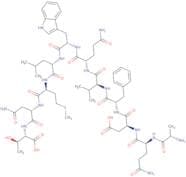
Formula:C61H89N15O18S
InChI:InChI=1/C61H89N15O18S/c1-29(2)23-40(55(87)68-39(21-22-95-7)54(86)73-43(26-47(65)80)59(91)76-50(32(6)77)61(93)94)70-56(88)42(25-34-28-66-36-16-12-11-15-35(34)36)72-53(85)38(18-20-46(64)79)69-60(92)49(30(3)4)75-58(90)41(24-33-13-9-8-10-14-33)71-57(89)44(27-48(81)82)74-52(84)37(17-19-45(63)78)67-51(83)31(5)62/h8-16,28-32,37-44,49-50,66,77H,17-27,62H2,1-7H3,(H2,63,78)(H2,64,79)(H2,65,80)(H,67,83)(H,68,87)(H,69,92)(H,70,88)(H,71,89)(H,72,85)(H,73,86)(H,74,84)(H,75,90)(H,76,91)(H,81,82)(H,93,94)/t31-,32+,37-,38-,39-,40-,41-,42-,43-,44-,49-,50-/m0/s1
Sinonimi:- H-Ala-Gln-Asp-Phe-Val-Gln-Trp-Leu-Met-Asn-Thr-OH
- L-alanyl-L-glutaminyl-L-alpha-aspartyl-L-phenylalanyl-L-valyl-L-glutaminyl-L-tryptophyl-L-leucyl-L-methionyl-L-asparaginyl-L-threonine
- Miniglucagon (huMan, rat, porcine)
- GLUCAGON (19-29) (HUMAN, BOVINE, PORCINE)
- Glucagon (19-29) (huMan, rat, porcine)
- L-Alanyl-L-glutaminyl-L-a-aspartyl-L-phenylalanyl-L-valyl-L-glutaminyl-L-tryptophyl-L-leucyl-L-methionyl-L-asparaginyl-L-threonine
- L-Threonine, L-alanyl-L-glutaminyl-L-α-aspartyl-L-phenylalanyl-L-valyl-L-glutaminyl-L-tryptophyl-L-leucyl-L-methionyl-L-asparaginyl-
- glucagon(19-29
- GLUCAGON (19-29), BOVINE, HUMAN, PORCINE
- PHE-VAL-GLN-TRP-LEU-MET-ASN-THR: FVQWLMNT
- GLUCAGON (19-29), HUMAN
- AQDFVQWLMNT
- ALA-GLN-ASP-PHE-VAL-GLN-TRP-LEU-MET-ASN-THR
- Glucagon (19-29) (human, rat, porcine)
- Vedi altri sinonimi
Ordinare per
Purezza (%)
0
100
|
0
|
50
|
90
|
95
|
100
4 prodotti.
Glucagon (19-29) (human, rat, porcine)
CAS:Miniglucagon inhibited both the Ca²⁺ activated and Mg²⁺ dependent ATPase activity and Ca²⁺ transport in liver plasma membranes with an efficiency 1000-fold higher than that of glucagon. It is likely to be the active peptide involved in the inhibition of the liver Ca²⁺ pump. Miniglucagon, the ultimate processing product of proglucagon, is a regulator of the pancreatic islet physiology.Formula:C61H89N15O18SPurezza:> 96%Colore e forma:White PowderPeso molecolare:1352.53H-Ala-Gln-Asp-Phe-Val-Gln-Trp-Leu-Met-Asn-Thr-OH
CAS:Formula:C61H89N15O18SPurezza:95%Colore e forma:SolidPeso molecolare:1352.5141Glucagon (19-29), human
CAS:Glucagon, a 29-amino-acid hormone, is produced by alpha cells in the pancreas' islets of Langerhans.Formula:C61H89N15O18SPurezza:98%Colore e forma:SolidPeso molecolare:1352.53Glucagon (19-29) (human, rat, porcine) trifluoroacetate salt
CAS:Glucagon is a peptide hormone that belongs to the group of vasoactive intestinal peptides. It is produced by the alpha cells of the pancreas and stimulates gluconeogenesis in the liver, thereby increasing blood glucose levels. Glucagon has also been shown to cause membrane hyperpolarization and cell death in cancer cells. Glucagon is a homologous protein that has been shown to have physiological effects similar to those of insulin, such as increased levels of cytosolic Ca2+ ions and camp levels. Glucagon binds to its receptor on the plasma membrane with high affinity, activating adenylate cyclase and phospholipase C, which leads to an increase in intracellular camp levels. This results in activation of protein kinase A (PKA), which phosphorylates proteins involved in glycogenolysis, glycolysis, and lipolysis. Glucagon also activates mitogen-activated protein kinases (MAPKFormula:C61H89N15O18SPurezza:Min. 95%Peso molecolare:1,352.52 g/mol