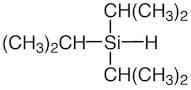
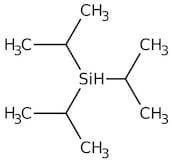
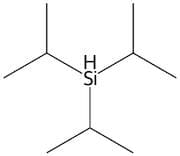
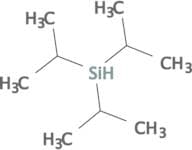
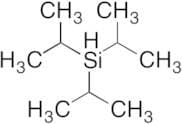
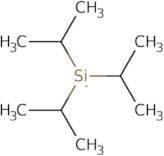
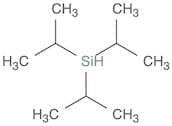
CAS 6485-79-6
:Triisopropilsilano
- Silane, triisopropyl-
- Silane, tris(1-methylethyl)-
- Triisopropylhydrosilane
- Tripropan-2-Ylsilane
- Tris(1-methylethyl)silane
- Triisopropylsilane
- Tris-isopropylsilane
- SILANE IP3H
- Triisopropylsilane [Cas#
- (ME2CH)3SIH
- Triisopropylsilane ,97%
- TIS
- TIPS
- Vedi altri sinonimi
Triisopropylsilane
CAS:Formula:C9H22SiPurezza:>98.0%(GC)Colore e forma:Colorless to Almost colorless clear liquidPeso molecolare:158.36Triisopropylsilane, 98%
CAS:Triisopropylsilane is used as a protecting group in peptide synthesis and is also used as a reducing agent for the selective reduction of anomeric C-phenyl ketals. It is used in the selective silylation of primary hydroxyl groups without affecting the secondary hydroxyl group. It is used in the prepFormula:C9H22SiPurezza:98%Colore e forma:Clear colorless, LiquidPeso molecolare:158.36Triisopropylsilane
CAS:TriisopropylsilaneFormula:C9H22SiPurezza:98%Colore e forma: clear. colourless liquidPeso molecolare:158.35647g/molTriisopropylsilane
CAS:S17975 - Triisopropylsilane
Formula:C9H22SiPurezza:99%Colore e forma:Clear LiquidPeso molecolare:157.141Triisopropylsilane
CAS:Prodotto controllatoApplications Triisopropylsilane is used in the design of internalizing PSMA-specific Glu-ureido-based radiotherapeuticals for prostrate cancers. Reagent for the rational design of dual peptides targeting ghrelin and Y2 receptors to regulate food intake and body weight. Also functions as a highly selective reducing agent used in the preparation of anti-1,2-diols.
Not a dangerous good if item is equal to or less than 1g/ml and there is less than 100g/ml in the package
References Wuestemann, T., et al.: Theranostics, 6, 1085 (2016); Kilian, T., et al.: J. Med. Chem., 58, 4180 (2015); Horners, L.; et al.: Organomet. Chem., 282, 155 (1985)Formula:C9H22SiColore e forma:NeatPeso molecolare:158.36TRIISOPROPYLSILANE, 97%
CAS:Trialkylsilyl Blocking Agent
Used as a protecting group for reactive hydrogens in alcohols, amines, thiols, and carboxylic acids. Organosilanes are hydrogen-like, can be introduced in high yield, and can be removed under selective conditions. They are stable over a wide range of reaction conditions and can be removed in the presence of other functional groups, including other protecting groups. The tolerance of silylated alcohols to chemical transformations summary is presented in Table 1 of the Silicon-Based Blocking Agents brochure.
Tri-substituted Silane Reducing Agent
Organosilanes are hydrocarbon-like and possess the ability to serve as both ionic and free-radical reducing agents. These reagents and their reaction by-products are safer and more easily handled and disposed than many other reducing agents. The metallic nature of silicon and its low electronegativity relative to hydrogen lead to polarization of the Si-H bond yielding a hydridic hydrogen and a milder reducing agent compared to aluminum-, boron-, and other metal-based hydrides. A summary of some key silane reductions are presented in Table 1 of the Silicon-Based Reducing Agents brochure.
Triisopropylsilane; Triisopropylsilylhydride; TIPS-H
Silylates strong acids with loss of hydrogenSilylates 1° alcohols selectivelySteric bulk allows for selective silylation of compounds with more than one hydroxyl groupSummary of selective deprotection conditions is provided in Table 7 through Table 20 of the Silicon-Based Blocking Agents brochureVery sterically-hindered silaneBlocking agent forming derivatives stable in presence of Grignard reagentsSelectively silylates primary alcohols in presence of secondary alcoholsUsed as a cation scavenger in the deprotection of peptidesExtensive review of silicon based reducing agents: Larson, G.; Fry, J. L. "Ionic and Organometallic-Catalyzed Organosilane Reductions", Wipf, P., Ed.; Wiley, 2007Formula:C9H22SiPurezza:97%Colore e forma:LiquidPeso molecolare:158.36Ref: 3H-SIT8385.0
1.5kgPrezzo su richiesta14kgPrezzo su richiesta100gPrezzo su richiesta150kgPrezzo su richiestaTriisopropylsilane
CAS:Triisopropylsilane is a water-soluble analog of trifluoroacetic acid. It is used in the synthesis of peptides and other organic compounds. Triisopropylsilane has been shown to have significant cytotoxicity against cancer cells, with a half maximal inhibitory concentration (IC) of 0.1 mM. This compound also has the ability to chelate transition metals and is used as a fluorescence probe for metal ions. The pharmacokinetics of triisopropylsilane are dependent on its sodium-dependent glucose uptake and hydroxyl group metabolism. Triisopropylsilane binds to DNA and RNA, inhibiting their synthesis, which may be related to its antiviral activity against HIV infections.Formula:C9H22SiPurezza:Min. 95%Colore e forma:Colorless Clear LiquidPeso molecolare:158.36 g/mol