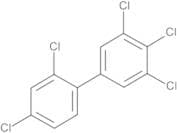
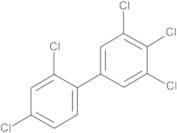
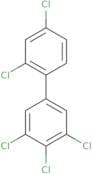
CAS 65510-44-3
:PCB 123
Descrizione:
PCB 123, o bifenile policlorato 123, è un membro della famiglia dei bifenili policlorati (PCB), che consiste in sostanze chimiche organiche sintetiche con diversi gradi di clorazione. Caratterizzato dalla sua struttura a bifenile, PCB 123 contiene più atomi di cloro attaccati alla struttura del bifenile, influenzando le sue proprietà fisiche e chimiche. Questo composto è tipicamente un solido o un liquido incolore o giallo chiaro, a seconda della sua purezza e temperatura. I PCB sono noti per la loro natura idrofobica, bassa volatilità e alta stabilità termica, rendendoli utili in varie applicazioni industriali, come attrezzature elettriche e scambiatori di calore. Tuttavia, a causa della loro persistenza ambientale e potenziale tossicità, i PCB, incluso PCB 123, sono soggetti a rigorose regolamentazioni. Possono bioaccumularsi nella catena alimentare e rappresentare rischi per la salute umana e della fauna selvatica, inclusi disturbi endocrini ed effetti cancerogeni. Di conseguenza, l'uso e la produzione di PCB sono stati ampiamente eliminati in molti paesi, e gli sforzi in corso si concentrano sulla bonifica dei siti contaminati.
Formula:C12H5Cl5
InChI:InChI=1S/C12H5Cl5/c13-7-1-2-8(9(14)5-7)6-3-10(15)12(17)11(16)4-6/h1-5H
InChI key:InChIKey=YAHNWSSFXMVPOU-UHFFFAOYSA-N
SMILES:ClC1=C(C2=CC(Cl)=C(Cl)C(Cl)=C2)C=CC(Cl)=C1
Sinonimi:- 1,1'-Biphenyl, 2',3,4,4',5-pentachloro-
- 1,1'-Biphenyl, 2,3',4,4',5'-Pentachloro-
- 1,1′-Biphenyl, 2,3′,4,4′,5′-pentachloro-
- 2',3,4,4',5-Pentachloro-1,1'-biphenyl
- 2',3,4,4',5-Pentachlorobiphenyl
- 2,3',4,4',5'-Pcb
- 2,3',4,4',5'-Pentachloro-1,1'-biphenyl
- 2,3′,4,4′,5′-Pentachloro-1,1′-biphenyl
- 2,3′,4,4′,5′-Pentachlorobiphenyl
- 2′,3,4,4′,5-PeCB
- 65510-44-3
- Cb 123
- Pcb 123
- Vedi altri sinonimi
Ordinare per
Purezza (%)
0
100
|
0
|
50
|
90
|
95
|
100
Trovati 9 prodotti.
PCB No. 123 10 µg/mL in Isooctane
CAS:Prodotto controllatoFormula:C12H5Cl5Colore e forma:Single SolutionPeso molecolare:326.43PCB-Mix 41 10 µg/mL in Isooctane
CAS:Prodotto controllato- 31508-00-6
- 32598-13-3
- 32598-14-4
- 32774-16-6
- 38380-08-4
- 39635-31-9
- 52663-72-6
- 57465-28-8
- 65510-44-3
- 69782-90-7
- 70362-50-4
- 74472-37-0
Formula:C12H6Cl4Colore e forma:MixturePeso molecolare:291.99WHO PCB Mixture 10 µg/mL in Isooctane
CAS:Prodotto controllato- 31508-00-6
- 32598-13-3
- 32598-14-4
- 32774-16-6
- 38380-08-4
- 39635-31-9
- 52663-72-6
- 57465-28-8
- 65510-44-3
- 69782-90-7
- 70362-50-4
- 74472-37-0
Formula:C12H6Cl4Colore e forma:MixturePeso molecolare:291.99WHO/Europe ISS PCB Mixture 319 10 µg/mL in Isooctane
CAS:Prodotto controllato- 16606-02-3
- 31508-00-6
- 32598-13-3
- 32598-14-4
- 32774-16-6
- 35065-27-1
- 35065-28-2
- 35065-29-3
- 35065-30-6
- 35693-99-3
- 37680-65-2
- 37680-73-2
- 38379-99-6
- 38380-01-7
- 38380-03-9
- 38380-04-0
- 38380-07-3
- 38380-08-4
- 39635-31-9
- 41464-39-5
- 51908-16-8
- 52663-63-5
- 52663-68-0
- 52663-69-1
- 52663-70-4
- 52663-72-6
- 57465-28-8
- 65510-44-3
- 69782-90-7
- 7012-37-5
- 70362-50-4
- 74472-37-0
Colore e forma:MixtureHJ 902-2017, HJ 903-2017 PCB Mixture 160 100 µg/mL in Isooctane
CAS:Prodotto controllato- 2051-24-3
- 31508-00-6
- 32598-10-0
- 32598-13-3
- 32598-14-4
- 32774-16-6
- 34883-43-7
- 35065-27-1
- 35065-28-2
- 35065-29-3
- 35065-30-6
- 35693-99-3
- 37680-65-2
- 37680-73-2
- 38380-07-3
- 38380-08-4
- 39635-31-9
- 40186-72-9
- 41464-39-5
- 52663-68-0
- 52663-72-6
- 52663-78-2
- 57465-28-8
- 65510-44-3
- 69782-90-7
- 7012-37-5
- 70362-50-4
- 74472-37-0
Colore e forma:Mixture2',3,4,4',5-Pentachlorobiphenyl
CAS:Prodotto controllato2',3,4,4',5-Pentachlorobiphenyl is a biliary and hepatic toxin that binds to thyroxine binding globulin (TBG) and albumin in the blood. This binding reduces the hormone's availability in the body. It also inhibits thyroid-stimulating hormone (TSH) by blocking its receptor, thereby decreasing the production of thyroxine. 2',3,4,4',5-Pentachlorobiphenyl is also known to bind to transthyretin (TTR) and regulate its release into the bloodstream. The receptor-mediated mechanism of 2',3,4,4',5-Pentachlorobiphenyl allows it to be insensitive to changes in temperature or pH. In addition, this compound is not metabolized by mammals but instead excreted through bile and urine.Formula:C12H5Cl5Purezza:Min. 95%Peso molecolare:326.43 g/mol