CAS 6552-68-7
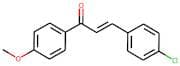
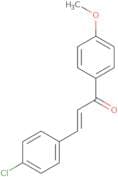
:3-(4-clorofenile)-1-(4-metossifenile)prop-2-en-1-one
Descrizione:
3-(4-clorofenile)-1-(4-metossifenile)prop-2-en-1-one, noto anche come un tipo di chalcone, è un composto organico caratterizzato dal suo sistema di doppi legami coniugati e dalla presenza di anelli aromatici. Questo composto presenta uno scheletro di prop-2-en-1-one, che contribuisce alla sua reattività e potenziale attività biologica. La presenza di un gruppo 4-clorofenile e di un gruppo 4-metossifenile aumenta la sua lipofilia e può influenzare la sua interazione con obiettivi biologici. Le chalcone sono conosciute per le loro diverse proprietà farmacologiche, comprese le attività antinfiammatorie, antiossidanti e anticancro. La struttura del composto consente potenziali applicazioni in chimica medicinale e scienza dei materiali. Viene tipicamente sintetizzato attraverso la reazione di condensazione di Claisen-Schmidt, e le sue proprietà possono essere influenzate dai sostituenti sugli anelli aromatici. Come per molti composti organici, devono essere osservate precauzioni di sicurezza e manipolazione, poiché può presentare tossicità o effetti irritanti.
Formula:C16H13ClO2
InChI:InChI=1/C16H13ClO2/c1-19-15-9-5-13(6-10-15)16(18)11-4-12-2-7-14(17)8-3-12/h2-11H,1H3
SMILES:COc1ccc(cc1)C(=O)C=Cc1ccc(cc1)Cl
Ordinare per
Purezza (%)
0
100
|
0
|
50
|
90
|
95
|
100
2 prodotti.
3-(4-Chlorophenyl)-1-(4-methoxyphenyl)prop-2-en-1-one
CAS:3-(4-Chlorophenyl)-1-(4-methoxyphenyl)prop-2-en-1-onePurezza:≥95%4-Chloro-4'-methoxychalcone
CAS:4-Chloro-4'-methoxychalcone (4MC) is a chalcone with an antibacterial activity. It is synthesized from 4,4'-dimethoxychalcone by substitution of one or two methoxy groups on the aromatic ring with chlorine atoms. 4MC has shown to be active against a number of different bacterial strains, including Staphylococcus aureus and Pseudomonas aeruginosa. The dilution method is used for the determination of the minimal inhibitory concentrations (MICs). This method involves serial dilutions in which bacteria are grown in liquid media containing increasing concentrations of the test compound. The lowest concentration of the test compound that inhibits bacterial growth is determined and recorded as MIC. Plutella xylostella larvae were found to be resistant to 4MC because they lack esterase enzymes that hydrolyze 4MC. Irradiation can be used to produce esters that are more reactive towardsFormula:C16H13ClO2Purezza:Min. 95%Colore e forma:PowderPeso molecolare:272.73 g/mol