CAS 65718-85-6
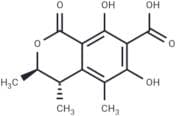
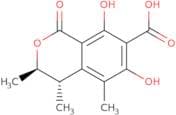
:acido (3R,4S)-6,8-diidrossi-3,4,5-trimetil-1-osso-3,4-diidro-1H-isochromene-7-carbossilico
Descrizione:
La sostanza chimica nota come acido (3R,4S)-6,8-diidrossi-3,4,5-trimetil-1-osso-3,4-diidro-1H-isochromene-7-carbossilico, con il numero CAS 65718-85-6, è un composto che si verifica naturalmente e appartiene alla classe degli isocromeni. Questo composto presenta più gruppi idrossilici, che contribuiscono al suo potenziale come molecola bioattiva, influenzando la sua solubilità e reattività. La presenza di un gruppo funzionale acido carbossilico suggerisce che può partecipare a reazioni acido-base e può mostrare caratteristiche polari. La sua estereochimica, indicata dalla configurazione (3R,4S), implica disposizioni spaziali specifiche che possono influenzare la sua attività biologica e le interazioni con altre molecole. I gruppi trimetilici migliorano il suo carattere idrofobico, il che può influenzare la sua permeabilità attraverso le membrane biologiche. In generale, questo composto può avere applicazioni in ambito farmaceutico o come prodotto naturale con potenziali proprietà terapeutiche, sebbene specifiche attività biologiche richiederebbero ulteriori indagini.
Formula:C13H14O6
InChI:InChI=1/C13H14O6/c1-4-6(3)19-13(18)8-7(4)5(2)10(14)9(11(8)15)12(16)17/h4,6,14-15H,1-3H3,(H,16,17)/t4-,6-/m1/s1
SMILES:C[C@@H]1[C@@H](C)OC(=O)c2c1c(C)c(c(c2O)C(=O)O)O
Ordinare per
Purezza (%)
0
100
|
0
|
50
|
90
|
95
|
100
2 prodotti.
Dihydrocitrinone
CAS:Dihydrocitrinone is a useful organic compound for research related to life sciences. The catalog number is T124457 and the CAS number is 65718-85-6.Formula:C13H14O6Colore e forma:SolidPeso molecolare:266.25Dihydrocitrinone
CAS:Dihydrocitrinone is a weight-loss drug that has been shown to have cytotoxic activity in vitro. It is metabolized by rat liver microsomes into the major metabolites, dihydrocitrinone and citrinone. Dihydrocitrinone has also been shown to be stable when complexed with acetate extract and transport properties. The molecular modeling of dihydrocitrinone shows an interaction with glutathione reductase and cytochrome P450 enzyme. Dihydrocitrinone has been found in urine samples from humans, but not rats or mice, suggesting that this drug may be excreted through the kidneys. There are no known chemical structures for this drug, but it is thought to be an acid conjugate due to its low toxicity.Formula:C13H14O6Purezza:85%MinColore e forma:PowderPeso molecolare:266.25 g/mol