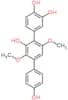
CAS 66163-76-6
:3-Idrossiterfenillina
Descrizione:
3-Idrossiterfenillina, con il numero CAS 66163-76-6, è un composto organico che appartiene alla classe dei derivati del terfenile. È caratterizzato dalla presenza di tre anelli fenilici collegati da una catena di carbonio centrale, con un gruppo idrossile (-OH) attaccato a uno degli anelli fenilici, il che influisce sulle sue proprietà chimiche e reattività. Questo composto è tipicamente un solido a temperatura ambiente e può presentare una struttura cristallina. È noto per le sue potenziali applicazioni in vari campi, inclusa l'elettronica organica, come materiale fluorescente e nella sintesi di altri composti organici. Il gruppo idrossile contribuisce alla sua solubilità in solventi polari e può partecipare a legami idrogeno, influenzando le sue interazioni con altre molecole. Inoltre, 3-Idrossiterfenillina può presentare interessanti proprietà ottiche, rendendolo oggetto di studio in fotochimica e scienza dei materiali. Come molti composti organici, la sua stabilità e reattività possono essere influenzate da fattori ambientali come temperatura e pH.
Formula:C20H18O6
InChI:InChI=1/C20H18O6/c1-25-17-10-14(11-3-6-13(21)7-4-11)20(26-2)19(24)18(17)12-5-8-15(22)16(23)9-12/h3-10,21-24H,1-2H3
InChI key:InChIKey=YLSPFNUVVOKJDF-UHFFFAOYSA-N
SMILES:O(C)C1=C(C(O)=C(OC)C(=C1)C2=CC=C(O)C=C2)C3=CC(O)=C(O)C=C3
Sinonimi:- NSC 299113
- [1,1′:4′,1′′-Terphenyl]-2′,3,4,4′′-tetrol, 3′,6′-dimethoxy-
- 3',6'-Dimethoxy-(1,1':4',1''-terphenyl)-2',3,4,4''-tetrol
- 3′,6′-Dimethoxy[1,1′:4′,1′′-terphenyl]-2′,3,4,4′′-tetrol
- 3-Hydroxyterphenyllin
- [1,1':4',1''-Terphenyl]-2',3,4,4''-tetrol, 3',6'-dimethoxy-
Ordinare per
Purezza (%)
0
100
|
0
|
50
|
90
|
95
|
100
2 prodotti.
3-Hydroxyterphenyllin
CAS:<p>3-Hydroxyterphenyllin from A. candidus is a fungal compound with antioxidant, anticancer, antibacterial, and antiviral effects.</p>Formula:C20H18O6Colore e forma:SolidPeso molecolare:354.353-Hydroxyterphenyllin
CAS:Prodotto controllato<p>3-Hydroxyterphenyllin is a natural compound that has been shown to have anticancer activity. It can be used as an anticancer agent for the treatment of cancer tissues. 3-Hydroxyterphenyllin has antioxidative properties and can inhibit the growth of prostate cancer cells. It also has pro-apoptotic properties, which leads to cell death by apoptosis, or programmed cell death. The apoptotic effect of 3-hydroxyterphenyllin is due to its ability to activate pro-apoptotic proteins such as Bax and Bak, which are involved in the mitochondrial membrane potential and the release of cytochrome c from mitochondria. 3-Hydroxyterphenyllin also inhibits nuclear DNA synthesis by binding to nucleic acid bases, preventing their incorporation into DNA strands.</p>Formula:C20H18O6Purezza:Min. 95%Peso molecolare:354.4 g/mol

