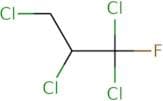
CAS 666-27-3
:1,1,2,3-Tetracloro-1-fluoropropano
Descrizione:
1,1,2,3-Tetracloro-1-fluoropropano, con il numero CAS 666-27-3, è un composto organico alogenato caratterizzato dai suoi quattro atomi di cloro e un atomo di fluoro attaccati a una struttura di propano a tre atomi di carbonio. Questo composto è tipicamente un liquido incolore a temperatura ambiente ed è noto per la sua densità relativamente alta e bassa volatilità rispetto ad altri solventi organici. Non è infiammabile e ha una stabilità chimica distintiva, rendendolo utile in varie applicazioni industriali, in particolare come solvente o nella produzione di altri prodotti chimici. Tuttavia, a causa della sua natura alogenata, può presentare rischi ambientali e per la salute, inclusa la potenziale tossicità e persistenza nell'ambiente. Il suo utilizzo è regolamentato in molte regioni a causa delle preoccupazioni sui suoi effetti sulla salute umana e sulla fascia di ozono. Una corretta gestione e smaltimento sono essenziali per mitigare eventuali effetti avversi associati all'esposizione a questo composto.
Formula:C3H3Cl4F
InChI:InChI=1S/C3H3Cl4F/c4-1-2(5)3(6,7)8/h2H,1H2
InChI key:InChIKey=AUCDWYVJFVHEHQ-UHFFFAOYSA-N
SMILES:C(C(Cl)(Cl)F)(CCl)Cl
Sinonimi:- HCFC 241db
- Propane, 1,1,2,3-tetrachloro-1-fluoro-
- 1,1,2,3-Tetrachloro-1-fluoropropane
Ordinare per
Purezza (%)
0
100
|
0
|
50
|
90
|
95
|
100
1 prodotti.
1,1,2,3-Tetrachloro-1-fluoropropane
CAS:Prodotto controllato<p>1,1,2,3-Tetrachloro-1-fluoropropane is a solvent that can be used to solvate organic compounds. It is volatile and has a boiling point of -78°C. This compound is used in the chlorination of methane and ethane, which produces 1,1,2-trichloroethane and 1,2-dichloroethane respectively. Hydrogen fluoride is also produced as an unwanted byproduct. The chlorine produced by this process is then catalyzed to form fluorine gas. This gas can be vaporized or depletes depending on the reaction conditions and the temperature of the reactor. Fluorine gas reacts with atmospheric water vapor to produce hydrofluoric acid (HF). When HF comes into contact with moist surfaces it will corrode them and produce hydrogen ions that react with metal oxides to produce metal salts and water. The emission of HF from chlorofluorocarbons</p>Formula:C3H3Cl4FPurezza:Min. 95%Peso molecolare:199.87 g/mol