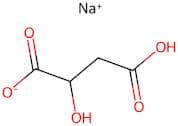
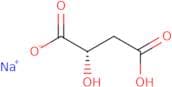
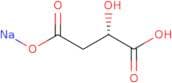
CAS 68303-40-2
:acido L-malico monosodico cristallino
Descrizione:
acido L-malico monosodico cristallino, con il numero CAS 68303-40-2, è un sale sodico dell'acido L-malico, un composto organico che gioca un ruolo significativo in vari processi biochimici, in particolare nel ciclo di Krebs. Questa sostanza appare tipicamente come una polvere cristallina bianca ed è solubile in acqua, rendendola utile in varie applicazioni, comprese le industrie alimentari e delle bevande come acidificante e esaltatore di sapidità. Possiede un sapore leggermente acido ed è nota per la sua capacità di esaltare l'acidità dei prodotti. Oltre ai suoi usi culinari, l'acido L-malico monosodico può anche fungere da agente tampone ed è utilizzato in prodotti farmaceutici e cosmetici per le sue proprietà stabilizzanti. Il composto è generalmente riconosciuto come sicuro (GRAS) quando utilizzato in quantità appropriate, ma come tutte le sostanze, deve essere maneggiato con cura per evitare potenziali effetti avversi. La sua struttura chimica include sia gruppi funzionali di acido carbossilico che di idrossile, contribuendo alla sua reattività e interazione con altri composti.
Formula:C4H5NaO5
Sinonimi:- L-Malic acid monosodium salt
- L-Hydroxybutanedioic acid sodium salt
- SODIUM BIMALATE
- SODIUM ACID MALATE
- Malic acid-Na-salt
- L-(-)-Malic acid sodiuM salt 95-100% (enzyMatic)
- L-malic acid monosodium crystalline
- SODIUM HYDROGEN MALATE
- DL-MALIC ACID MONOSODIUM SALT
- SODIUM HYDROGEN DL-MALATE
Ordinare per
Purezza (%)
0
100
|
0
|
50
|
90
|
95
|
100
4 prodotti.
Sodium 3-carboxy-2-hydroxypropanoate
CAS:Sodium 3-carboxy-2-hydroxypropanoatePurezza:95%Peso molecolare:156.07g/molL-(-)-Malic acid monosodium
CAS:L-Malic acid is a dicarboxylic acid that is found in many fruits and vegetables. It is the substrate for the enzyme malate dehydrogenase, which catalyzes the oxidation of L-malate to oxaloacetate. L-Malic acid is used to study mitochondrial function, as it can be used as an alternative energy source. The L-malic acid monosodium salt (LAM) has been shown to be effective in preventing muscle damage caused by exercise. This may be due to its ability to decrease oxidative stress and increase ATP production through increased mitochondrial activity. LAM also has been shown to promote photoreceptor cell survival and improve retinal function in animals with damaged photoreceptors, although it does not have any effect on normal animal eyes.Formula:C4H6O5•NaPurezza:Min. 95%Colore e forma:PowderPeso molecolare:157.08 g/molL-Malic acid, sodium salt
CAS:L-Malic acid, sodium salt is a white crystalline compound that is soluble in water and has a molecular weight of 136.08. It is a useful scaffold for the synthesis of organic compounds and can be used as a reaction component or as a speciality chemical. L-Malic acid, sodium salt can be used to synthesize many different types of compounds including pharmaceuticals, hormones, industrial chemicals, and research chemicals. This compound is also an important intermediate in the production of amino acids, polymers, and other organic compounds. L-Malic acid, sodium salt has been found to have high purity with few impurities.
Formula:C4H5NaO5Peso molecolare:156.07 g/molRef: 3D-M-0900
-Unit-ggPrezzo su richiesta10gPrezzo su richiesta25gPrezzo su richiesta50gPrezzo su richiesta100gPrezzo su richiesta