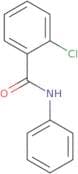
CAS 6833-13-2
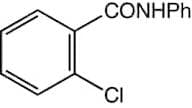
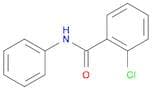
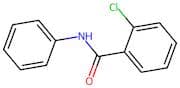
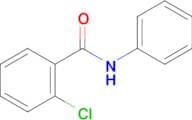
:2-cloro-N-fenilbenzamide
Descrizione:
2-cloro-N-fenilbenzamide è un composto organico caratterizzato dal suo gruppo funzionale ammidico, che consiste in un anello benzenico sostituito da un gruppo cloro e un gruppo N-fenile. Questo composto appare tipicamente come un solido a temperatura ambiente ed è solubile in solventi organici. La presenza del sostituente cloro introduce una reattività unica, rendendolo utile in varie reazioni chimiche, comprese le sostituzioni nucleofile e le reazioni di accoppiamento. Il legame ammidico contribuisce alla sua stabilità e influenza le sue proprietà fisiche, come i punti di fusione e di ebollizione. Inoltre, 2-cloro-N-fenilbenzamide può mostrare attività biologica, rendendolo di interesse nella ricerca farmaceutica. La sua struttura molecolare consente potenziali interazioni con bersagli biologici, che possono essere esplorate per applicazioni terapeutiche. Come molti composti clorurati, è essenziale maneggiare questa sostanza con cura a causa della potenziale tossicità e delle preoccupazioni ambientali. Devono essere osservate le adeguate misure di sicurezza quando si lavora con questo chimico in ambienti di laboratorio.
Formula:C13H10ClNO
InChI:InChI=1/C13H10ClNO/c14-12-9-5-4-8-11(12)13(16)15-10-6-2-1-3-7-10/h1-9H,(H,15,16)
SMILES:c1ccc(cc1)N=C(c1ccccc1Cl)O
Sinonimi:- Benzamide, 2-chloro-N-phenyl-
Ordinare per
Purezza (%)
0
100
|
0
|
50
|
90
|
95
|
100
5 prodotti.
2-Chloro-N-phenylbenzamide, 97%
CAS:This Thermo Scientific Chemicals brand product was originally part of the Alfa Aesar product portfolio. Some documentation and label information may refer to the legacy brand. The original Alfa Aesar product / item code or SKU reference has not changed as a part of the brand transition to Thermo Sci
Formula:C13H10ClNOPurezza:97%Peso molecolare:231.682-Chlorobenzanilide
CAS:2-Chlorobenzanilide is a chlorine compound that has been used to inhibit the growth of soil microorganisms. It is also an inhibitor of phenanthridone, which is an important intermediate in the synthesis of many herbicides. 2-Chlorobenzanilide can be prepared by reacting phenylhydrazine with chloroacetanilide. It can also be prepared by treating benzene with phosphorus chloride and then adding aniline to the reaction product. The rate of this reaction depends on the concentration of reactants, temperature, and pH. If more water is added to the reaction mixture, there will be a lower rate of reaction because hydroxide ions will compete with chloride ions for reactant molecules. The kinetic equation for this reaction follows:Formula:C13H10ClNOPurezza:Min. 95%Peso molecolare:231.68 g/mol