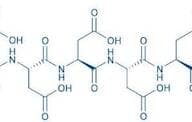
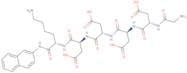
CAS 70023-02-8
:glicina-acido aspartico-acido aspartico-acido aspartico-acido aspartico-lisina-B-naftilamide
Descrizione:
glicina-acido aspartico-acido aspartico-acido aspartico-acido aspartico-lisina-B-naftilamide, noto anche con il suo numero CAS 70023-02-8, è un peptide sintetico che consiste in una sequenza di amminoacidi, specificamente glicina (Gly), acido aspartico (Asp) e lisina (Lys), legati a un gruppo B-naftilamide. Questo composto è caratterizzato dalla sua struttura unica, che combina componenti peptidici e aromatici, influenzando potenzialmente la sua attività biologica e le interazioni. La presenza di più residui di acido aspartico può contribuire alla sua capacità di formare legami idrogeno e interagire con vari bersagli biologici, mentre il gruppo B-naftilamide può aumentare la lipofilia e facilitare la permeabilità della membrana. Tali caratteristiche lo rendono di interesse nella ricerca biochimica, in particolare negli studi relativi alla sintesi di peptidi, progettazione di farmaci e riconoscimento molecolare. Le sue proprietà specifiche, come solubilità, stabilità e reattività, dipenderebbero dalle condizioni in cui viene studiato, inclusi pH e temperatura. In generale, questo composto esemplifica la complessità e la versatilità delle molecole basate su peptidi nella chimica medicinale.
Formula:C34H44N8O14
InChI:InChI=1/C34H44N8O14/c35-10-4-3-7-20(30(52)37-19-9-8-17-5-1-2-6-18(17)11-19)39-32(54)22(13-27(46)47)41-34(56)24(15-29(50)51)42-33(55)23(14-28(48)49)40-31(53)21(12-26(44)45)38-25(43)16-36/h1-2,5-6,8-9,11,20-24H,3-4,7,10,12-16,35-36H2,(H,37,52)(H,38,43)(H,39,54)(H,40,53)(H,41,56)(H,42,55)(H,44,45)(H,46,47)(H,48,49)(H,50,51)/t20-,21-,22?,23-,24-/m0/s1
SMILES:c1ccc2cc(ccc2c1)N=C([C@H](CCCCN)N=C(C(CC(=O)O)N=C([C@H](CC(=O)O)N=C([C@H](CC(=O)O)N=C([C@H](CC(=O)O)N=C(CN)O)O)O)O)O)O
Sinonimi:- H-Gly-Asp-Asp-Asp-Asp-Lys-.beta.NA
- glycyl-L-alpha-aspartyl-L-alpha-aspartyl-L-alpha-aspartyl-alpha-aspartyl-N-naphthalen-2-yl-L-lysinamide
- Gly-Asp-Asp-Asp-Asp-Lys Beta-Naphthylamide
Ordinare per
Purezza (%)
0
100
|
0
|
50
|
90
|
95
|
100
3 prodotti.
H-Gly-Asp-Asp-Asp-Asp-Lys-βNA
CAS:GDDDDK-βNA, specific substrate for the determination of enteropeptidase (enterokinase), also used in histochemistry.Formula:C34H44N8O14Purezza:98.1%Colore e forma:WhitePeso molecolare:788.77Gly-L-Asp-L-Asp-L-Asp-L-Asp-L-Lys-beta-naphthylamide
CAS:Gly-L-Asp-L-Asp-L-Asp-L-Asp-L-Lys (GLAD) is a peptide that has been shown to inhibit the activity of protein kinases. GLAD binds to the ATP binding site and prevents ATP from binding to the kinase, which inhibits the phosphorylation of other proteins. GLAD may also activate certain protein kinases by binding to their ATP binding site. GLAD is a valuable research tool for studying protein interactions, as well as for identifying new receptor ligands and ion channels.Formula:C34H44N8O14Purezza:Min. 95%Peso molecolare:788.8 g/molH-Gly-Asp-Asp-Asp-Asp-Lys-bNA trifluoroacetic acid
CAS:H-Gly-Asp-Asp-Asp-Asp-Lys-bNA trifluoroacetic acid is a peptide that is used as a biocatalyst in the production of microspheres. It is also known as enterokinase, and cleaves proteins at their N termini. This enzyme has been immobilized on silica gel and then applied to the production of microspheres. The half life of this enzyme is 1 hour at 37°C, but it can be increased to 8 hours by immobilizing it on silica gel using glutaraldehyde. HGAASDAAKLysBNAtrifluoroacetic acid has been shown to have a high specific activity with an efficiency of 60% and a pH range between 4 and 10. It has been shown to have high protein cleavage rates at 30°C, 37°C, and 40°C, with bovine serum albumin being the
Formula:C38H45N8O16F3Purezza:Min. 95%Peso molecolare:788.76 g/mol