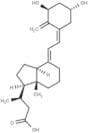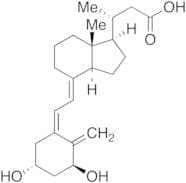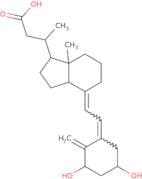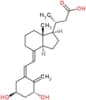
CAS 71204-89-2
:Acido calcitroico
Descrizione:
Acido calcitroico, con il numero CAS 71204-89-2, è un composto chimico che funge da metabolita del calcitriolo, la forma attiva della vitamina D. È caratterizzato dal suo ruolo nella regolazione del metabolismo del calcio e del fosfato nel corpo. Strutturalmente, Acido calcitroico presenta un gruppo idrossile e un gruppo acido carbossilico, che contribuiscono alla sua solubilità in acqua e alla sua attività biologica. Questo composto è principalmente coinvolto nella regolazione del feedback dei livelli di vitamina D, influenzando la sintesi e la degradazione del calcitriolo. La sua presenza nei sistemi biologici è significativa per mantenere la salute delle ossa e l'omeostasi del calcio. Inoltre, Acido calcitroico può avere implicazioni in vari processi fisiologici, inclusa la funzione immunitaria e la differenziazione cellulare. Sebbene le applicazioni specifiche in medicina o nell'industria possano non essere ampiamente documentate, comprendere i suoi percorsi biochimici è cruciale per comprendere il metabolismo della vitamina D e i suoi effetti sulla salute umana.
Formula:C23H34O4
InChI:InChI=1S/C23H34O4/c1-14(11-22(26)27)19-8-9-20-16(5-4-10-23(19,20)3)6-7-17-12-18(24)13-21(25)15(17)2/h6-7,14,18-21,24-25H,2,4-5,8-13H2,1,3H3,(H,26,27)/b16-6+,17-7-/t14-,18-,19-,20+,21+,23-/m1/s1
InChI key:InChIKey=MBLYZRMZFUWLOZ-ZTIKAOTBSA-N
SMILES:C[C@@]12[C@](\C(=C\C=C\3/C(=C)[C@@H](O)C[C@H](O)C3)\CCC1)(CC[C@@]2([C@@H](CC(O)=O)C)[H])[H]
Sinonimi:- (βR,1R,3aS,4E,7aR)-4-[(2Z)-2-[(3S,5R)-3,5-Dihydroxy-2-methylenecyclohexylidene]ethylidene]octahydro-β,7a-dimethyl-1H-indene-1-propanoic acid
- 1α-Hydroxycalcioic acid
- 1H-Indene-1-propanoic acid, 4-[(2Z)-2-[(3S,5R)-3,5-dihydroxy-2-methylenecyclohexylidene]ethylidene]octahydro-β,7a-dimethyl-, (βR,1R,3aS,4E,7aR)-
- 24-Nor-9,10-secochola-5,7,10(19)-trien-23-oic acid, 1,3-dihydroxy-, (1α,3β,5Z,7E)-
- Calcitroic acid
Ordinare per
Purezza (%)
0
100
|
0
|
50
|
90
|
95
|
100
5 prodotti.
Calcitroic acid
CAS:Calcitroic acid is a vitamin D receptor (VDR) agonist that activates VDR-mediated transcription. It is the primary metabolite of 1,25-dihydroxyvitamin D3, showing the highest concentrations in the liver and mucosa of mice. The compound exhibits metabolic stability and extremely low toxicity.Formula:C23H34O4Colore e forma:SolidPeso molecolare:374.514Ref: 4Z-V-1219
5mgPrezzo su richiesta10mgPrezzo su richiesta25mgPrezzo su richiesta50mgPrezzo su richiesta100mgPrezzo su richiestaCalcitroic Acid
CAS:Prodotto controllatoStability Light Sensitive
Applications Calcitroic Acid is a major metabolite of Calcitriol (C144500).
Not a dangerous good if item is equal to or less than 1g/ml and there is less than 100g/ml in the package
References Esvelt, R.P. et al.: Arch. Biochem. Biophys., 206, 403 (1981); Onisko, B.L. et al.: Biochemistry, 19, 4124 (1980); Reddy, G.S. et al.: Biochemistry, 28, 1763 (1989);Formula:C23H34O4Purezza:>85%Colore e forma:NeatPeso molecolare:374.51Calcitroic acid
CAS:Calcitroic acid is a metabolite of vitamin D, which is derived from the enzymatic degradation of calcitriol, the hormonally active form of vitamin D3. This compound is found within biological systems as a result of the breakdown processes occurring in the liver and kidneys, orchestrated by specific enzyme activities that convert calcitriol into calcitroic acid. Its mode of action involves participation in the metabolic pathways that facilitate the regulation of calcium and phosphate homeostasis in the body, albeit as a less active form compared to its precursor, calcitriol.Formula:C23H34O4Purezza:Min. 95%Peso molecolare:374.5 g/molRef: ST-EA-CP-C49014
10mgPrezzo su richiesta25mgPrezzo su richiesta50mgPrezzo su richiesta100mgPrezzo su richiesta