CAS 71637-37-1
:2-Tiofeneacetonitrile,5-bromo-
Descrizione:
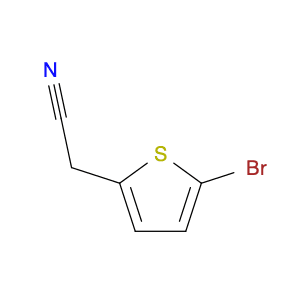
Il 2-tiofenacetonitrile, 5-bromo- è un composto organico caratterizzato dalla presenza di un anello di tiofene, che è un eterociclo aromatico a cinque membri contenente zolfo. Il composto presenta un atomo di bromo sostituito nella posizione 5 dell'anello di tiofene e un gruppo funzionale acetonitrile attaccato alla posizione 2. Questa struttura conferisce proprietà chimiche uniche, inclusa la reattività potenziale in reazioni di sostituzione nucleofila a causa della presenza del gruppo acetonitrile. Il sostituente bromo può anche fungere da gruppo uscente in varie applicazioni sintetiche. Il composto è tipicamente utilizzato nella sintesi organica e può fungere da intermedio nella produzione di farmaci o agrochimici. Le sue proprietà fisiche, come solubilità e punto di fusione, possono variare in base alle condizioni specifiche e alla purezza del campione. Come molti composti bromurati, è importante maneggiarlo con cura a causa dei potenziali impatti ambientali e sulla salute.
Formula:C6H4BrNS
Sinonimi:- 5-Bromo-2-thiophenacetonitrile
- 5-Bromo-2-thiopheneacetonitrile
- (5-Bromo-Thiophen-2-Yl)-Acetonitrile
Ordinare per
Purezza (%)
0
100
|
0
|
50
|
90
|
95
|
100
4 prodotti.
2-(5-Bromothiophen-2-yl)acetonitrile
CAS:Formula:C6H4BrNSPurezza:95%Colore e forma:SolidPeso molecolare:202.07172-(5-Bromothiophen-2-yl)acetonitrile
CAS:2-(5-Bromothiophen-2-yl)acetonitrilePurezza:99%Peso molecolare:202.07g/mol2-(5-Bromothiophen-2-yl)acetonitrile
CAS:2-(5-Bromothiophen-2-yl)acetonitrile is an acceptor in organic solar cells and devices. It has a molecular weight of 122.1 g/mol and a melting point of -34 °C, with a solubility of 0.0013g/mL in water. The UV absorption spectrum shows that it absorbs at wavelengths between 270-300 nm. 2-(5-Bromothiophen-2-yl)acetonitrile can be used as an electron donor for semiconducting heterojunction photovoltaic devices and has been shown to have good transport properties. This molecule also has molecular orbitals that are lower than those found in the ground state, which may be due to the presence of hydrogen bonding groups on the phenyl rings or the presence of electron donating groups such as nitro (-NO2) or cyano (-CN).
Formula:C6H4NSBrPurezza:Min. 95%Peso molecolare:202.07 g/mol