CAS 719-22-2
:2,6-Di-terz-butil-1,4-benzochinone
Descrizione:
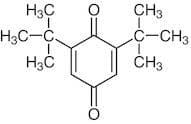
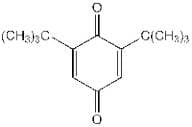
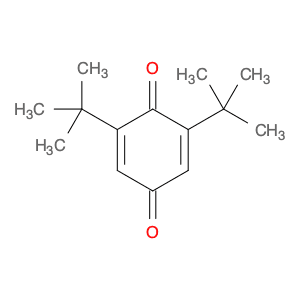
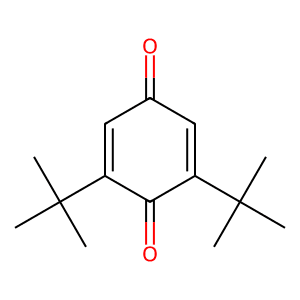
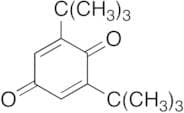
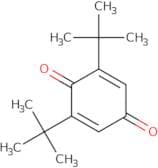
2,6-Di-terz-butil-1,4-benzochinone è un composto organico caratterizzato dalla sua struttura di chinone, che presenta due gruppi tert-butilo nelle posizioni 2 e 6 dell'anello benzenico. Questo composto è noto per le sue forti proprietà antiossidanti, rendendolo utile in varie applicazioni, inclusi come stabilizzatore nei polimeri e come reagente nella sintesi organica. Tipicamente è un solido giallo-arancione a temperatura ambiente ed è solubile in solventi organici come acetone e cloroformio, ma ha una solubilità limitata in acqua. La presenza dei voluminosi gruppi tert-butilo contribuisce al suo ingombro sterico, influenzando la sua reattività e stabilità. Inoltre, 2,6-Di-terz-butil-1,4-benzochinone può subire reazioni redox, permettendo di partecipare a processi di trasferimento di elettroni. Devono essere adottate precauzioni di sicurezza quando si maneggia questo composto, poiché può comportare rischi per la salute se inalato o ingerito. In generale, le sue caratteristiche strutturali uniche e le proprietà lo rendono un composto prezioso sia in contesti industriali che di ricerca.
Formula:C14H20O2
InChI:InChI=1/C14H20O2/c1-13(2,3)10-7-9(15)8-11(12(10)16)14(4,5)6/h7-8H,1-6H3
InChI key:InChIKey=RDQSIADLBQFVMY-UHFFFAOYSA-N
SMILES:C(C)(C)(C)C=1C(=O)C(C(C)(C)C)=CC(=O)C1
Sinonimi:- 2,5-Cyclohexadiene-1,4-dione, 2,6-bis(1,1-dimethylethyl)-
- 2,6-Bis(1,1-dimethylethyl)-2,5-cyclohexadiene-1,4-dione
- 2,6-Bis[1,1-dimethyl ethyl]quinone
- 2,6-Di-Tert-Butyl-P-Benzoquinon
- 2,6-Di-Tert-Butylcyclohexa-2,5-Diene-1,4-Dione
- 2,6-Di-tert-butyl-1,4-benzoquinone
- 2,6-Di-tert-butyl-2,5-cyclohexadien-1,4-dione
- 2,6-Di-tert-butyl-2,5-cyclohexadiene-1,4-dione
- 2,6-Di-tert-butyl-p-quinone
- 2,6-Di-tert-butylbenzoquinone
- 2,6-Di-tert-butylquinone
- 2,6-Ditert-butylcyclohexa-2,5-diene-1,4-dione
- 3,5-Di-tert-butyl-p-benzoquinone
- 3,5-Di-tert-butylquinone
- Dibutylpbenzoquinone
- NSC 14448
- p-Benzoquinone, 2,6-di-tert-butyl-
- DBQ
- 2,5-Cyclohexadiene-1,4-dione,2,6-
- 2,6-Di-tert-butyl-p-benzoquinone, 98+%
- 2,6-DI(TERT-BUTYL)BENZO-1,4-QUINONE
- 4-dione,2,6-bis(1,1-dimethylethyl)-5-cyclohexadiene-1
- 2,6-DI-T-BUTYL-1,4-BENZOQUINONE
- 2,6-di-tert-Butyl-p-benzoquino
- p-Benzoquinone, 2,6-bis-(1,1-dimethylethyl)
- 2,6-DI-T-BUTYL-P-BENZOQUINONE
- 2,6-DI-TERT-BUTYL-P-BENZOQUINONE
- Benzoquinone, 2,6-di-(1,1-dimethylethyl)
- Vedi altri sinonimi
Ordinare per
Purezza (%)
0
100
|
0
|
50
|
90
|
95
|
100
8 prodotti.
2,6-Di-tert-butyl-1,4-benzoquinone
CAS:Formula:C14H20O2Purezza:>98.0%(GC)Colore e forma:Light yellow to Yellow to Orange powder to crystalPeso molecolare:220.312,6-Di-tert-butyl-p-benzoquinone, 98+%
CAS:2,6-Di-tert-butyl-1,4-benzoquinone was used as an antioxidant to study the elimination rate of micro pollutant from storm and waste water. It was also used as a metabolite of butylated hydroxytoluene. It is used as a treatment agent to improve germination and plant health. This Thermo Scientific CheFormula:C14H20O2Purezza:98+%Colore e forma:Orange, Crystals or crystalline powderPeso molecolare:220.312,6-Di-tert-butylcyclohexa-2,5-diene-1,4-dione
CAS:Formula:C14H20O2Purezza:98%Colore e forma:SolidPeso molecolare:220.30742,6-di(tert-butyl)benzo-1,4-quinone
CAS:2,6-di(tert-butyl)benzo-1,4-quinoneFormula:C14H20O2Purezza:98%Colore e forma: yellow solidPeso molecolare:220.31g/molRef: 4Z-Q-010003
5mgPrezzo su richiesta10mgPrezzo su richiesta25mgPrezzo su richiesta50mgPrezzo su richiesta100mgPrezzo su richiesta2,6-Di-tert-butyl-p-benzoquinone
CAS:Applications 2.6-Di-tert-butyl-p-benzoquinone was used as a treatment agent to improve germination, plant health and yield.
Formula:C14H20O2Colore e forma:NeatPeso molecolare:220.312,6-Di-tert-butylcyclohexa-2,5-diene-1,4-dione
CAS:Formula:C14H20O2Purezza:98%Colore e forma:Solid, Reddish yellow to yellow red powderPeso molecolare:220.3122,6-Di-tert-butylcyclohexa-2,5-diene-1,4-dione
CAS:2,6-Di-tert-butylcyclohexa-2,5-diene-1,4-dione (BHT) is a chemical compound that is used as an oxygenation catalyst and analytical method. The molecular structure of BHT contains a hydroxyl group with a redox potential of 0.3 V and a thermal expansion coefficient of 7 x 10 K. This compound has been shown to be toxic in mice, causing lung damage and oxidative DNA damage. BHT also inhibits the transcriptional regulation of genes by binding to amines in the cell membrane. It can act as an antioxidant because it binds to reactive oxygen species and prevents them from oxidizing other molecules in the cell. These properties make it useful for protecting cells from oxidative stress caused by reactive oxygen species or peroxides.Formula:C14H20O2Purezza:Min. 95%Peso molecolare:220.31 g/mol