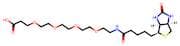
![4,7,10,13-Tetraoxa-16-azaheneicosanoicacid, 21-[(3aS,4S,6aR)-hexahydro-2-oxo-1H-thieno[3,4-d]imida…](/_next/image/?url=https%3A%2Fstatic.cymitquimica.com%2Fcas-image%2Fthumb-webp%2F307440-471013-tetraoxa-16-azaheneicosanoicacid-21-3as-4s-6ar-hexahydro-2-oxo-1h-thieno-34-d-imidazol-4-yl-17-oxo.webp&w=3840&q=75)
CAS 721431-18-1
:acido 4,7,10,13-tetraossa-16-azaheneicosanoico, 21-[(3aS,4S,6aR)-esaidro-2-osso-1H-tieno[3,4-d]imidazol-4-il]-17-osso-
Descrizione:
L'acido 4,7,10,13-tetraoxa-16-azaheneicosanoico, con numero CAS 721431-18-1, è un composto organico complesso caratterizzato dalle sue uniche caratteristiche strutturali, inclusi più atomi di ossigeno e azoto all'interno della sua struttura molecolare. Questo composto contiene una lunga catena di carbonio, che contribuisce alle sue proprietà idrofobiche, mentre la presenza di gruppi funzionali di tetraoxa e acido azaheneicosanoico conferisce idrofobicità e potenziale reattività. La porzione di tieno[3,4-d]imidazolo suggerisce attività biologica, indicando possibilmente il suo ruolo nella chimica medicinale o come un farmacoforo. La stereochimica, indicata dalla configurazione specifica del gruppo esahidro-2-oxo, può influenzare le sue interazioni biologiche e l'efficacia. In generale, la struttura intricata di questo composto suggerisce potenziali applicazioni nello sviluppo di farmaci, in particolare nel targeting di specifici percorsi o funzioni biologiche. Ulteriori studi sarebbero necessari per chiarire il suo comportamento chimico completo, stabilità e potenziali usi terapeutici.
Formula:C21H37N3O8S
Sinonimi:- 15-[D(+)-Biotinylamino]-4,7,10,13-Tetraoxapentadecanoic Acid
Ordinare per
Purezza (%)
0
100
|
0
|
50
|
90
|
95
|
100
9 prodotti.
Biotin-PEG4-propionic Acid
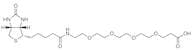
CAS:Formula:C21H37N3O8SPurezza:>98.0%(T)Colore e forma:White to Light yellow powder to crystalPeso molecolare:491.6015-[D-(+)-Biotinylamino]-4,7,10,13-tetraoxapentadecanoic acid
CAS:Formula:C21H37N3O8SPurezza:97%Colore e forma:SolidPeso molecolare:491.5988Ref: IN-DA005JT7
5gPrezzo su richiesta10gPrezzo su richiesta50gPrezzo su richiesta25mg51,00€50mg63,00€100mg75,00€250mg111,00€1g245,00€Biotin-PEG4-acid
CAS:Biotin-PEG4-acid is a PEG-based linker for PROTACs which joins two essential ligands, crucial for forming PROTAC molecules.Formula:C21H37N3O8SColore e forma:SolidPeso molecolare:491.6Biotin-PEG4-propionic acid
CAS:Biotin-PEG4-propionic acid is a PEG compound with two different functional groups (also known as heterobifunctional). Unlike homobifunctional PEG compounds (same functional group on both ends), this type of compounds are more versatile as have two different anchor points. Biotin-PEG4-propionic acid is used as a linker and spacer to add a PEG moiety, via pegylation (a bioconjugation technique) to proteins, peptides, oligonucleotides, small molecules and nanoparticles.Formula:C21H37N3O8SPurezza:Min. 95%Colore e forma:PowderPeso molecolare:491.6 g/moldPEG®24-Biotin Acid
CAS:dPEG®24-Biotin Acid is a PEG compound with two different functional groups (also known as heterobifunctional). Unlike homobifunctional PEG compounds (same functional group on both ends), this type of compounds are more versatile as have two different anchor points. dPEG®24-Biotin Acid is used as a linker and spacer to add a PEG moiety, via pegylation (a bioconjugation technique) to proteins, peptides, oligonucleotides, small molecules and nanoparticles.Formula:C61H117N3O28SPurezza:Min. 95%Peso molecolare:1,325.6 g/moldPEG®4 Biotin Acid
CAS:dPEG®4 Biotin Acid is a PEG compound with two different functional groups (also known as heterobifunctional). Unlike homobifunctional PEG compounds (same functional group on both ends), this type of compounds are more versatile as have two different anchor points. dPEG®4 Biotin Acid is used as a linker and spacer to add a PEG moiety, via pegylation (a bioconjugation technique) to proteins, peptides, oligonucleotides, small molecules and nanoparticles.
Purezza:Min. 95%Peso molecolare:491.6 g/moldPEG®48-Biotin Acid
CAS:dPEG®48-Biotin Acid is a PEG compound with two different functional groups (also known as heterobifunctional). Unlike homobifunctional PEG compounds (same functional group on both ends), this type of compounds are more versatile as have two different anchor points. dPEG®48-Biotin Acid is used as a linker and spacer to add a PEG moiety, via pegylation (a bioconjugation technique) to proteins, peptides, oligonucleotides, small molecules and nanoparticles.Formula:C112H218N4O53SPurezza:Min. 95%Peso molecolare:2,500.99 g/mol

![15-[D-(+)-Biotinylamino]-4,7,10,13-tetraoxapentadecanoic acid](/_next/image/?url=https%3A%2Fstatic.cymitquimica.com%2Fproducts%2FIN%2Fthumb%2FDA005JT7.jpg&w=3840&q=75)