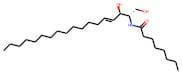
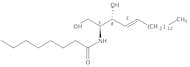
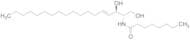
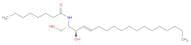
CAS 74713-59-0
:C8-Ceramide
- Octanamide, N-[(1S,2R,3E)-2-hydroxy-1-(hydroxymethyl)-3-heptadecen-1-yl]-
- Octanamide, N-[2-hydroxy-1-(hydroxymethyl)-3-heptadecenyl]-, [R-[R*,S*-(E)]]-
- Octanamide, N-[(1S,2R,3E)-2-hydroxy-1-(hydroxymethyl)-3-heptadecenyl]-
- N-[(1S,2R,3E)-2-Hydroxy-1-(hydroxymethyl)-3-heptadecen-1-yl]octanamide
- N-Octanoylsphingosine
C8-Ceramide
CAS:C8 Ceramide, a cell-permeable analog, is analog to naturally occur ceramides.Formula:C26H51NO3Colore e forma:SolidPeso molecolare:425.69C8 Ceramide
CAS:Prodotto controllatoStability Temperature Sensitive
Applications A biologically active, cell permeable, but nonphysiologic ceramide analog. It induces phosphorylation on Thr-669 in A-431 cells by stimulation of ceramide-activated protein kinase. It stimulates IL-2 secretion and induces apoptosis.
References Mathias, S., et al.: Proc. Natl. Sci. USA, 88, 10009 (1991), Mathias, S., et al.: Science, 259, 519 (1993), Jarvis, W.D., et al.: Proc. Natl. Acad. Sci. USA, 91, 73 (1994)Formula:C26H51NO3Colore e forma:NeatPeso molecolare:425.69Ref: IN-DA005HYB
Prodotto fuori produzioneC8-Ceramide
CAS:C8-Ceramide is a glucosylceramide that is involved in the production of C8-ceramides. It has shown to have potent apoptosis activity and inhibit p21, an inhibitor of cell cycle progression. C8-Ceramide also has been shown to be an inhibitor of tumor necrosis factor alpha (TNF-α) induced inflammation and apoptosis in mouse tumor cells. In addition, it can induce apoptosis by inhibiting the epidermal growth factor receptor (EGFR) pathway. This polymerase chain reaction (PCR) product was found to bind to DNA in a model system using calf thymus DNA as well as bacterial DNA gyrase and topoisomerase IV enzymes.
Formula:C26H51NO3Purezza:Min. 95%Peso molecolare:425.69 g/molRef: 3D-FC19618
Prodotto fuori produzione