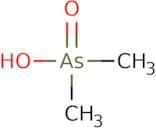
CAS 75-60-5
:Acido dimetilarsinico
Descrizione:
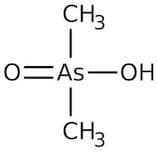
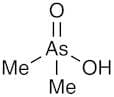
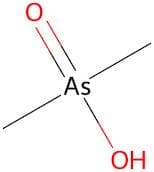
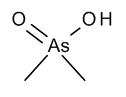
Acido dimetilarsinico (DMAA) è un composto organoarsenico caratterizzato dai suoi due gruppi metilici attaccati a un atomo di arsenico, insieme a un gruppo funzionale acido carbossilico. Si incontra tipicamente come un liquido incolore o giallo pallido o solido, a seconda della sua forma e purezza. Il DMAA è solubile in acqua e in solventi organici polari, il che facilita il suo utilizzo in varie applicazioni, inclusa come reagente nella sintesi organica e in studi relativi al metabolismo dell'arsenico. Il composto è di interesse a causa della sua potenziale tossicità e impatto ambientale, poiché l'arsenico è un noto cancerogeno. Nei sistemi biologici, Acido dimetilarsinico può subire trasformazioni metaboliche, portando alla formazione di altre specie di arsenico. La sua presenza nell'ambiente, in particolare in fonti d'acqua contaminate, solleva preoccupazioni riguardo alla salute umana e agli effetti ecologici. Le misure di sicurezza sono essenziali quando si maneggia il DMAA, poiché l'esposizione può portare a effetti negativi sulla salute. In generale, Acido dimetilarsinico funge da composto significativo sia nella ricerca chimica che negli studi ambientali relativi ai composti di arsenico.
Formula:C2H7AsO2
InChI:InChI=1/C2H7AsO2/c1-3(2,4)5/h1-2H3,(H,4,5)
InChI key:InChIKey=OGGXGZAMXPVRFZ-UHFFFAOYSA-N
SMILES:[As](C)(C)(=O)O
Sinonimi:- Acide dimethylarsinique
- Acido Dimetilarsinico
- Ansar 138
- Arsan
- Arsine oxide, hydroxydimethyl-
- Arsinic Acid, Dimethyl-
- Arsinic acid, As,As-dimethyl-
- As,As-Dimethylarsinic acid
- Dimethylarsenic acid
- Dimethylarsinic acid
- Dimethylarsinsaure
- Dimethylarsonic acid
- Hydroxydimethylarsine oxide
- Kakodylsaeure
- Nsc 103115
- Nsc 71157
- Nsc 71158
- Phytar
- Silvisar 510
- Sylvicor
- Cacodylic acid
- agentblue
- Cacodylie acid
- Ansar
- DIMETHYLHYDROXYARSINE OXIDE
- Acide cacodylique
- Agent blue
- RAD-E-CATE 35(R)
- SILVISAR(R)
- alkargen
- acidecacodylique(french)
- PHYTAR(R)
- ANSAR(R)
- acidedimethylarsinique
- acidedimethylarsenique(french)
- Vedi altri sinonimi
Ordinare per
Purezza (%)
0
100
|
0
|
50
|
90
|
95
|
100
6 prodotti.
Cacodylic acid, 98%
CAS:A useful arsenic acid for proteomics research. It a good substitute for phosphate in applications to avoid phosphates. Cacodylic Acid is useful for some DNA applications and is also popular in microscopy. This Thermo Scientific Chemicals brand product was originally part of the Alfa Aesar productFormula:C2H7AsO2Purezza:98%Colore e forma:White, Crystals or powder or crystalline powderPeso molecolare:138.00Dimethylarsinic acid (Cacodylic acid), 98%
CAS:Dimethylarsinic acid (Cacodylic acid), 98%
Formula:(CH3)2AsOOHPurezza:98%Colore e forma:white pwdr.Peso molecolare:138.00Cacodylic Acid
CAS:Applications Cacodylic acid is used for dermatologic treatment in cronic eczema, anemia and as a tonic.
Not a dangerous good if item is equal to or less than 1g/ml and there is less than 100g/ml in the package
References Mandal, B., et al.: Talanta, 58, 201 (2002), Naranmandura, H., et al.: Chem. Res. Toxicol., 20, 616 (2007), Naranmandura, H., et al.: Toxicol. Appl. Pharmacol., 227, 390 (2008), Violin, J., et al.: J. Biol. Chem., 283, 2949 (2008),Formula:C2H7AsO2Colore e forma:NeatPeso molecolare:138.00Cacodylic acid
CAS:Cacodylic acid is a white to brown crystalline powder that is soluble in water. It has been used as an analytical reagent, polymerase chain reaction (PCR) inhibitor, and skin cancer treatment. Cacodylic acid inhibits the activity of the bacterial enzyme activities in humans and other mammals. The mechanism of action of cacodylic acid is not completely understood but it appears that it binds to inorganic iron and blocks its availability for use by bacterial enzymes such as dihydropteroate synthase, which is required for DNA synthesis. This leads to cell death. Cacodylic acid has also been shown to inhibit the growth of human HL-60 cells in vitro, suggesting that it may have carcinogenic potential.Formula:C2H7AsO2Purezza:Min. 95%Colore e forma:PowderPeso molecolare:138 g/mol