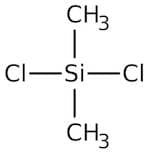
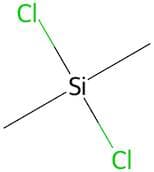
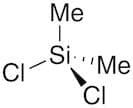
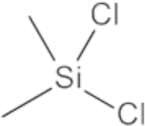
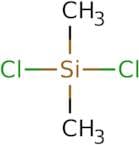
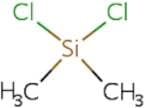
CAS 75-78-5
:Diclorodimetilsilano
- Chlorodimethylsilane
- Dcdms
- Dichlor(dimethyl)silan
- Dichloro(dimethyl)silane
- Dichlorodimethylsilicon
- Dicloro(Dimetil)Silano
- Dimethyl dichlorosilane
- Dimethyldichlorosilane
- Dimethylsilane dichloride
- Dimethylsilyl dichloride
- Dmdcs
- Inerton AW-DMCS
- Ka 12
- Ka 22
- LS 130 (silane)
- Ls 130
- M 2
- M 2 (silane)
- Nsc 77070
- Repel-Silane
- Sid 4120.0
- Silane, Dichlorodimethyl
- Silanization Sol. Ii
- Silanization solution II
- Sylon Ct
- Tsl 8032
- Vedi altri sinonimi
Dichlorodimethylsilane, 98+%
CAS:Dichlorodimethylsilane is used to prepare a resin bound siloxane with tertiary alcohols and it is also used as a reagent for synthesis of optically active ansa-mettallocene polymerization catalysts. It acts as a precursor to silicone and polysilane compounds. It is also used in the glass coating toFormula:C2H6Cl2SiPurezza:98+%Colore e forma:Liquid, Clear colorless to pale yellowPeso molecolare:129.06Dichlorodimethylsilane
CAS:DichlorodimethylsilaneFormula:C2H6Cl2SiPurezza:95%Colore e forma: clear. colourless liquidPeso molecolare:129.06054g/molDimethyldichlorosilane, 99%
CAS:Dimethyldichlorosilane, 99%
Formula:(CH3)2SiCl2Purezza:99%Colore e forma:colorless liq.Peso molecolare:129.07DIMETHYLDICHLOROSILANE, 98%
CAS:Bridging Silicon-Based Blocking Agent
Used as a protecting group for reactive hydrogens in alcohols, amines, thiols, and carboxylic acids. Organosilanes are hydrogen-like, can be introduced in high yield, and can be removed under selective conditions. They are stable over a wide range of reaction conditions and can be removed in the presence of other functional groups, including other protecting groups. The tolerance of silylated alcohols to chemical transformations summary is presented in Table 1 of the Silicon-Based Blocking Agents brochure.
Alkyl Silane - Conventional Surface Bonding
Aliphatic, fluorinated aliphatic or substituted aromatic hydrocarbon substituents are the hydrophobic entities which enable silanes to induce surface hydrophobicity. The organic substitution of the silane must be non-polar. The hydrophobic effect of the organic substitution can be related to the free energy of transfer of hydrocarbon molecules from an aqueous phase to a homogeneous hydrocarbon phase. A successful hydrophobic coating must eliminate or mitigate hydrogen bonding and shield polar surfaces from interaction with water by creating a non-polar interphase. Although silane and silicone derived coatings are in general the most hydrophobic, they maintain a high degree of permeability to water vapor. This allows coatings to breathe and reduce deterioration at the coating interface associated with entrapped water. Since ions are not transported through non-polar silane and silicone coatings, they offer protection to composite structures ranging from pigmented coatings to rebar reinforced concrete. A selection guide for hydrophobic silanes can be found on pages 22-31 of the Hydrophobicity, Hydrophilicity and Silane Surface Modification brochure.
Dimethyldichlorosilane; Dichlorodimethylsilane; DMS
AIR TRANSPORT FORBIDDENViscosity: 0.47 cStVapor pressure, 17 °C: 100 mmSpecific heat: 0.92 J/g/°ΔHcomb: -2,055 kJ/molΔHvap: 33.5 kJ/molSurface tension: 20.1 mN/mCoefficient of thermal expansion: 1.3 x 10⁻³Critical temperature: 247.2 °CCritical pressure: 34.4 atmFundamental monomer for siliconesEmployed in the tethering of two olefins for the cross metathesis-coupling step in the synthesis of Attenol AAids in the intramolecular Pinacol reactionReacts with alcohols, diols, and hydroxy carboxylic acidsEmployed as a protecting group/template in C-glycoside synthesisHigher purity available as SID4120.1Summary of selective deprotection conditions is provided in Table 7 through Table 20 of the Silicon-Based Blocking Agents brochureFormula:C2H6Cl2SiPurezza:98%Colore e forma:Straw Amber LiquidPeso molecolare:129.06DIMETHYLDICHLOROSILANE, 99+% 5-GAL DRUM
CAS:Bridging Silicon-Based Blocking Agent
Used as a protecting group for reactive hydrogens in alcohols, amines, thiols, and carboxylic acids. Organosilanes are hydrogen-like, can be introduced in high yield, and can be removed under selective conditions. They are stable over a wide range of reaction conditions and can be removed in the presence of other functional groups, including other protecting groups. The tolerance of silylated alcohols to chemical transformations summary is presented in Table 1 of the Silicon-Based Blocking Agents brochure.
Alkyl Silane - Conventional Surface Bonding
Aliphatic, fluorinated aliphatic or substituted aromatic hydrocarbon substituents are the hydrophobic entities which enable silanes to induce surface hydrophobicity. The organic substitution of the silane must be non-polar. The hydrophobic effect of the organic substitution can be related to the free energy of transfer of hydrocarbon molecules from an aqueous phase to a homogeneous hydrocarbon phase. A successful hydrophobic coating must eliminate or mitigate hydrogen bonding and shield polar surfaces from interaction with water by creating a non-polar interphase. Although silane and silicone derived coatings are in general the most hydrophobic, they maintain a high degree of permeability to water vapor. This allows coatings to breathe and reduce deterioration at the coating interface associated with entrapped water. Since ions are not transported through non-polar silane and silicone coatings, they offer protection to composite structures ranging from pigmented coatings to rebar reinforced concrete. A selection guide for hydrophobic silanes can be found on pages 22-31 of the Hydrophobicity, Hydrophilicity and Silane Surface Modification brochure.
Dimethyldichlorosilane; Dichlorodimethylsilane; DMS
AIR TRANSPORT FORBIDDENRedistilledViscosity: 0.47 cStVapor pressure, 17 °C: 100 mmSpecific heat: 0.92 J/g/°ΔHcomb: -2,055 kJ/molΔHvap: 33.5 kJ/molSurface tension: 20.1 mN/mCoefficient of thermal expansion: 1.3 x 10⁻³Critical temperature: 247.2 °CCritical pressure: 34.4 atmFundamental monomer for siliconesEmployed in the tethering of two olefins for the cross metathesis-coupling step in the synthesis of Attenol AAids in the intramolecular Pinacol reactionReacts with alcohols, diols, and hydroxy carboxylic acidsEmployed as a protecting group/template in C-glycoside synthesisAvailable in a lower purity as SID4120.0Summary of selective deprotection conditions is provided in Table 7 through Table 20 of the Silicon-Based Blocking Agents brochureFormula:C2H6Cl2SiPurezza:99+%Colore e forma:Straw LiquidPeso molecolare:129.06Dichlorodimethylsilicon
CAS:Prodotto controllatoApplications Dichlorodimethylsilicon is a organosilicon compound and is the precursor to dimethylsilicone and polysilane compounds.
E0
References Tsekova, D., et al.: Chem. Engineer. Sci., 77, 201 (2012); Mujawar, L.H., et al.: Analyst., 138. 518 (2013);Formula:C2H6Cl2SiColore e forma:NeatPeso molecolare:129.06Dichlorodimethylsilane
CAS:Dichlorodimethylsilane is a chemical compound that belongs to the group of organic compounds that are solids at room temperature. It has been used as a model system for studying the hydrophobic effect, and has also been shown to be an efficient solid catalyst for hydrogenation reactions. Dichlorodimethylsilane can be used in analytical chemistry as it is soluble in water, and it can be used as a reaction solution for potassium dichromate. The reaction mechanism for dichlorodimethylsilane is yet to be determined, but it is believed that the hydroxyl group on one molecule reacts with the hydrogen on another molecule.
Formula:C2H6Cl2SiPurezza:Min. 95%Peso molecolare:129.06 g/molDimethyl Dichlorosilane (DMDCS) pure, 98%
CAS:Formula:C2H6Cl2SiPurezza:min. 98%Colore e forma:Clear, Colourless to pale yellow, LiquidPeso molecolare:129.06Ref: SR-21800
Prodotto fuori produzione