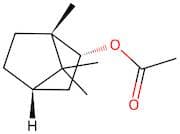
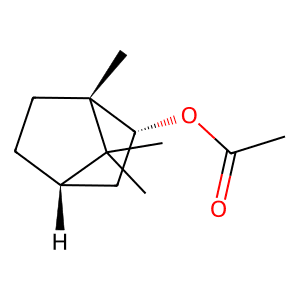
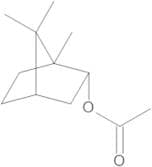
CAS 76-49-3
:(±)-Acetato di bornile
Descrizione:
(±)-Acetato di bornile è un composto organico classificato come un estere, specificamente derivato dall'alcol bornilico e dall'acido acetico. È un liquido incolore o giallo pallido con un aroma caratteristico piacevole, simile al pino, che lo rende popolare nelle industrie delle fragranze e dei sapori. Il composto ha un punto di ebollizione relativamente basso ed è solubile in solventi organici, ma solo leggermente solubile in acqua. La sua formula molecolare è C12H20O2 e presenta una struttura biciclica tipica dei terpeni, che contribuisce al suo profumo distintivo. (±)-Acetato di bornile è spesso utilizzato in profumi, cosmetici e aromatizzanti alimentari grazie alle sue proprietà aromatiche. Inoltre, mostra alcune attività antimicrobiche e repellenti per insetti, rendendolo interessante in varie applicazioni oltre alla fragranza. Come composto chirale, esiste in due forme enantiomeriche, ma la miscela racemica è comunemente chiamata (±)-Acetato di bornile. I dati di sicurezza indicano che deve essere maneggiato con cura, poiché può causare irritazione al contatto con la pelle o gli occhi.
Formula:C12H20O2
InChI:InChI=1/C12H20O2/c1-8(13)14-10-7-9-5-6-12(10,4)11(9,2)3/h9-10H,5-7H2,1-4H3/t9-,10+,12+/s2
InChI key:InChIKey=KGEKLUUHTZCSIP-QJUVKGSQNA-N
SMILES:C[C@@]12[C@H](OC(C)=O)C[C@@](C1(C)C)(CC2)[H]
Sinonimi:- 1,7,7-Trimethylbicyclo(2.2.1)heptan-2-ol acetate
- 1,7,7-Trimethylbicyclo(2.2.1)heptan-2-yl acetate, endo-
- 2-Camphanol acetate
- 2-Camphanyl acetate
- Acetate de endo-1,7,7-trimethylbicyclo[2.2.1]hept-2-yle
- Acetate, 1,7,7-Trimethyl-Bicyclo(2.2.1)Hept-2-Yl, Endo-
- Acetato De Endo-1,7,7-Trimetilbiciclo[2.2.1]Hept-2-Ilo
- Ai3-00665
- Bicyclo(2.2.1)heptan-2-ol, 1,7,7-trimethyl-, 2-acetate, (1R,2S,4R)-rel-
- Bicyclo(2.2.1)heptan-2-ol, 1,7,7-trimethyl-, acetate, (1R,2S,4R)-rel-
- Bicyclo(2.2.1)heptan-2-ol, 1,7,7-trimethyl-, acetate, endo-
- Borneol, acetate
- Borneol, acetate (8CI)
- Borneyl acetate
- Bornyl acetic ester
- Bornyl acetic ether
- Bornyl ethanoate
- Endo-1,7,7-trimethylbicyclo[2.2.1]hept-2-yl aceatate
- FEMA No. 2159
- Nsc 407158
- dl-Bornyl acetate
- endo-1,7,7-Trimethylbicyclo(2.2.1)hept-2-yl acetate
- endo-1,7,7-Trimethylbicyclo[2.2.1]hept-2-ylacetat
- endo-2-Camphanyl ethanoate
- endo-Bornyl acetate
- Vedi altri sinonimi
Ordinare per
Purezza (%)
0
100
|
0
|
50
|
90
|
95
|
100
10 prodotti.
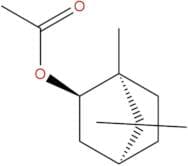
Bicyclo[2.2.1]heptan-2-ol,1,7,7-trimethyl-, 2-acetate, (1R,2S,4R)-rel-
CAS:Formula:C12H20O2Purezza:97%Peso molecolare:196.2860Bornyl acetate
CAS:Bornyl acetate (Isobornyl acetate) has an anti-inflammatory effect. It is the volatile ingredient in some Chinese traditional herbs and numerous conifer oils.Formula:C12H20O2Purezza:99.19%Colore e forma:LiquidPeso molecolare:196.29Bornyl acetate
CAS:Formula:C12H20O2Purezza:≥ 90.0%Colore e forma:Clear, colourless to pale yellow liquidPeso molecolare:196.29Bornyl Acetate (Mixture of Diastereomers)
CAS:Applications Bornyl Acetate (Mixture of Diastereomers) is a monoterpene ester, and also the main, natural constituent of valerian root oil. Bornyl acetate also has analgesic and anti-inflammatory properties.
References Buchbauer, G., et al.: Die Pharm., 47, 620 (1992); Oh, H., et al.: Appl. Micro., 15, 777 (1967); Wu, X., et al.: J. Chinese Med. Mat., 27, 438 (2004)Formula:C12H20O2Colore e forma:NeatPeso molecolare:196.29Ref: ST-EA-CP-B454000
10mgPrezzo su richiesta25mgPrezzo su richiesta50mgPrezzo su richiesta100mgPrezzo su richiesta(+/-)-Bornyl acetate
CAS:(-)Bornyl acetate is a natural product that has been shown to have antimicrobial properties. It is extracted from plants such as the Boronia and has been shown to inhibit the growth of bacteria. (-)Bornyl acetate interacts with hydroxyl groups on proteins, inhibiting their function. This interaction leads to the production of reactive oxygen species, which causes cellular damage and death. Bornyl acetate also can interact with other sites on proteins, including the nitro group, which may lead to reduced nitric oxide production and decreased inflammatory response. The compound class of (-)bornyl acetate includes alkanoic acids and fatty acids. Molecular docking analysis has identified a number of possible binding sites for this molecule in protein structures. -Bornyl acetate is not active against viruses or fungi.br>br> Bornyl acetate has been shown to be an anti-inflammatory agent that inhibits prostaglandin synthesis and exhibits anti-infective properties.br>brFormula:C12H20O2Purezza:Min. 95%Colore e forma:Clear LiquidPeso molecolare:196.29 g/mol
![Bicyclo[2.2.1]heptan-2-ol,1,7,7-trimethyl-, 2-acetate, (1R,2S,4R)-rel-](/_next/image/?url=https%3A%2Fstatic.cymitquimica.com%2Fproducts%2FIN%2Fthumb%2FDA0038GL.jpg&w=3840&q=75)