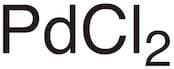
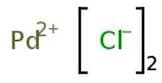
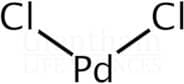
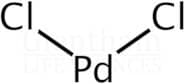
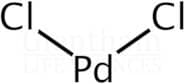
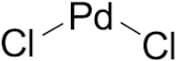
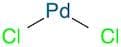
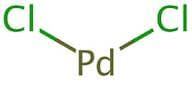
CAS 7647-10-1
:Cloruro di palladio
- Dichloropalladium
- Dichlorure de palladium
- Dicloruro De Paladio
- Enplate Activator 440
- Niklad 262
- Nsc 146183
- Palladium (Ii) Chloride
- Palladium Dichloride
- Palladium chloride
- Palladium chloride (PdCl<sub>2</sub>)
- Palladiumdichlorid
- Palladous chloride
- PdCl2
- palladium(ii) chloride anhydrous
- Palladium chloride (PdCl2)
- palladium(2+) chloride hydrate (1:2:2)
- palladium(2+) dichloride
- Vedi altri sinonimi
Palladium(II) Chloride
CAS:Formula:PdCl2Purezza:>98.0%(T)Colore e forma:Dark red to Brown powder to crystalPeso molecolare:177.32Palladium(II) chloride, 99.9% (metals basis), Pd 59.0% min
CAS:Catalyst precursor. Palladium(II) chloride is used to remove the stain present in stainless steel . Its solutions are used to test the corrosion-resistance of stainless steel. It is used in carbon monoxide detectors. It is also used for cosmetic tattooing of leukomas in the cornea and in the prepar
Formula:Cl2PdPurezza:99.9%Peso molecolare:177.32Palladium(II) chloride, solution, Pd 9.0-11.0% w/w (cont. Pd)
CAS:Palladium(II) chloride is used to remove the stain present stainless steel . Its solutions are used to test the corrosion-resistance of stainless steel. It is used in carbon monoxide detectors. It is also used for cosmetic tatooing of leukomas in thecornea and in the preparation of palladium(II) iodFormula:Cl2PdPurezza:9.0-11.0%Peso molecolare:177.32Palladium(II) chloride (99.9%-Pd)
CAS:Palladium(II) chloride (99.9%-Pd)
Formula:PdCl2Purezza:(99.9%-Pd)Colore e forma:rust colored xtl.Peso molecolare:177.31Palladium(II) chloride
CAS:Palladium(II) chlorideFormula:·Pd·2ClPurezza:98%Colore e forma: brown powderPeso molecolare:177.326g/molPalladium(II) chloride
CAS:Formula:PdCl2Purezza:≥ 59.5% (Pd)Colore e forma:Red to brown powderPeso molecolare:177.31Palladium(II) chloride, 99.9% (metals basis)
CAS:Formula:PdCl2Purezza:≥ 99.9%Colore e forma:Dark red crystalline powderPeso molecolare:177.63Palladium(II) chloride solution, approx. 20.0%
CAS:Formula:PdCl2Colore e forma:Amber to brown liquidPeso molecolare:177.33Palladium chloride
CAS:Prodotto controllatoPalladium chloride is a palladium-containing compound that reacts with sodium-dependent glucose to produce hydrogen and palladium metal. Palladium chloride is also known as the "carbonyl" of palladium. It can be used in the laboratory as a catalyst for ethylene diamine synthesis, and has been shown to have clinical relevance in the treatment of high blood sugar levels. The reaction mechanism between palladium chloride and glucose involves a diazonium salt and hydrochloric acid, which forms ethylene diamine, chloride, and hydrogen gas. The biological studies of palladium chloride are mostly related to its ability to form hydrogen bonds with proteins. Palladium is an effective catalyst for reactions involving organic compounds called carbonyls, such as ethylene diamine. High values for this compound have been found in patients with acute pancreatitis, who also had elevated levels of potassium dichromate (a type of chromium).Formula:PdCl2Purezza:Min. 95%Colore e forma:PowderPeso molecolare:177.33 g/molPalladium (II) Chloride
CAS:Prodotto controllatoApplications Palladium (II) chloride is used to catalyze the carbonylation of organotellurium compounds with carbon monoxide. Palladium (II) chloride is also sometimes used in carbon monoxide detectors where it undergoes a redox reaction and changes colour, causing the alarm to be triggered.
Not a dangerous good if item is equal to or less than 1g/ml and there is less than 100g/ml in the package
References Ohe, K., et al.: J. Org. Chem., 52, 4859 (1987)Formula:PdCl2Colore e forma:NeatPeso molecolare:177.33Palladium (II) Chloride pure, 99%, 59-60% Pd
CAS:Formula:PdCl2Colore e forma:Brown, Powder, Clear, BrownPeso molecolare:177.33Ref: SR-33080
Prodotto fuori produzionePalladium (II) Chloride ACS, ExiPlus, Multi-Compendial, 99%, 59-60% Pd
CAS:Formula:PdCl2Colore e forma:Brown, Powder, Clear, BrownPeso molecolare:177.33Ref: SR-96917
Prodotto fuori produzione