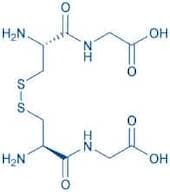
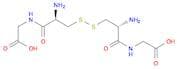
CAS 7729-20-6
:N,N'-L-Cistinyldiglicina
- (H-Cys-Gly-OH)2 (Disulfide bond)
- (H-Cys-Gly-Oh)2
- 1: PN: IE20060154 PAGE: 25 claimed protein
- 2,2'-{Disulfanediylbis[(2-Amino-1-Oxopropane-3,1-Diyl)Imino]}Diacetic Acid (Non-Preferred Name)
- Bnp 7776S
- Cystinyl-bis-glycine
- Glycine, <span class="text-smallcaps">L</span>-cysteinyl-, bimol. (1→1′)-disulfide
- Glycine, N,N′-<span class="text-smallcaps">L</span>-cystyldi-
- Glycine, N,N′-cystyldi-
- N,N′-<span class="text-smallcaps">L</span>-Cystinyldiglycine
- N,N′-<span class="text-smallcaps">L</span>-Cystyldiglycine
- NSC 333711
- Oxidized cysteinylglycine
- Glycine, L-cysteinyl-, bimol. (1→1′)-disulfide
- N,N′-L-Cystinyldiglycine
- N,N′-L-Cystyldiglycine
- Vedi altri sinonimi
(H-Cys-Gly-OH)₂
CAS:NSC333711. Besides its reduced form, this product of glutathione metabolism is found in plasma.Formula:C10H18N4O6S2Purezza:99.7%Colore e forma:WhitePeso molecolare:354.412-((R)-2-Amino-3-(((R)-2-amino-3-((carboxymethyl)amino)-3-oxopropyl)disulfanyl)propanamido)acetic acid
CAS:Formula:C10H18N4O6S2Purezza:95%Colore e forma:SolidPeso molecolare:354.4031Ref: 4Z-PG-2529
5mgPrezzo su richiesta10mgPrezzo su richiesta25mgPrezzo su richiesta50mgPrezzo su richiesta100mgPrezzo su richiesta(H-Cys-Gly-OH)2
CAS:Disulfide bond is a covalent chemical bond that links two sulfur atoms to each other. Disulfides are the major form of sulfur-containing proteins, and are important in many biological processes, such as postnatal development, biliary function, hepatitis diagnosis and cancer. Disulfide bonds can be detected using chromatographic methods such as high performance liquid chromatography (HPLC) or gas chromatography (GC). The biosynthesis of disulfides is an essential process in the metabolism of glutathione. Disulfide bonds are formed by the oxidation of two sulfhydryl groups (-SH) in a protein by reactive oxygen species (ROS), which results in the formation of a single disulfide bond between two cysteine residues. This reaction requires glutathione as a cofactor, which catalyzes the formation of -S-S- bridges between two cysteine residues by reducing them to their corresponding thiols (-SH). Glutathione also
Formula:C10H18N4O6S2Purezza:Min. 95%Peso molecolare:354.41 g/mol