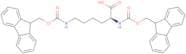
CAS 78081-87-5
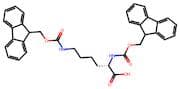
:N(alpha),N(epsilon)-di-fmoc-L-lisina
- Fmoc-Lys(Fmoc)-OH
- N2,N6-bis[(9H-fluoren-9-ylmethoxy)carbonyl]-L-lysine
- N2,N6-Bis-Fmoc-L-lysine
Fmoc-Lys(Fmoc)-OH
CAS:Building block for the synthesis of branched peptides and MAP matrices.Formula:C36H34N2O6Purezza: 98.8%Colore e forma:WhitePeso molecolare:590.68Fmoc-Lys(Fmoc)-OH
CAS:Purezza:≥ 98.0%Colore e forma:White to faint yellow or beige powderPeso molecolare:590.66Nα,Nε-Bis[(9H-fluoren-9-ylmethoxy)carbonyl]-L-lysine
CAS:Formula:C36H34N2O6Purezza:>98.0%(T)(HPLC)Colore e forma:White to Almost white powder to crystalPeso molecolare:590.68Fmoc-Lys(Fmoc)-OH
CAS:Fmoc-Lys(Fmoc)-OH is an antibacterial agent that can be synthesized from a number of precursors. It has been shown to inhibit the uptake of mannose by staphylococcus cells and its subsequent use in the synthesis of bacterial cell walls. Fmoc-Lys(Fmoc)-OH also inhibits the growth of viruses, such as HIV, and human immunodeficiency virus type 1 (HIV-1), by binding to mannose receptors on the surface of macrophage-like cells. Intramolecular hydrogen bonds stabilise this complex, which prevents it from breaking down. This allows Fmoc-Lys(Fmoc)-OH to remain in the body for a longer period of time than other antibiotics that are broken down by enzymes. Fmoc-Lys(Fmoc)-OH has also been shown to be an effective antibacterial agent against Staphylococcus a
Formula:C36H34N2O6Purezza:Min. 98.0 Area-%Peso molecolare:590.67 g/molFmoc-Lys(Fmoc)-OH
CAS:Fmoc-Lys(Fmoc)-OH is an ester of lysine that is used in peptide synthesis. It has shown to have antimicrobial properties against bacteria and fungi. Fmoc-Lys(Fmoc)-OH has been found to be taken up by cancer cells, suggesting that it may have anticancer effects. It has also been found to inhibit the growth of bladder cancer cells as well as histidine aminopeptidase from the cell surface. Fmoc-Lys(Fmoc)-OH is stable in trifluoroacetic acid, making it a good candidate for solid-phase synthesis. This product can be synthesized by attaching the amino acid lysine to an ester linker with a fluorinated side chain. The product is then linked end-to-end via intramolecular hydrogen bonds and chemical stability is achieved through covalent amide bond formation between Lys and Fmoc groups
Formula:C36H34N2O6Purezza:Min. 95%Colore e forma:SolidPeso molecolare:590.67 g/mol
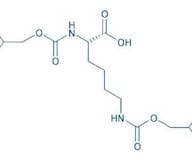

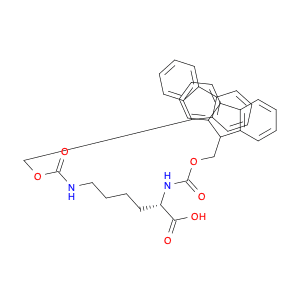

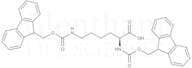


![Nα,Nε-Bis[(9H-fluoren-9-ylmethoxy)carbonyl]-L-lysine](/_next/image/?url=https%3A%2Fstatic.cymitquimica.com%2Fproducts%2F3B%2Fthumb%2FB4931.jpg&w=3840&q=75)