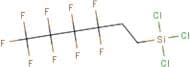
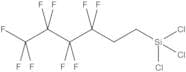
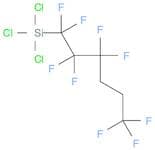
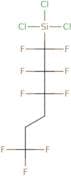
CAS 78560-47-1
:tricloro(3,3,4,4,5,5,6,6,6-nonafluoroesil)silano
1H,1H,2H,2H-Perfluorohexyltrichlorosilane
CAS:1H,1H,2H,2H-PerfluorohexyltrichlorosilaneFormula:C6H4Cl3F9SiPurezza:97%Colore e forma: clear liquidPeso molecolare:381.53g/molNONAFLUOROHEXYLTRICHLOROSILANE
CAS:Fluoroalkyl Silane - Conventional Surface Bonding
Aliphatic, fluorinated aliphatic or substituted aromatic hydrocarbon substituents are the hydrophobic entities which enable silanes to induce surface hydrophobicity. The organic substitution of the silane must be non-polar. The hydrophobic effect of the organic substitution can be related to the free energy of transfer of hydrocarbon molecules from an aqueous phase to a homogeneous hydrocarbon phase. A successful hydrophobic coating must eliminate or mitigate hydrogen bonding and shield polar surfaces from interaction with water by creating a non-polar interphase. Although silane and silicone derived coatings are in general the most hydrophobic, they maintain a high degree of permeability to water vapor. This allows coatings to breathe and reduce deterioration at the coating interface associated with entrapped water. Since ions are not transported through non-polar silane and silicone coatings, they offer protection to composite structures ranging from pigmented coatings to rebar reinforced concrete. A selection guide for hydrophobic silanes can be found on pages 22-31 of the Hydrophobicity, Hydrophilicity and Silane Surface Modification brochure.
Nonafluorohexyltrichlorosilane; 1-(Trichlorosilyl)nonafluorofluorohexaneFormula:C6H4Cl3F9SiPurezza:97%Colore e forma:Straw LiquidPeso molecolare:381.53Silane,trichloro(3,3,4,4,5,5,6,6,6-nonafluorohexyl)-
CAS:Formula:C6H4Cl3F9SiPurezza:98%Peso molecolare:381.5261Nonafluorohexyltrichlorosilane
CAS:Nonafluorohexyltrichlorosilane is a silicon-based surfactant that can be used as a surface treatment agent. It is hydrophilic and has excellent wetting properties. Nonafluorohexyltrichlorosilane is also an effective coagulant, which makes it useful for the treatment of wastewater containing suspended solids. This agent can be used to coat surfaces with silicon to make them more hydrophobic, making it useful in the production of photoreceptors, emulsions, and immobilized cell culture. The chemical structure of Nonafluorohexyltrichlorosilane allows it to be easily synthesized by the reaction between chlorosilanes and alcohols.
Formula:C6H4Cl3F9SiPurezza:Min. 95%Colore e forma:Clear LiquidPeso molecolare:381.53 g/molRef: 3D-FN79644
Prodotto fuori produzione