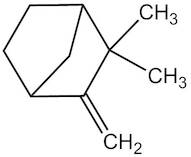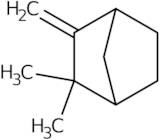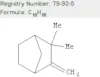
CAS 79-92-5
:(±)-Canfene
Descrizione:
(±)-Canfene è un monoterpene biciclico con la formula molecolare C10H16, noto per il suo distintivo odore simile al canfora. È un liquido incolore o giallo pallido a temperatura ambiente ed è insolubile in acqua ma solubile in solventi organici come etanolo ed etere. (±)-Canfene ha un punto di ebollizione nella gamma di 160-162°C e una densità di circa 0,87 g/cm³. Questo composto è caratterizzato dalla sua struttura unica, che presenta un telaio di biciclo[3.1.0]esano, che contribuisce alla sua reattività e potenziali applicazioni. È comunemente usato nell'industria delle fragranze e dei sapori, così come nella sintesi di altri composti organici. Inoltre, (±)-Canfene può essere trovato negli oli essenziali ed è prodotto naturalmente da varie piante. La sua attività ottica è dovuta alla presenza di centri chirali, portando alla designazione di (±) per indicare una miscela racemica di enantiomeri. Le considerazioni di sicurezza includono la sua infiammabilità e potenziali proprietà irritanti, richiedendo un'adeguata manipolazione e stoccaggio.
Formula:C10H16
InChI:InChI=1S/C10H16/c1-7-8-4-5-9(6-8)10(7,2)3/h8-9H,1,4-6H2,2-3H3
InChI key:InChIKey=CRPUJAZIXJMDBK-UHFFFAOYSA-N
SMILES:CC1(C)C2CC(C1=C)CC2
Sinonimi:- (.+-.)-2,2-Dimethylenebicyclo[2.2.1]Heptane
- (.+-.)-Camphene
- 2,2-Dimethyl-3-methylenebicyclo[2.2.1]heptane
- 2,2-Dimethyl-3-methylenenorbornane
- 2,2-Dimethyl-3-methylidenebicyclo[2.2.1]heptane
- 2-Methylene-3,3-dimethylbicyclo[2.2.1]heptane
- 3,3-Dimethyl-2-methylenenorbornane
- 3,3-Dimethyl-2-methylenenorcamphane
- DL-Camphene
- Camphen
- Canfeno
- Nsc 4165
- YS Camphene
- dl-Camphene
- Vedi altri sinonimi
Filtra per
Percentuale di purezza
0
100
|
0
|
50
|
90
|
95
|
100
- Prezzo più basso
- Prezzo più alto
- Purezza più bassa
- Purezza più alta
- Consegna più veloce
D,L-Camphene
CAS:Alicyclic hydrocarbonFormula:C10H16Purezza:≥ 95.0 % (GC)Colore e forma:WaxyPeso molecolare:136.24(±)-Camphene, contains ca. 20% Tricyclene
CAS:Camphene is a sesquiterpene lactone that is found in many plants and has been used in traditional medicine. Camphene is an organic compound that has the chemical formula of C10H16. It can be synthesized from limonene, which is a hydrocarbon derivative of pinene. Camphene is used as a solvent for dyes, resins, and waxes and as a precursor to other organic compounds. This compound also has kinetic data for hydrochloric acid and water vapor. Camphene has shown to have antioxidant properties via its ability to increase mitochondrial membrane potential and inhibit dehydrocostus lactone production. The surface methodology of camphene includes high values for emissions (i.e., low toxicity).
Formula:C10H16Purezza:Min. 95%Colore e forma:PowderPeso molecolare:136.23 g/mol