CAS 80-59-1
:Acido tiglico
Descrizione:
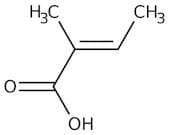
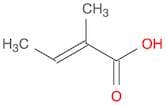
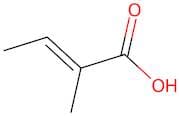
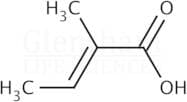
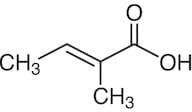
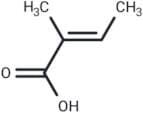
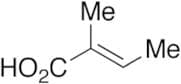
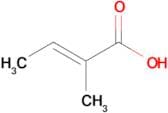
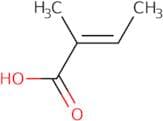
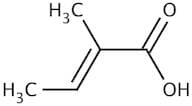
Acido tiglico, noto anche come acido 2-metil-2-butenoico, è un acido carbossilico insaturo caratterizzato dalla sua struttura ramificata e dalla presenza di un doppio legame nella sua catena carboniosa. Ha la formula molecolare C5H8O2 e presenta un gruppo carbossilico (-COOH) che conferisce proprietà acide. Acido tiglico è un liquido incolore a temperatura ambiente e ha un odore distintivo e pungente. È solubile in solventi organici come etanolo ed etere, ma ha una solubilità limitata in acqua a causa dei suoi gruppi alchilici idrofobici. Questo composto è utilizzato principalmente nella sintesi organica e come intermediario nella produzione di vari prodotti chimici, comprese fragranze e prodotti farmaceutici. Inoltre, Acido tiglico può essere derivato da fonti naturali, come alcuni oli essenziali. La sua reattività è influenzata dalla presenza del doppio legame, rendendolo un utile mattone di costruzione in varie reazioni chimiche, inclusa la polimerizzazione e l'estereficazione. Devono essere adottate precauzioni di sicurezza quando si maneggia Acido tiglico, poiché può essere irritante per la pelle e gli occhi.
Formula:C5H8O2
InChI:InChI=1S/C5H8O2/c1-3-4(2)5(6)7/h3H,1-2H3,(H,6,7)/b4-3+
InChI key:InChIKey=UIERETOOQGIECD-ONEGZZNKSA-N
SMILES:C(\C(O)=O)(=C/C)/C
Sinonimi:- (2E)-2-Methyl-2-butenoic acid
- (E)-2,3-Dimethylacrylic acid
- (E)-2-Methyl-2-butenoic acid
- (E)-2-Methylcrotonic acid
- (E)-α-Methylcrotonic acid
- 2-Butenoic acid, 2-methyl-, (2E)-
- 2-Butenoic acid, 2-methyl-, (E)-
- Cevadic acid
- Crotonic acid, 2-methyl-, (E)-
- NSC 44235
- NSC 8999
- Tiglic acid
- Tiglinic acid
- trans-2-Methyl-2-butenoic acid
- trans-2-Methylcrotonic acid
- Vedi altri sinonimi
Ordinare per
Purezza (%)
0
100
|
0
|
50
|
90
|
95
|
100
11 prodotti.
Tiglic acid, 97+%
CAS:This Thermo Scientific Chemicals brand product was originally part of the Alfa Aesar product portfolio. Some documentation and label information may refer to the legacy brand. The original Alfa Aesar product / item code or SKU reference has not changed as a part of the brand transition to Thermo SciFormula:C5H8O2Purezza:97+%Colore e forma:White to cream to pale brown, Crystals or powder or crystalline powderPeso molecolare:100.12Ref: IN-DA0035P7
5kgPrezzo su richiesta1g21,00€5g21,00€10g24,00€25g25,00€50g31,00€100g50,00€250g80,00€500g120,00€1kg160,00€trans-2,3-Dimethylacrylic acid
CAS:Formula:C5H8O2Purezza:≥ 98.0%Colore e forma:White to off-white crystalline powder or crystalsPeso molecolare:100.12Tiglic Acid
CAS:Formula:C5H8O2Purezza:>98.0%(GC)(T)Colore e forma:White to Almost white powder to crystalPeso molecolare:100.12Tiglic acid
CAS:Tiglic acid (Cevadic acid) is a thick, syrupy poisonous liquid, C5H8O2, derived from croton oil, having a spicy odor and used in making perfumes and flavoringFormula:C5H8O2Purezza:99.99%Colore e forma:Triclinic Plates Rods From Water Density As Water And Slightly Soluble In Water May Burn If Heated To High Temperatures May SeverelyPeso molecolare:100.12Tiglic Acid
CAS:Applications Tiglic acid is the stable isomer of angelic acid. Tiglic acid was found as glyceride in croton oil, as butyl ester in the oil of the Roman camomile, and as geranyl tiglate in oil of geranium. Tiglic acid is formed during the charcoaling of maple wood.
Not a dangerous good if item is equal to or less than 1g/ml and there is less than 100g/ml in the package
References Bueding, et al.: J. Biol. Chem., 202, 505 (1953),Formula:C5H8O2Colore e forma:NeatPeso molecolare:100.12Tiglic Acid
CAS:Formula:C5H8O2Purezza:98%Colore e forma:Liquid, No data available.Peso molecolare:100.117Tiglic acid
CAS:Tiglic acid is a sodium salt that can be synthesized in an asymmetric synthesis. It is a white crystalline powder with a melting point of 190-191°C. Tiglic acid has been shown to increase the activity of cinchonidine, which is a compound often used to treat eye disorders and chronic arthritis. Tiglic acid also has the ability to bind to fatty acids, which may be due to hydrogen bonding interactions. In vitro assays have shown that tiglic acid's antimicrobial properties are related to its ability to cause cell lysis by interacting with fatty acids on the cell membrane.Formula:C5H8O2Purezza:Min. 95%Colore e forma:PowderPeso molecolare:100.12 g/molTiglic Acid extrapure, 98%
CAS:Formula:C5H8O2Purezza:min. 98%Colore e forma:White to beige, Powder, ClearPeso molecolare:100.12