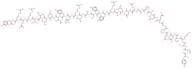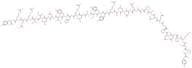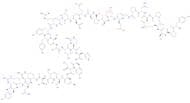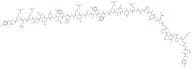
CAS 83589-17-7
:Neuropeptide Y (suino)
Descrizione:
Neuropeptide Y (suino), con il numero CAS 83589-17-7, è un peptide che gioca un ruolo significativo in vari processi fisiologici, in particolare nel sistema nervoso centrale e nei tessuti periferici. È composto da 36 aminoacidi ed è noto per il suo coinvolgimento nella regolazione dell'appetito, dell'ansia, dei ritmi circadiani e delle funzioni cardiovascolari. Il neuropeptide Y è prodotto principalmente nel cervello ed è rilasciato in risposta allo stress, influenzando l'assunzione di cibo e l'equilibrio energetico. La sua struttura presenta una regione C-terminale conservata che è critica per il legame ai recettori e l'attività biologica. Il peptide interagisce con specifici recettori del neuropeptide Y, che sono recettori accoppiati a proteine G, mediando i suoi effetti sulla segnalazione neuronale. Nelle specie suine, questo neuropeptide è particolarmente studiato per le sue implicazioni nella crescita, nel metabolismo e nelle risposte allo stress, rendendolo un argomento di interesse sia nella ricerca veterinaria che biomedica. In generale, il neuropeptide Y è un componente vitale della segnalazione neuroendocrina, con ruoli diversi nel mantenimento dell'omeostasi e nella risposta ai cambiamenti ambientali.
Formula:C10H287N55O57
InChI:InChI=1/C190H286N54O58/c1-16-94(9)149(180(296)234-129(81-140(193)253)169(285)226-124(74-93(7)8)172(288)239-150(95(10)17-2)181(297)240-151(100(15)247)182(298)221-116(32-23-67-208-190(202)203)156(272)220-119(59-62-145(260)261)161(277)218-114(30-21-65-206-188(198)199)157(273)223-121(152(195)268)76-102-39-49-108(249)50-40-102)238-173(289)127(79-105-45-55-111(252)56-46-105)229-168(284)128(80-106-86-204-90-210-106)230-159(275)115(31-22-66-207-189(200)201)219-165(281)123(73-92(5)6)224-155(271)97(12)212-174(290)134(88-245)236-167(283)126(78-104-43-53-110(251)54-44-104)228-166(282)125(77-103-41-51-109(250)52-42-103)227-158(274)113(29-20-64-205-187(196)197)216-153(269)96(11)211-163(279)122(72-91(3)4)225-170(286)131(84-147(264)265)232-162(278)118(58-61-144(258)259)217-154(270)98(13)213-177(293)137-34-25-68-241(137)183(299)99(14)214-164(280)130(83-146(262)263)231-160(276)117(57-60-143(256)257)215-142(255)87-209-176(292)136-33-24-70-243(136)186(302)133(82-141(194)254)235-171(287)132(85-148(266)267)233-178(294)139-36-27-71-244(139)185(301)120(28-18-19-63-191)222-175(291)135(89-246)237-179(295)138-35-26-69-242(138)184(300)112(192)75-101-37-47-107(248)48-38-101/h37-56,86,90-100,112-139,149-151,245-252H,16-36,57-85,87-89,191-192H2,1-15H3,(H2,193,253)(H2,194,254)(H2,195,268)(H,204,210)(H,209,292)(H,211,279)(H,212,290)(H,213,293)(H,214,280)(H,215,255)(H,216,269)(H,217,270)(H,218,277)(H,219,281)(H,220,272)(H,221,298)(H,222,291)(H,223,273)(H,224,271)(H,225,286)(H,226,285)(H,227,274)(H,228,282)(H,229,284)(H,230,275)(H,231,276)(H,232,278)(H,233,294)(H,234,296)(H,235,287)(H,236,283)(H,237,295)(H,238,289)(H,239,288)(H,240,297)(H,256,257)(H,258,259)(H,260,261)(H,262,263)(H,264,265)(H,266,267)(H4,196,197,205)(H4,198,199,206)(H4,200,201,207)(H4,202,203,208)/t94-,95-,96-,97-,98-,99-,100+,112-,113-,114-,115-,116-,117-,118-,119-,120-,121-,122-,123-,124-,125-,126-,127-,128-,129-,130-,131-,132-,133-,134-,135-,136-,137-,138-,139-,149-,150-,151-/m0/s1
Sinonimi:- H-Tyr-Pro-Ser-Lys-Pro-Asp-Asn-Pro-Gly-Glu-Asp-Ala-Pro-Ala-Glu-Asp-Leu-Ala-Arg-Tyr-Tyr-Ser-Ala-Leu-Arg-His-Tyr-Ile-Asn-Leu-Ile-Thr-Arg-Gln-Arg-Tyr-NH2
- Neuropeptide Y (13-36), Porcine Syntheti C >97%
Ordinare per
Purezza (%)
0
100
|
0
|
50
|
90
|
95
|
100
6 prodotti.
Neuropeptide Y, Porcine
CAS:<p>For cellular and molecular biology applications</p>Formula:C190H287N55O57Peso molecolare:4253.7Neuropeptide Y (porcine)
CAS:<p>Bachem ID: 4011654.</p>Formula:C190H287N55O57Purezza:97.3%Colore e forma:White LyophilisatePeso molecolare:4253.71NPY (Porcine, Bovine)
CAS:<p>NPY is a peptide that belongs to the family of neuropeptides. NPY regulates appetite and energy expenditure, among other physiological processes, by binding to receptors in the brain. NPY has been shown to be an inhibitor of protein interactions, activator of ligands, and a receptor for antibodies. This peptide is synthesized in the hypothalamus as well as other parts of the central nervous system. NPY is also found in blood platelets, pancreas, and intestines.</p>Formula:C190H287N55O57Purezza:Min. 95%Peso molecolare:4,253.6 g/molNPY (Porcine, Bovine)
CAS:<p>NPY is a peptide that belongs to the family of neuropeptides. It is an endogenous regulator of appetite and energy expenditure in the central nervous system, which has been shown to act as a neurotransmitter and neuromodulator. NPY is also an activator of ion channels, such as potassium channels, sodium channels, and calcium channels. NPY has been shown to bind with high affinity to receptors in the brain, heart, lungs, kidneys, and intestines. The binding of NPY to its receptor leads to activation of protein interactions. This process can lead to changes in cell physiology or regulation of physiological functions by altering gene expression or changing the concentration of ions in the blood. NPY has also been shown as an inhibitor for many different ligands and receptors including dopamine D1 receptors and serotonin 5-HT2A/C receptors.</p>Formula:C190H287N55O57Purezza:Min. 95%Peso molecolare:4,253.6 g/molNeuropeptide Y (porcine) trifluoroacetate salt
CAS:<p>Neuropeptide Y (porcine) trifluoroacetate salt H-Tyr-Pro-Ser-Lys-Pro-Asp-Asn-Pro-Gly-Glu-Asp-Ala-Pro-Ala-Glu-Asp-Leu -Ala -Arg Tyr Tyr Ser Ala Leu Arg His Tyr Ile Asn Leu Ile Thr Arg Gln Arg Tyr NH2 trifluoroacetate salt is a peroxidase enzyme that is biotinylated and purified from porcine sources. It has been used as an antiserum in the development of a plate sealer.</p>Formula:C190H287N55O57Purezza:Min. 95%Peso molecolare:4,253.65 g/molNeuropeptide Y (pig)
CAS:Formula:C190H287N55O57Purezza:98%Colore e forma:SolidPeso molecolare:4253.6461Ref: IN-DA01E9QM
Prodotto fuori produzione