CAS 85233-19-8
:BAPTA
Descrizione:
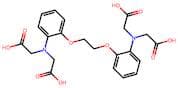
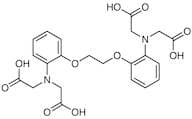
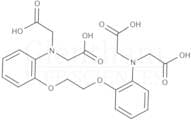
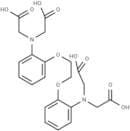
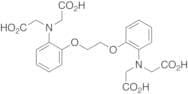
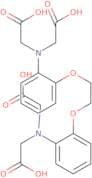
BAPTA, o acido bis-(o-amminofenossietano)-N,N,N',N'-tetracetico, è un agente chelante utilizzato principalmente per la sua capacità di legare ioni di calcio con alta specificità. Presenta una struttura che include due gruppi o-amminofenossilo e quattro moieties di acido acetico, che facilitano la sua interazione con ioni metallici. BAPTA è particolarmente apprezzato nella ricerca biochimica per il suo ruolo nello studio delle vie di segnalazione del calcio, poiché può sequestrare efficacemente ioni di calcio, modulando così le risposte cellulari. Il composto è spesso utilizzato in colture cellulari e esperimenti fisiologici per controllare i livelli di calcio intracellulare. BAPTA è noto per la sua relativamente bassa permeabilità alla membrana rispetto ad altri chelanti del calcio, rendendolo adatto per applicazioni in cui è necessario un buffering localizzato del calcio. Inoltre, BAPTA può esistere in varie forme, inclusi il suo acido libero e varie forme di sale, che possono influenzare la sua solubilità e reattività. In generale, BAPTA è uno strumento cruciale nei campi della biochimica e della biologia cellulare, contribuendo alla comprensione del ruolo del calcio nei processi cellulari.
Formula:C22H24N2O10
InChI:InChI=1S/C22H24N2O10/c25-19(26)11-23(12-20(27)28)15-5-1-3-7-17(15)33-9-10-34-18-8-4-2-6-16(18)24(13-21(29)30)14-22(31)32/h1-8H,9-14H2,(H,25,26)(H,27,28)(H,29,30)(H,31,32)
InChI key:InChIKey=FTEDXVNDVHYDQW-UHFFFAOYSA-N
SMILES:N(CC(O)=O)(CC(O)=O)C1=C(OCCOC2=C(N(CC(O)=O)CC(O)=O)C=CC=C2)C=CC=C1
Sinonimi:- 1,2-Bis(o-aminophenoxy)ethane-N,N,N′,N′-tetraacetic acid
- 2,2',2'',2'''-[Ethane-1,2-Diylbis(Oxybenzene-2,1-Diylnitrilo)]Tetraacetate
- 2,2',2'',2'''-[Ethane-1,2-Diylbis(Oxybenzene-2,1-Diylnitrilo)]Tetraacetic Acid
- 2-[2-[2-[2-[Bis(carboxymethyl)amino]phenoxy]ethoxy]-N-(carboxymethyl)anilino]acetic acid
- Bapta
- Glycine, N,N′-[1,2-ethanediylbis(oxy-2,1-phenylene)]bis[N-(carboxymethyl)-
- N,N′-[1,2-Ethanediylbis(oxy-2,1-phenylene)]bis[N-(carboxymethyl)glycine]
- 1,2-Bis(2-aminophenoxy)ethane-N,N,N′,N′-tetraacetic acid
- 1,2-Bis(2-aminophenoxy)ethane-N,N,N',N'-tetraacetic Acid
Ordinare per
Purezza (%)
0
100
|
0
|
50
|
90
|
95
|
100
13 prodotti.
BAPTA, 97%
CAS:Acts as a calcium chelatorBAPTA is used as a selective calcium chelating reagent. It is suitable for the spectrophotometric monitoring of calcium levels. It is a lipophilic diesters of the chelating agent used for the inhibition of proteolytic activities of certain metalloproteinases, calpain and trFormula:C22H24N2O10Purezza:97%Colore e forma:White to pale cream to pale yellow, PowderPeso molecolare:476.44Glycine,N,N'-[1,2-ethanediylbis(oxy-2,1-phenylene)]bis[N-(carboxymethyl)-
CAS:Formula:C22H24N2O10Purezza:97%Colore e forma:SolidPeso molecolare:476.43341,2-Bis(2-aminophenoxy)ethane-N,N,N',N'-tetraacetic acid
CAS:1,2-Bis(2-aminophenoxy)ethane-N,N,N',N'-tetraacetic acidFormula:C22H24N2O10Purezza:97%Colore e forma: pale yellow solidPeso molecolare:476.43335g/mol1,2-Bis(2-aminophenoxy)ethane-N,N,N',N'-tetraacetic Acid
CAS:Formula:C22H24N2O10Purezza:>97.0%(T)(HPLC)Colore e forma:White to Almost white powder to crystalPeso molecolare:476.441,2-Bis(2-aminophenoxy)ethane-N,N,N'',N''-tetraacetic acid
CAS:Formula:C22H24N2O10Purezza:≥ 97.0%Colore e forma:White to off-white or faint beige powderPeso molecolare:476.44BAPTA (1,2-bis(o-Aminophenoxy)ethane-N,N,N',N'-tetra-Acetic Acid)
CAS:Formula:C22H24N2O10Peso molecolare:476.44Ref: 4Z-A-138070
5mgPrezzo su richiesta10mgPrezzo su richiesta25mgPrezzo su richiesta50mgPrezzo su richiesta100mgPrezzo su richiestaBAPTA
CAS:BAPTA is a neuroprotective agent in cerebral ischemia, acting as an intercellular Ca2+ chelator.Formula:C22H24N2O10Purezza:97.21% - ≥95%Colore e forma:White SolidPeso molecolare:476.43BAPTA
CAS:Prodotto controllatoApplications BAPTA is a highly selective calcium chelating reagent. Lipophilic diesters of the chelating agent 1,2-Bis(2 aminophenoxy)ethane-N,N,N',N'-tetraacetic acid (BAPTA) are used for inhibition of proteolytic activities of certain metalloproteinases, calpain and TACE.
References Tsien, R.Y., Biochemistry, 19, 2396 (1980), Wu, S.Y., et al.: J. Neurophysiology, 74, 2600 (1995), Venant, A., et al.: Biol. Cell, 85, 197 (1995), Tucker, T., et al.: Neuron, 15, 1323 (1995)Formula:C22H24N2O10Colore e forma:NeatPeso molecolare:476.43BAPTA
CAS:BAPTA is a fluorescent probe that binds to cytosolic calcium and can be used to measure intracellular calcium levels. It can also be used as a fluorescence probe for the measurement of mitochondrial membrane potential. BAPTA is a potent inhibitor of neuronal death induced by excess cytosolic calcium, which leads to activation of calcium-dependent proteases and cell lysis. The mechanism by which BAPTA inhibits neuronal death is unclear, but it may be due to its ability to modulate mitochondrial membrane potential or regulate Ca2+ release from intracellular stores. BAPTA has been shown to inhibit the polymerase chain reaction (PCR) in cells and tissues and can also inhibit the transcriptional activity of nuclear DNA. In addition, BAPTA can inhibit the function of ryanodine receptors in cells, leading to an increase in cytosolic Ca2+.Formula:C22H24N2O10Purezza:Min. 97 Area-%Colore e forma:White PowderPeso molecolare:476.43 g/molTetrasodium 1,2-Bis(2-aminophenoxy)ethane-N,N,N',N'-tetraacetate
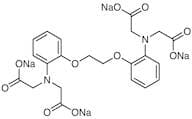
CAS:Formula:C22H20N2Na4O10Purezza:>98.0%(T)Colore e forma:White to Almost white powder to crystalPeso molecolare:564.37
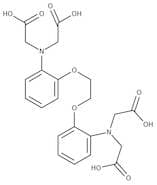

![Glycine,N,N'-[1,2-ethanediylbis(oxy-2,1-phenylene)]bis[N-(carboxymethyl)-](/_next/image/?url=https%3A%2Fstatic.cymitquimica.com%2Fproducts%2FIN%2Fthumb%2FDA00IDLE.jpg&w=3840&q=75)