CAS 85901-57-1
:Pyr-Phe-Leu-pNA
Descrizione:
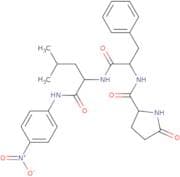
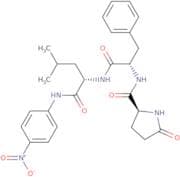
Pyr-Phe-Leu-pNA, noto anche come Leucina p-Nitroanilide Fenil Piridile, è un substrato peptidico sintetico comunemente utilizzato in saggi biochimici, in particolare nello studio delle enzimi proteolitiche. Questo composto presenta un gruppo piridina, un residuo di fenilalanina, un residuo di leucina e un gruppo di p-nitroanilide, che insieme contribuiscono alle sue proprietà come substrato per varie proteasi. La presenza del gruppo p-nitroanilide consente la rilevazione colorimetrica dopo la scissione da parte delle enzimi, rendendolo utile nei saggi di attività enzimatica. Pyr-Phe-Leu-pNA è tipicamente solubile in solventi organici e mostra stabilità in condizioni di laboratorio standard. La sua struttura molecolare consente interazioni specifiche con enzimi target, facilitando lo studio della cinetica e dei meccanismi enzimatici. Inoltre, a causa della sua natura sintetica, può essere modificato per migliorare la specificità o la sensibilità per applicazioni particolari nella ricerca e nella diagnostica. Come per tutte le sostanze chimiche, è necessario osservare le opportune precauzioni di manipolazione e sicurezza quando si lavora con Pyr-Phe-Leu-pNA in ambienti di laboratorio.
Formula:C26H31N5O6
InChI:InChI=1/C26H31N5O6/c1-16(2)14-21(25(34)27-18-8-10-19(11-9-18)31(36)37)29-26(35)22(15-17-6-4-3-5-7-17)30-24(33)20-12-13-23(32)28-20/h3-11,16,20-22H,12-15H2,1-2H3,(H,27,34)(H,28,32)(H,29,35)(H,30,33)/t20-,21-,22-/m0/s1
SMILES:CC(C)C[C@@H](C(=O)Nc1ccc(cc1)N(=O)=O)N=C([C@H](Cc1ccccc1)N=C([C@@H]1CCC(=N1)O)O)O
Sinonimi:- Pyroglutamyl-phenylalanyl-leucine-4-nitroanilide
- Pglu-phe-leu-pna
- L-Leucinamide, 5-oxo-L-prolyl-L-phenylalanyl-N-(4-nitrophenyl)-
- 5-oxo-L-prolyl-L-phenylalanyl-N-(4-nitrophenyl)-L-leucinamide
- pglu-phe-leu P-nitroanilide
- PYR-FL-PNA
- PYR-PHE-LEU-PNA
- PYR-PHE-GLY-PNA
- Pyr-FG-pNA
- L-PYROGLUTAMYL-L-PHENYLALANYL-L-LEUCINE P-NITROANILIDE
Ordinare per
Purezza (%)
0
100
|
0
|
50
|
90
|
95
|
100
3 prodotti.
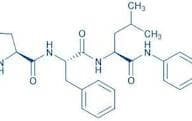
Pyr-Phe-Leu-pNA
CAS:Chromogenic substrate for thiol proteinases from plants (caricain, papain, ficin, and bromelain) and from mammalian brain (cathepsin B). pEFL-pNA is also cleaved by a serine carboxypeptidase (HlSCP1) identified in the midgut of the hard tick Haemaphysalis longicornis, which was shown to process hemoglobin.Formula:C26H31N5O6Purezza:99.4%Colore e forma:Light YellowPeso molecolare:509.56Pyr-Phe-Leu-pNA
CAS:Pyr-Phe-Leu-pNA is a proteolytic enzyme that can be used as a pharmaceutical drug. It has been shown to have insecticidal activity against the Anopheles mosquito and other insects, as well as antimicrobial activity against bacteria and fungi. Pyr-Phe-Leu-pNA is activated by tryptophan fluorescence, which is why it is suitable for use in peptide mapping. This enzyme also has an important physiological function in the zymogen activation pathway, which enables it to act as an enzyme substrate. Pyr-Phe-Leu-pNA will also degrade proteins that contain sequences of leishmania protease activity or signal peptide.Formula:C26H31N5O6Purezza:Min. 95%Peso molecolare:509.55 g/molPyr-Phe-Leu-pNA
CAS:Pyr-Phe-Leu-pNA is a proteolytic enzyme that is used in the production of monoclonal antibodies. The enzyme was originally isolated from human pancreas, but has also been found in other sources including eggs, bovine pancreas, and various bacteria. Pyr-Phe-Leu-pNA hydrolyzes peptide bonds with a preference for serine and threonine residues. This enzyme has been shown to be effective at cleaving influenza virus protein hemagglutinin, which may be useful in the development of new vaccines. Pyr-Phe-Leu-pNA has also been shown to have high salt tolerance, making it a good candidate for use in food processing applications.
Formula:C26H31N5O6Purezza:Min. 95%Peso molecolare:509.55 g/mol