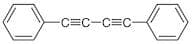
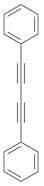
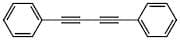
CAS 886-66-8
:1,4-Difenil-1,3-butadiino
Descrizione:
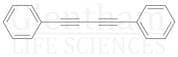
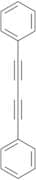
1,4-Difenil-1,3-butadiino è un composto organico caratterizzato dalla sua struttura lineare con due gruppi fenilici attaccati a uno scheletro di butadiino. Questo composto appartiene alla classe degli alchini, in particolare agli alchini coniugati, a causa della presenza di legami doppi e tripli alternati. Tipicamente è un solido a temperatura ambiente e presenta un alto grado di stabilità grazie alla stabilizzazione per risonanza fornita dai gruppi fenilici. Il composto è noto per le sue uniche proprietà ottiche ed elettroniche, rendendolo di interesse nella scienza dei materiali e nell'elettronica organica. La sua sintesi spesso implica reazioni di accoppiamento e può essere utilizzato come precursore per varie applicazioni di sintesi organica. 1,4-Difenil-1,3-butadiino è anche notevole per le sue potenziali applicazioni nello sviluppo di semiconduttori organici e come blocco di costruzione nella sintesi di molecole organiche più complesse. Tuttavia, si devono osservare precauzioni durante la manipolazione a causa della sua potenziale tossicità e reattività.
Formula:C16H10
InChI:InChI=1S/C16H10/c1-3-9-15(10-4-1)13-7-8-14-16-11-5-2-6-12-16/h1-6,9-12H
InChI key:InChIKey=HMQFJYLWNWIYKQ-UHFFFAOYSA-N
SMILES:C(#CC#CC1=CC=CC=C1)C2=CC=CC=C2
Sinonimi:- 1,1′-(1,3-Butadiyne-1,4-diyl)bis[benzene]
- Butadiyne, diphenyl-
- Diphenylbutadiyne
- Diphenyldiacetylene
- Benzene, 1,1′-(1,3-butadiyne-1,4-diyl)bis-
Ordinare per
Purezza (%)
0
100
|
0
|
50
|
90
|
95
|
100
8 prodotti.
1,4-Diphenylbutadiyne
CAS:Formula:C16H10Purezza:>98.0%(GC)Colore e forma:White to Light yellow powder to crystalPeso molecolare:202.261,4-Diphenylbutadiyne, 99%
CAS:1,4-Diphenylbutadiyne was used in the preparation of 7,8-dehydropurpurin dimers via two-fold Pd-catalyzed [3+2] annulation of meso-bromoporphyrin. This Thermo Scientific Chemicals brand product was originally part of the Alfa Aesar product portfolio. Some documentation and label information may refeFormula:C16H10Purezza:99%Colore e forma:White to pale cream, Crystals or powder or crystalline powderPeso molecolare:202.261,4-Diphenylbutadiyne
CAS:1,4-Diphenylbutadiyne is a conjugated diyne and aromatic compound widely used in biochemical experiments and drug synthesis research.Formula:C16H10Colore e forma:SolidPeso molecolare:202.251,4-Diphenylbutadiyne
CAS:Formula:C16H10Purezza:≥ 98.5%Colore e forma:White to off-white powderPeso molecolare:202.251,4-Diphenylbutadiyne
CAS:1,4-Diphenylbutadiyne is a chemical compound that has been used in fluorescence studies. It is insoluble in water and can be used as a polymer with high values. 1,4-Diphenylbutadiyne reacts with sodium carbonate to form the light emitting compound dimethyl fumarate. This reaction mechanism is due to the formation of an intramolecular hydrogen bond between the carbonyl group and one of the phenyl groups. The basic structure of this molecule is made up of nitrogen atoms that are arranged in a planar fashion. The molecule has high resistance to heat and oxidation, making it useful as a solid catalyst for reactions involving organic compounds.
Formula:C16H10Purezza:Min. 95%Peso molecolare:202.25 g/mol1,4-Diphenylbutadiyne
CAS:Formula:C16H10Purezza:98%Colore e forma:Solid, No data available.Peso molecolare:202.256