CAS 89466-08-0
:Acido 2-idrossibenzenboronico
Descrizione:
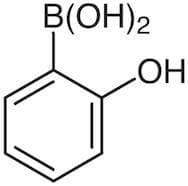
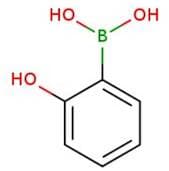
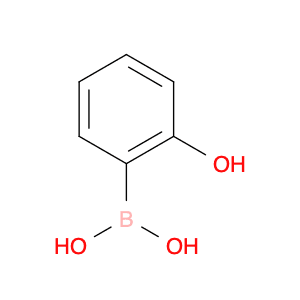
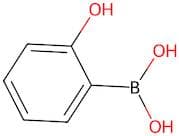
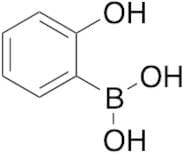
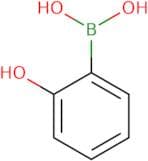
Acido 2-idrossibenzenboronico, noto anche come acido salicilboronico, è un composto organoboro caratterizzato dalla presenza di un gruppo funzionale acido boronico attaccato a un anello di benzene sostituito da un idrossile. La sua struttura molecolare presenta un gruppo idrossile fenolico (-OH) orto al gruppo acido boronico (-B(OH)2), che contribuisce alla sua reattività e proprietà uniche. Questo composto è tipicamente un solido bianco a bianco sporco ed è solubile in solventi polari come acqua e alcoli, rendendolo utile in varie applicazioni chimiche. Acido 2-idrossibenzenboronico è noto per la sua capacità di formare legami covalenti reversibili con dioli, il che è significativo nello sviluppo di sensori e sistemi di somministrazione di farmaci. Inoltre, svolge un ruolo nelle reazioni di accoppiamento incrociato di Suzuki-Miyaura, facilitando la formazione di legami carbonio-carbonio nella sintesi organica. La sua funzionalità di acido boronico consente anche di partecipare alla complessazione con biomolecole, rendendolo prezioso nella ricerca e nelle applicazioni biochimiche. In generale, Acido 2-idrossibenzenboronico è un composto versatile con importanti implicazioni sia nella chimica sintetica che in quella medicinale.
Formula:C6H7BO3
InChI:InChI=1/C6H7BO3/c8-6-4-2-1-3-5(6)7(9)10/h1-4,8-10H
SMILES:c1ccc(c(c1)B(O)O)O
Sinonimi:- 2-Boronophenol
- 2-Hydroxyphenylboronic acid
Ordinare per
Purezza (%)
0
100
|
0
|
50
|
90
|
95
|
100
Trovati 7 prodotti.
2-Hydroxyphenylboronic Acid (contains varying amounts of Anhydride)
CAS:Formula:C6H7BO3Colore e forma:White to Light yellow to Light orange powder to crystalPeso molecolare:137.932-Hydroxybenzeneboronic acid, 97%
CAS:2-Hydroxybenzeneboronic acid is used as a pharmaceutical intermediate. This Thermo Scientific Chemicals brand product was originally part of the Alfa Aesar product portfolio. Some documentation and label information may refer to the legacy brand. The original Alfa Aesar product / item code or SKU reFormula:C6H7BO3Purezza:97%Colore e forma:Powder, White to pale creamPeso molecolare:137.932-Hydroxyphenylboronic acid
CAS:Formula:C6H7BO3Purezza:96%Colore e forma:SolidPeso molecolare:137.9290Ref: IN-DA003HFX
1gPrezzo su richiesta5g28,00€10g34,00€25g62,00€50g99,00€100g152,00€250g265,00€500g692,00€2-Hydroxybenzeneboronic acid
CAS:2-Hydroxybenzeneboronic acid
Formula:C6H7BO3Purezza:≥95%Colore e forma: white to off-white powderPeso molecolare:137.92898g/mol2-Hydroxyphenylboronic acid
CAS:Formula:C6H7BO3Purezza:98%Colore e forma:White to off-white solidPeso molecolare:137.932-Hydroxyphenylboronic acid
CAS:Prodotto controllatoApplications 2-Hydroxyphenylboronic acid
Formula:C6H7BO3Colore e forma:NeatPeso molecolare:137.93(2-Hydroxyphenyl)boronic acid
CAS:(2-Hydroxyphenyl)boronic acid is an organic compound that contains a boronate ester group and a hydroxyl group. It is used in the synthesis of lysine-containing peptides, proteins, and other compounds. (2-Hydroxyphenyl)boronic acid is synthesized by cross-coupling reactions using palladium-catalyzed coupling reactions. The most common type of reaction is the Suzuki coupling reaction, which involves the addition of an aryl halide to an aryl or vinyl boronate ester. This reaction is carried out at elevated temperature in organic solvents such as tetrahydrofuran or dioxane. The yield for this reaction can be improved by using catalytic amounts of palladium acetate, which speeds up the rate at which the reaction occurs. The use of catalysts also decreases the need for high temperatures, making it possible to perform this process atFormula:C6H7BO3Purezza:Min. 95%Peso molecolare:137.93 g/mol