CAS 9004-62-0
:Cellulosa, etere 2-idrossietilico
Descrizione:
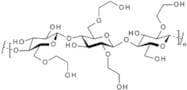
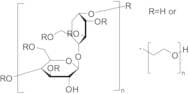
Cellulosa, etere 2-idrossietilico, comunemente noto come cellulosa idrossietilica (HEC), è un polimero non ionico, solubile in acqua, derivato dalla cellulosa. È caratterizzato dalla sostituzione di gruppi idrossietilici sulla catena di cellulosa, che ne migliora la solubilità in acqua e modifica le sue proprietà reologiche. L'HEC è tipicamente utilizzato come agente addensante, stabilizzante e filmogeno in varie applicazioni, tra cui prodotti farmaceutici, cosmetici e alimentari. È noto per la sua capacità di formare gel e migliorare la texture e la viscosità delle formulazioni. L'HEC è anche biocompatibile e biodegradabile, rendendolo adatto per applicazioni ecocompatibili. Le sue proprietà possono essere adattate modificando il grado di sostituzione e il peso molecolare, consentendo una vasta gamma di usi funzionali. Inoltre, l'HEC è stabile in una varietà di condizioni di pH e può resistere a temperature moderate, rendendolo versatile in sistemi acquosi e non acquosi. In generale, la cellulosa idrossietilica è un ingrediente prezioso in molti prodotti industriali e di consumo grazie alle sue caratteristiche multifunzionali.
Formula:C2H6O2·xUnspecified
Sinonimi:- 100000Yp2
- 2500Hec
- 250Hbr
- 250Hhbr
- 250Hr
- 250Lr
- 250Mbr
- 30000S
- 30000Yp2
- 3000M
- 3089Fs
- Aldiamed
- Cellosize
- Cf-G
- Cf-W
- HEC
- HEC-Unicel
- Hec-Cf-G
- Hydroxyaethylcellulose
- Hyetellose
- Liporamnosan
- Natrasol
- Natrosol
- OETs
- PF-VMTs
- Sanhec
- Sulfatsell
- Telhec
- Natrosol 250HR
- Cellulose, 2-hydroxyethyl ether
- Natrosol 250 M
- hydroxyl ethyl cellulose
- Cellulose hydroxyethylate
- Hydroxyethyl Cellulose
- Hydroxyethyl cellulose ether
- Cellosize WP 4400
- Natrosol 250 H
- Hydroxy Ethyl Cellulose
- Hydroxyethyl ether cellulose
- Natrosol LR
- Natrosol 240JR
- Natrosol L 250
- Natrosol 250 HHR
- ah15
- cellosizeqp3
- aw15[polysaccharide]
- CELLULOSE, HYDROXYETHYL ETHER
- cellosizeqp30000
- 2-hydroxyethylcelluloseether
- 2-HYDROXYETHYL CELLULOSE
- CELLOSIZE WP-40
- HYDROXYETHYL-CELLULOSE DYED WITH OSTAZIN BRILLIANT RED H-3B
- cellosizeqp
- cellosize4400h16
- HYDROXYETHYL-CELLULOSE 140'000-160'000
- cellosizeqp1500
- bl15
- Vedi altri sinonimi
Ordinare per
Purezza (%)
0
100
|
0
|
50
|
90
|
95
|
100
25 prodotti.
Hydroxyethyl Cellulose (800-1500mPa·s, 2% in Water at 20°C)
CAS:Colore e forma:White to Light red to Green powder to crystalHydroxyethyl Cellulose (4500-6500mPa·s, 2% in Water at 25°C)
CAS:Colore e forma:White to Light yellow to Light orange powder to crystalHydroxyethyl Cellulose (200-300mPa·s, 2% in Water at 20°C)
CAS:Colore e forma:White to Light red to Green powder to crystalHydroxyethyl Cellulose
CAS:Cellulose ethers,nesoiColore e forma:White Light Grey PowderPeso molecolare:203.09061Hydroxyethyl cellulose, high viscosity
CAS:Colore e forma:White, off-white to light-yellow or faint beige powderPeso molecolare:~300,000 (avg.)Hydroxyethyl cellulose, medium viscosity
CAS:Colore e forma:White to light-yellow or faint beige powderPeso molecolare:~170,000 (avg.)Hydroxyethyl cellulose, low viscosity
CAS:Colore e forma:White to light-yellow or faint beige powderPeso molecolare:~60,000 (avg.)Hydroxyethyl cellulose, very low viscosity
CAS:Colore e forma:White, off-white to light-yellow or faint beige powderPeso molecolare:~30,000 (avg.)Hydroxyethyl cellulose
CAS:Hydroxyethyl cellulose (2-Hydroxyethyl cellulose) is a nonionic water-soluble modified cellulose polymer used as a thickener in water-soluble cosmetics andPurezza:98%Colore e forma:Light Yellow PowderHydroxyethylcellulose for Identification RS
CAS:Colore e forma:White To Yellowish White Solid Powder Or GrainsHydroxyethyl cellulose - Viscosity 2400 to 2800(1% aqueous solution)
CAS:<p>Water thickener; rheological control additive; has industrial appplications</p>Purezza:Min. 95%Hydroxyethyl cellulose, viscosity 1500 ~ 2500
CAS:<p>Hydroxyethyl cellulose (EHEC) is a non-ionic, water-soluble cellulose derivative produced by introduction of ethylene oxide groups to the hydroxyl groups of the cellulose backbone. Hydroxyethyl cellulose is useful as a water thickener, rheological control additive, protective colloid, binder, stabilizer, suspending agent and film former. It is used in many industrial applications including latex paints, emulsion polymerization, petroleum, paper, pharmaceuticals, cosmetics and many other applications.</p>Purezza:Min. 95%Colore e forma:Powder2-Hydroxyethyl Cellulose
CAS:Prodotto controllato<p>Applications 2-Hydroxyethyl Cellulose is used in preparation of waterborne coating compound.Also, used in preparation method of high-temperature resistant stealth material.<br>References Zhang, J., et al.: Faming Zhuanli Shenqing, (2020); You, S., et al.: Faming Zhuanli Shenqing, (2020);<br></p>Formula:C6H4ClNO3S2Colore e forma:NeatPeso molecolare:0.00Hydroxyethyl cellulose, Mw about 250'000
CAS:<p>Hydroxyethyl cellulose (HEC) is a polysaccharide that is used as a thickener and emulsifier in the pharmaceutical industry. It has been shown to be effective in treating human serum with detrusor muscle contractions. HEC is also used as a negative control for experiments involving the effect of drugs on HIV infection. When mixed with isoxsuprine hydrochloride, HEC can be used to measure the concentration of basic proteins in human serum. The fluorescence probe can bind to specific regions of the protein, which will cause an increase in fluorescence when exposed to a wavelength of light. The optimum concentration of HEC for binding fluorescence probes was found using Langmuir adsorption isotherm measurements and fluorescence detector experiments. HEC has been shown to be an effective antimicrobial agent against bacteria and fungi, such as Staphylococcus aureus and Candida albicans. The benzalkonium chloride in HEC may</p>Ref: 3D-Q-201218
5kgPrezzo su richiesta10kgPrezzo su richiesta25kgPrezzo su richiesta2500gPrezzo su richiesta-Unit-kgkgPrezzo su richiestaHydroxyethyl cellulose - Viscocity 4500-6500mPa·s
CAS:Water thickener; rheological control additive; has industrial appplicationsPurezza:Min. 95%Ref: IN-DA00ILIZ
Prodotto fuori produzione