CAS 9005-38-3
:Alginato di sodio
Descrizione:
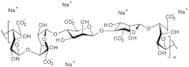
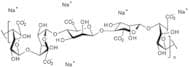
Alginato di sodio è un polisaccaride di origine naturale derivato da alghe brune, composto principalmente da unità di acido manuronico e guluronico. È una polvere bianca o giallastra che è solubile in acqua, formando un gel viscoso all'idratazione. Questo biopolimero è noto per la sua capacità di formare gel in presenza di cationi bivalenti, come gli ioni di calcio, rendendolo prezioso in applicazioni alimentari, farmaceutiche e biomediche. Alginato di sodio è ampiamente utilizzato come agente addensante, stabilizzante ed emulsionante in vari prodotti alimentari, tra cui gelati e condimenti per insalate. Nell'industria farmaceutica, funge da agente di rilascio del farmaco ed è utilizzato in medicazioni per ferite grazie alla sua biocompatibilità e alla capacità di mantenere un ambiente umido. Inoltre, Alginato di sodio è riconosciuto per la sua bassa tossicità ed è generalmente considerato sicuro per il consumo. Le sue proprietà uniche, come la formazione di gel e la viscosità, lo rendono un ingrediente versatile in numerose applicazioni industriali.
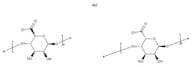
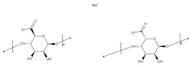
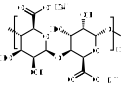
Formula:C5H7O4COONa
InChI:InChI=1/C6H10O7.Na/c7-1-2(8)4(5(10)11)13-6(12)3(1)9;/h1-4,6-9,12H,(H,10,11);/q;+1/p-1/t1-,2-,3-,4-,6+;/m0./s1
SMILES:C1(C(C(C(=O)O)OC(C1O)O)O)O.[Na]
Sinonimi:- 1-3F
- Algecolloid
- Algin
- Alloid
- Alman
- Alroid-G
- Alto
- Amnucol
- Ascophyllum
- EHV
- Flavicam
- GMB
- Gos-Lyi
- Halltex
- Kelcosol
- Kelgin
- Kelset
- Kelsize
- Keltex
- Keltone
- Kelvis
- Kimitex
- Lamitex
- MV
- Manucol
- Minus
- Mosanon
- Natriumalginat
- Nouralgine
- Nspll
- Pectalgine
- Proctin
- Pronova
- Protanal
- Protatek
- Seacor
- Skat-Ulv
- Skat-Uvl
- Solgin
- Sorugin
- Stipine
- Tagat
- Tragaya
- Kelgin F
- Alginic acid, sodium salt
- Cohasal IH
- sodium 3,4,5,6-tetrahydroxytetrahydro-2H-pyran-2-carboxylate (non-preferred name)
- alginic acid sodium
- Polymannuronic acid sodium salt
- Sodium alginate
- SODIUM ALIGINATE
- sodium (2S,3S,4S,5S,6R)-3,4,5,6-tetrahydroxytetrahydro-2H-pyran-2-carboxylate (non-preferred name)
- daridqh
- antimigrantc45
- ALGINIC SODIUM
- cecalginetbv
- algin(polysaccharide)
- algiponl-1168
- algiline
- Alginic acid monosodium salt
- SODIUM ALGINATE 500-600
- SODIUM ALGINATE 80-120
- SODIUM ALGINATE 300-400
- alginatekmf
- FEMA 2015
- Vedi altri sinonimi
Ordinare per
Purezza (%)
0
100
|
0
|
50
|
90
|
95
|
100
Alginic acid sodium salt, very low viscosity
CAS:It is a hematologic agent, drug that acts on blood and blood-forming organs and those that affect the hemostatic system. sodium alginate has been used in warp sizing, packing and printing. In printing, it is an ideal kind of material with wide applications in the cotton, wool, silk and synthetic fiFormula:(C6H7O7)A(C6H7O7)BNaColore e forma:White to cream to pale brown, PowderPeso molecolare:NaNAlginic acid sodium salt, low viscosity
CAS:A gelling polysaccharide extracted from giant brown seaweed, it is useful in viscosity studiesAlginic acid sodium salt is widely utilized in the food industry as flavorless gum which enhances viscosity and acts as an emulsifier. It finds application as a thickener for reactive dyestuffs which is use
Formula:(C6H7O7)A(C6H7O7)BNaColore e forma:White to cream to pale brown or yellowish brown, PowderPeso molecolare:NaNAlginic acid sodium salt, high viscosity
CAS:A gelling polysaccharide extracted from giant brown seaweed, useful in viscosity studiesFormula:(C6H7O7)A(C6H7O7)BNaColore e forma:Powder, WhitePeso molecolare:NaNSodium Alginate
CAS:Alginic acid,its salts and estersFormula:(C6H8NaO6)(C6H7NaO6)n(C6H8NaO7)Colore e forma:White Yellow PowderSodium Alginate
CAS:Formula:C12H14O12·2NanColore e forma:White To Off-White SolidPeso molecolare:[350.24 2*22.99]nSodium alginate-Low Viscosity
CAS:Sodium alginate-Low ViscosityPurezza:Ph: 6.0 to 8.0 7.9. viscosity: (Typical Value in Batch COA)Colore e forma: light brown powderAlginic acid sodium salt
CAS:Purezza:≥ 99.0%Colore e forma:White to off-white powder or beige powderPeso molecolare:-Alginic Acid Sodium Salt, Technical Grade
CAS:Applications Alginic Acid Sodium Salt, can be used as a flavorless gum. It is used by the foods industry to increase viscosity and as an emulsifier. It is also used in indigestion tablets and the preparation of dental impressions.
References Raymond C. R., et al.: Adipic Acid, Handbook of Pharmaceutical Excipients, 11 (2009); Augst, A. et al.: Macromol. Bio. 6, 623 (2006); Chen, S. et al.: J. Contorl. Rel., 96, 285 (2004);Formula:(C6H7O6Na)nColore e forma:White To Light BrownPeso molecolare:216.12Sodium alginate, viscosity 250 - 350 mPa.s
CAS:Sodium alginate is a natural polysaccharide that is extracted from seaweed and used as an emulsifier, thickener, and stabilizer in food products. It is also used to create a gel with water or other liquids. The viscosity of sodium alginate can be modified by adding sugar, glycosylation, or methylation. Click modification is used to introduce fluorine atoms into the polymer backbone. Sodium alginate may be modified by adding oligosaccharides or monosaccharides for use as a bio-sorbent in wastewater treatment plants.Colore e forma:PowderSodium alginate, high viscosity
CAS:Sodium salt of a polysaccharide obtained from the brown seaweeds (e.g. Laminaria hyperborea, Fucus vesiculosus, Ascophyllum nodosum). The chemical structure consists of blocks of (1,4) linked-β-D-polymannuronic acid (poly M), (1,4) linked-α-L-polyguluronic acid (poly G) and alternating blocks of the two uronic acids (poly MG). Alginates form strong gels with divalent metal cations and the egg box model has been used to describe this form of gelation. The main use for alginate is in textile printing as a thickener in the printing of cottons with reactive dyes. In the food industry it is used as a thickener and gelling agent. Recently, it has been shown that ternary mixtures of Konjac glucomannan, Xanthan gum and Sodium alginate can form a non-covalently linked complex which exhibits enhanced rheological properties of value in, for example, functional foods. The image was kindly provided by Prof Mike Guiry from Cork who runs ‘The Seaweed Site’.High viscosity (500-500mPa.s).Purezza:Min. 95%Colore e forma:White PowderSodium alginate, Laminaria Hyperborea
CAS:Sodium alginate is a biocompatible polymer that is used in the treatment of wastewater. It is a water-soluble substance that forms a viscous solution when dissolved in water. Sodium alginate has been shown to inhibit the growth of bacteria and fungi, as well as to reduce the number of coliforms and other microorganisms in water. The potential for an alginate to be biocompatible depends on its chemical structure, with Laminaria Hyperborea being the most biocompatible. Alginates have been shown to have surface properties that are similar to those of natural tissue, making them useful for wound dressings.Viscosity: 10-20 mPa.sFormula:C6H9NAO7Colore e forma:PowderPeso molecolare:216.12 g/molSodium alginate, low viscosity
CAS:Sodium salt of a polysaccharide obtained from the brown seaweeds (e.g. Laminaria hyperborea, Fucus vesiculosus, Ascophyllum nodosum). The chemical structure consists of blocks of (1,4) linked-β-D-polymannuronic acid (poly M), (1,4) linked-α-L-polyguluronic acid (poly G) and alternating blocks of the two uronic acids (poly MG). Alginates form strong gels with divalent metal cations and the egg box model has been used to describe this form of gelation. The main use for alginate is in textile printing as a thickener in the printing of cottons with reactive dyes. In the food industry it is used as a thickener and gelling agent. Recently, it has been shown that ternary mixtures of Konjac glucomannan, Xanthan gum and Sodium alginate can form a non-covalently linked complex which exhibits enhanced rheological properties of value in, for example, functional foods. The image was kindly provided by Prof Mike Guiry from Cork who runs ‘The Seaweed Site’.Viscosity: min 50 mPa.sColore e forma:White Powder