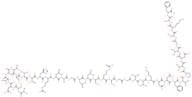
CAS 90954-53-3
:peptide correlato al gene della calcitonina umano
- Calcitonin Gene-Related Peptide-I, Human
- Ala-Cys-Asp-Thr-Ala-Thr-Cys-Val-Thr-His-Arg-Leu-Ala-Gly-Leu-Leu-Ser-Arg-Ser-Gly-Gly-Val-Val-Lys-Asn-Asn-Phe-Val-Pro-Thr-Asn-Val-Gly-Ser-Lys-Ala-Phe-Nh2
Calcitonin Gene Related Peptide, Human
CAS:For cellular and molecular biology applications
Formula:C163H267N51O49S2Peso molecolare:3789.3α-CGRP(human)
CAS:Endogenous calcitonin gene-related peptide receptor (CGRP) agonist.Formula:C163H267N51O49S2Purezza:98%Colore e forma:SolidPeso molecolare:3789.33CGRP (Human)
CAS:Human CGRP with a disulfide bond between Cys2-Cys7 and available as a 0.1mg vial. CGRP (calcitonin gene-related peptide) is a 37-amino acid neuropeptide that is found in humans and is widely distributed in the nervous system, particularly in sensory neurons, and is involved in the regulation of vascular tone, blood flow, pain perception, and inflammation. It is a potent vasodilator and has been implicated in the pathophysiology of several vascular disorders, including migraine headaches, cluster headaches, and hypertension.
In addition to its vascular effects, human CGRP also has neuroprotective properties and has been investigated as a potential therapeutic agent for various neurological disorders, such as Alzheimer's disease and Parkinson's disease.
Human CGRP has been extensively studied as a research tool to investigate its physiological and pathological roles in various tissues and diseases. It has also been targeted by pharmacological agents, such as CGRP antagonists and antibodies, for the treatment of migraine headaches and other conditions associated with CGRP dysfunction.Formula:C163H267N51O49S2Purezza:Min. 95%Peso molecolare:3,789.3 g/molCGRP (Human)
CAS:CGRP (calcitonin gene-related peptide) is a 37-amino acid neuropeptide that is found in humans and is widely distributed in the nervous system, particularly in sensory neurons, and is involved in the regulation of vascular tone, blood flow, pain perception, and inflammation. It is a potent vasodilator and has been implicated in the pathophysiology of several vascular disorders, including migraine headaches, cluster headaches, and hypertension.
In addition to its vascular effects, human CGRP also has neuroprotective properties and has been investigated as a potential therapeutic agent for various neurological disorders, such as Alzheimer's disease and Parkinson's disease.
Human CGRP has been extensively studied as a research tool to investigate its physiological and pathological roles in various tissues and diseases. It has also been targeted by pharmacological agents, such as CGRP antagonists and antibodies, for the treatment of migraine headaches and other conditions associated with CGRP dysfunction.
This product is available as a 0.5mg vial.Formula:C163H267N51O49S2Purezza:Min. 95%Peso molecolare:3,789.3 g/molα-CGRP (human)
CAS:Bachem ID: 4013281.
Formula:C163H267N51O49S2Purezza:97.62%Colore e forma:WhitePeso molecolare:3789.36