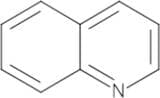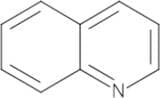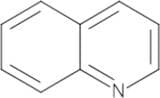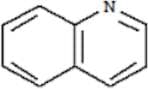
CAS 91-22-5
:Chinolina
- 1-Azanaphthalene
- 1-Azonaphthalene
- 1-Benzazene
- 1-Benzazine
- B 500
- Benzo(b)pyridine
- Benzopyridine
- Chinolin
- Leucol
- Leucoline
- Leukol
- Nsc 3396
- Quinoleine
- Quinolin
- Quinolina
- Quinoline
- chinoline
- 1-Benzaine
- 1-benzine
- chinoleine
- 2,3-BENZOPYRIDINE
- USAF ek-218
- ai3-01241
- AKOS 91715
- chinolin(czech)
- Vedi altri sinonimi
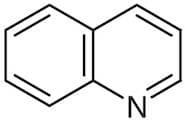
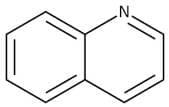
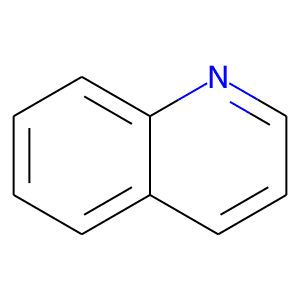
Quinoline
CAS:Formula:C9H7NPurezza:>98.0%(GC)(T)Colore e forma:Colorless to Light yellow to Light orange clear liquidPeso molecolare:129.16Quinoline
CAS:Formula:C9H7NPurezza:>97.0%(GC)Colore e forma:Colorless to Brown clear liquidPeso molecolare:129.16Quinoline, 98%
CAS:Quinoline acts as a precursor to 8-hydroxyquinoline, hydroxyquinoline sulfate and niacin. It is used as a solvent for resins and terpenes. It is also used in the manufacture of dyes, food colorants, antibiotics, alkaloids, rubber chemicals, flavoring agents, corrosion inhibitors and preservatives. IFormula:C9H7NPurezza:98%Peso molecolare:129.16Quinoline, 96%
CAS:This Thermo Scientific Chemicals brand product was originally part of the Alfa Aesar product portfolio. Some documentation and label information may refer to the legacy brand. The original Alfa Aesar product / item code or SKU reference has not changed as a part of the brand transition to Thermo SciFormula:C9H7NPurezza:96%Colore e forma:Clear colorless to pale yellow to yellow to brown to dark brown, LiquidPeso molecolare:129.16Quinoline
CAS:QuinolineFormula:C9H7NPurezza:98%Colore e forma: clear. almost colourless liquidPeso molecolare:129.16g/molEPA Method 538 Mixture in Methanol
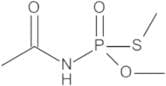
CAS:Formula:C4H10NO3PSColore e forma:MixturePeso molecolare:183.17LC PestiMix 6 10 µg/mL in Acetonitrile
CAS:- 1007-28-9
- 1114-71-2
- 113036-88-7
- 113136-77-9
- 114420-56-3
- 115086-54-9
- 115852-48-7
- 116255-48-2
- 119791-41-2
- 121776-33-8
- 126535-15-7
- 130000-40-7
- 136849-15-5
- 138164-12-2
- 139528-85-1
- 147150-35-4
- 149508-90-7
- 180409-60-3
- 181274-17-9
- 1929-88-0
- 199119-58-9
- 2008-41-5
- 210631-68-8
- 211867-47-9
- 221667-31-8
- 223580-51-6
- 23576-24-1
- 239110-15-7
- 2439-10-3
- 25606-41-1
- 27314-13-2
- 27605-76-1
- 2797-51-5
- 302-27-2
- 321-54-0
- 32889-48-8
- 3337-71-1
- 335104-84-2
- 33820-53-0
- 35367-31-8
- 37019-18-4
- 372137-35-4
- 4151-50-2
- 422556-08-9
- 42609-52-9
- 4849-32-5
- 55861-78-4
- 57160-47-1
- 58011-68-0
- 6119-70-6
- 61432-55-1
- 64-10-8
- 66-81-9
- 69335-91-7
- 69806-50-4
- 74051-80-2
- 74222-97-2
- 76578-12-6
- 8065-36-9
- 81103-11-9
- 81335-77-5
- 82211-24-3
- 838-85-7
- 86811-58-7
- 88678-67-5
- 90982-32-4
- 91-22-5
- 93697-74-6
- 944-22-9
- 951659-40-8
- 96182-53-5
- 96525-23-4
- 97780-06-8
- 97886-45-8
- 99105-77-8
Colore e forma:MixturePAH Mixture 390 1000 µg/mL in Dichloromethane
CAS:Prodotto controllato- 120-12-7
- 129-00-0
- 191-24-2
- 192-97-2
- 193-39-5
- 198-55-0
- 205-82-3
- 205-99-2
- 206-44-0
- 207-08-9
- 208-96-8
- 218-01-9
- 260-94-6
- 50-32-8
- 53-70-3
- 56-55-3
- 83-32-9
- 85-01-8
- 86-73-7
- 90-12-0
- 90-13-1
- 91-20-3
- 91-22-5
- 91-57-6
- 91-58-7
Formula:C10H7ClColore e forma:MixturePeso molecolare:162.62Quinoline 500 µg/mL in Methanol
CAS:Prodotto controllatoFormula:C9H7NColore e forma:Single SolutionPeso molecolare:129.16Quinoline
CAS:Formula:C9H7NPurezza:(GC) ≥ 97.0%Colore e forma:Colourless to light yellow or brown liquidPeso molecolare:129.16Ref: 4Z-Q-008005
5mgPrezzo su richiesta10mgPrezzo su richiesta25mgPrezzo su richiesta50mgPrezzo su richiesta100mgPrezzo su richiestaQuinoline
CAS:Applications Quinoline is a starting material that may be transformed by bacteria and fungi to produce intermediates useful for the synthesis of drugs. Used in the synthesis of tertiary alcohol modulators of RORγ (1) which appears to have various biological functions. Also derivatives of quinoline have been seen to promote anticancer, antibacterial and antiviral activity, however quinoline itself is often seen as an environmental contaminant (2,3). Dyes and metabolites, Environmental Testing.Drinking water contaminant candidate list 3 (CCL 3) compound as per United States Environmental Protection Agency (EPA), environmental, and food contaminants.
Not a dangerous good if item is equal to or less than 1g/ml and there is less than 100g/ml in the package
References 1. Kummer, D. et al.: Bioorg. Med. Chem. Lett. 2017 Feb 21.2. Ramirez-Prada, J. et al.: Eur J Med Chem. 2017 Mar 16;131:237-254.3. Mestankova, H. et al.: Water Res. 2016 Apr 15;93:110-20Formula:C9H7NColore e forma:NeatPeso molecolare:129.16Quinoline-13C3,15N
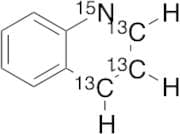
CAS:Prodotto controllatoApplications Isotope labelled Quinoline (Q700380), which is a starting material that may be transformed by bacteria and fungi to produce intermediates useful for the synthesis of drugs. Used in the synthesis of tertiary alcohol modulators of RORγ (1) which appears to have various biological functions. Also derivatives of quinoline have been seen to promote anticancer, antibacterial and antiviral activity, however quinoline itself is often seen as an environmental contaminant (2,3).Drinking water contaminant candidate list 3 (CCL 3) compound as per United States Environmental Protection Agency (EPA), environmental, and food contaminants.
References 1. Kummer, D. et al.: Bioorg. Med. Chem. Lett. 2017 Feb 21.2. Ramirez-Prada, J. et al.: Eur J Med Chem. 2017 Mar 16;131:237-254.3. Mestankova, H. et al.: Water Res. 2016 Apr 15;93:110-20Formula:C6C3H7NColore e forma:NeatPeso molecolare:133.13Quinoline (tech grade)
CAS:Formula:C9H7NPurezza:95.0%Colore e forma:Liquid, Clear LiquidPeso molecolare:129.162Ref: ST-EA-CP-Q5000
10mgPrezzo su richiesta25mgPrezzo su richiesta50mgPrezzo su richiesta100mgPrezzo su richiestaQuinoline pure, 97%
CAS:Formula:C9H7NPurezza:min. 97%Colore e forma:Clear, Pale yellow, LiquidPeso molecolare:129.16