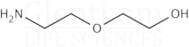
CAS 929-06-6
:Diglicolamina
- (2-Hydroxyaethyl)-(2-Aminoaethyl)-Aether
- 1-(2-Aminoethoxy)Ethanol
- 1-Amino-2-(2-hydroxyethoxy)ethane
- 2-(2-Aminoethoxy)ethan-1-ol
- 2-(2-Aminoetoxi)Etanol
- 2-(2-Hydroxyethoxy)Ethanaminium
- 2-(2-Hydroxyethoxy)ethylamine
- 2-(Hydroxyethoxy)ethylamine
- 2-Amino-2'-hydroxydiethyl ether
- 2-Aminoethyl 2-hydroxyethyl ether
- 5-Amino-3-oxapentan-1-ol
- 5-Hydroxy-3-oxapentylamine
- Aminoethoxyethanol
- DGA
- Diethylene glycol amine
- Diethylene glycol monoamine
- Diglycolamine
- Diglycolamine Agent
- Ethanol, 2-(2-aminoethoxy)-
- Nsc 86108
- O-(2-Hydroxyethyl) ethanolamine
- β-(β-Hydroxyethoxy)ethylamine
- β-Hydroxy-β'-aminodiethyl ether
- 2-(2-Aminoethoxy)ethanol
- AMINODIGLYCOL
- ETHYLENE GLYCOL MONO(2-AMINOETHYL) ETHER
- 2-(2-aminoethoxy)-ethano
- dga[qr]
- ADG
- 2-aminoethoxyethanol[qr]
- beta-Hydroxy-beta'-aminoethyl ether
- DIETHYLENE GLYCOLAMINE
- beta-(beta-Hydroxyethoxy)ethylamine
- Vedi altri sinonimi
2-(2-Aminoethoxy)ethanol
CAS:Formula:C4H11NO2Purezza:>98.0%(GC)(T)Colore e forma:Colorless to Light yellow clear liquidPeso molecolare:105.142-(2-Aminoethoxy)ethanol, 98%
CAS:2-(2-Aminoethoxy)ethanol is used mainly in stripper solutions for applications in electronics, in gas treating to remove carbon dioxide and hydrogen sulfide, and in coolants/lubricants for metal working applications. Other applications of aminoethoxyethanol (ADG) include, inter alia, crop protectionFormula:C4H11NO2Purezza:98%Colore e forma:Clear colorless to pale yellow, LiquidPeso molecolare:105.14Ref: 4Z-E-157025
5mgPrezzo su richiesta10mgPrezzo su richiesta25mgPrezzo su richiesta50mgPrezzo su richiesta100mgPrezzo su richiestaAmino-PEG2-alcohol
CAS:Prodotto controllatoApplications 2-(2-Aminoethoxy)ethanol is a widely used reactant that has been used in the preparation of TD-4306 as long-acting β2-agonist for asthma and COPD therapy.
Not a dangerous good if item is equal to or less than 1g/ml and there is less than 100g/ml in the package
References Mckinnell, R.M., et. al.: Bioorg. Med. Chem. Lett., 24, 2871 (2014)Formula:C4H11NO2Colore e forma:NeatPeso molecolare:105.142-(2-Aminoethoxy)ethanol
CAS:Formula:C4H11NO2Purezza:98.0%Colore e forma:ClearPeso molecolare:105.1372-(2-Aminoethoxy)ethanol
CAS:2-(2-Aminoethoxy)ethanol (2-AE) is a natural compound that has been synthesized from ethanol and 2-aminoethanol. It has been shown to react with sodium carbonate to form stable complexes that are resistant to hydrolysis by amines. The stability of the complex is attributed to the formation of an intermolecular hydrogen bond between the hydroxyl group on the 2-AE molecule and the carboxylate group on the sodium carbonate molecule. 2-AE reacts with benzalkonium chloride, a quaternary ammonium salt, in water vapor to produce an alcohol and a fatty acid, which is then hydrolyzed by glycol ethers into glycolates. This mechanism is similar to that of other reactions involving quaternary ammonium salts, such as those in fatty acids or glycol ethers.
Formula:C4H11NO2Purezza:Min. 95%Peso molecolare:105.14 g/mol