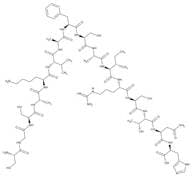
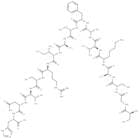
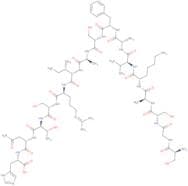
CAS 94071-26-8
:Cerebellina
Descrizione:
Cerebellina, con il numero CAS 94071-26-8, è un neuropeptide che gioca un ruolo significativo nel sistema nervoso centrale, in particolare nel cervelletto. È composto da una sequenza di amminoacidi ed è classificato come fattore neurotrofico, il che significa che supporta la crescita, la sopravvivenza e la differenziazione dei neuroni. Si sa che Cerebellina interagisce con recettori specifici, influenzando la plasticità sinaptica e la comunicazione neuronale. La sua struttura include tipicamente una serie di legami peptidici che contribuiscono alla sua attività biologica. Il peptide è coinvolto in vari processi neurologici, tra cui il controllo motorio e le funzioni cognitive. La ricerca ha indicato che Cerebellina potrebbe avere implicazioni nei disturbi del neurosviluppo e potrebbe essere un obiettivo per interventi terapeutici. Come sostanza chimica, è caratterizzato dal suo peso molecolare specifico, dalla solubilità nei fluidi biologici e dalla stabilità in condizioni fisiologiche. Comprendere le proprietà e i meccanismi d'azione di Cerebellina è cruciale per esplorare le sue potenziali applicazioni in neuroscienza e medicina.
Formula:C6H113N23O23
InChI:InChI=1/C69H113N23O23/c1-9-33(4)52(66(112)84-42(19-15-21-76-69(73)74)58(104)88-48(30-96)64(110)92-53(37(8)97)67(113)86-44(24-49(72)98)61(107)87-45(68(114)115)23-39-25-75-31-78-39)91-56(102)36(7)80-63(109)47(29-95)89-60(106)43(22-38-16-11-10-12-17-38)85-55(101)35(6)81-65(111)51(32(2)3)90-59(105)41(18-13-14-20-70)83-54(100)34(5)79-62(108)46(28-94)82-50(99)26-77-57(103)40(71)27-93/h10-12,16-17,25,31-37,40-48,51-53,93-97H,9,13-15,18-24,26-30,70-71H2,1-8H3,(H2,72,98)(H,75,78)(H,77,103)(H,79,108)(H,80,109)(H,81,111)(H,82,99)(H,83,100)(H,84,112)(H,85,101)(H,86,113)(H,87,107)(H,88,104)(H,89,106)(H,90,105)(H,91,102)(H,92,110)(H,114,115)(H4,73,74,76)/t33-,34-,35-,36-,37?,40-,41-,42-,43-,44-,45-,46-,47-,48-,51-,52-,53-/m0/s1
SMILES:CC[C@H](C)[C@@H](C(=N[C@@H](CCCNC(=N)N)C(=N[C@@H](CO)C(=N[C@@H](C(C)O)C(=N[C@@H](CC(=N)O)C(=N[C@@H](Cc1cnc[nH]1)C(=O)O)O)O)O)O)O)N=C([C@H](C)N=C([C@H](CO)N=C([C@H](Cc1ccccc1)N=C([C@H](C)N=C([C@H](C(C)C)N=C([C@H](CCCCN)N=C([C@H](C)N=C([C@H](CO)N=C(CN=C([C@H](CO)N)O)O)O)O)O)O)O)O)O)O
Sinonimi:- H-Ser-Gly-Ser-Ala-Lys-Val-Ala-Phe-Ser-Ala-Ile-Arg-Ser-Thr-Asn-His-OH
Ordinare per
Purezza (%)
0
100
|
0
|
50
|
90
|
95
|
100
4 prodotti.
Cerebellin
CAS:This Thermo Scientific Chemicals brand product was originally part of the Alfa Aesar product portfolio. Some documentation and label information may refer to the legacy brand. The original Alfa Aesar product / item code or SKU reference has not changed as a part of the brand transition to Thermo SciFormula:C69H113N23O23Peso molecolare:1632.8Cerebellin
CAS:Cerebellin: 16-amino acid peptide, from rat cerebellum, now found in human adrenal glands, mainly medullary chromaffin cells.Formula:C69H113N23O23Purezza:98%Colore e forma:SolidPeso molecolare:1632.78Cerebellin
CAS:Cerebellin is a protein that is found in the cerebellum. It has been shown to have a signal peptide, which is cleaved by proteases to form a mature protein. Cerebellin has receptor activity, and can bind to glutamate receptors. Cerebellin also has an effect on follicular growth and brain functions. The biological sample of cerebellin is from the Purkinje cells of the cerebellum. The chemical structure of cerebellin consists of three domains: two globular domains and one fibrous domain. It can be detected using fluorescein angiography or titration calorimetry, which measure its concentration in the body mass index or 3T3-L1 preadipocytes.Formula:C69H113N23O23Purezza:Min. 95%Peso molecolare:1,632.78 g/molCerebellin trifluoroacetate
CAS:Please enquire for more information about Cerebellin trifluoroacetate including the price, delivery time and more detailed product information at the technical inquiry form on this page
Formula:C69H113N23O23•(C2HF3O2)4Purezza:Min. 95%Peso molecolare:2,088.86 g/mol