CAS 95906-11-9
:Tris(2,4-di-terz-butilfenil) fosfato
Descrizione:
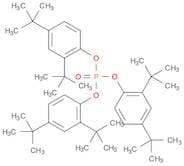
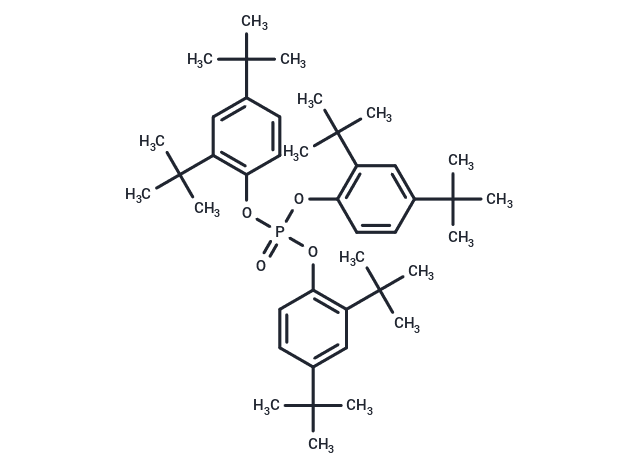
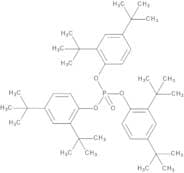
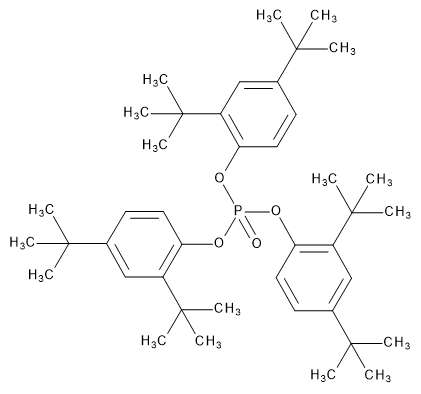
Tris(2,4-di-terz-butilfenil) fosfato, con il numero CAS 95906-11-9, è un composto organofosforato utilizzato principalmente come ritardante di fiamma e plastificante in varie applicazioni, inclusi polimeri e rivestimenti. Questa sostanza è caratterizzata dalla sua alta stabilità termica e resistenza alla degradazione, rendendola adatta per l'uso in ambienti ad alta temperatura. Presenta un gruppo fosfato legato a tre ingombranti gruppi 2,4-di-terc-butilfenile, che contribuiscono alla sua efficacia come ritardante di fiamma interrompendo il processo di combustione. I voluminosi gruppi terc-butilo migliorano la sua idrofobicità e riducono la volatilità, il che aiuta a mantenere le sue prestazioni nelle formulazioni. Inoltre, Tris(2,4-di-terz-butilfenil) fosfato mostra bassa tossicità ed è considerato avere un profilo ambientale favorevole rispetto ad altri ritardanti di fiamma. Tuttavia, come molti organofosforati, deve essere maneggiato con cura per evitare potenziali rischi per la salute associati all'esposizione. Le sue applicazioni si estendono oltre la resistenza al fuoco, inclusi l'uso in lubrificanti e come additivo in vari processi industriali.
Formula:C42H63O4P
InChI:InChI=1S/C42H63O4P/c1-37(2,3)28-19-22-34(31(25-28)40(10,11)12)44-47(43,45-35-23-20-29(38(4,5)6)26-32(35)41(13,14)15)46-36-24-21-30(39(7,8)9)27-33(36)42(16,17)18/h19-27H,1-18H3
InChI key:InChIKey=AZSKHRTUXHLAHS-UHFFFAOYSA-N
SMILES:P(OC1=C(C(C)(C)C)C=C(C(C)(C)C)C=C1)(OC2=C(C(C)(C)C)C=C(C(C)(C)C)C=C2)(OC3=C(C(C)(C)C)C=C(C(C)(C)C)C=C3)=O
Sinonimi:- D 16-834
- Phenol, 2,4-bis(1,1-dimethylethyl)-, 1,1′,1′′-phosphate
- P 3
- Phenol, 2,4-bis(1,1-dimethylethyl)-, phosphate (3:1)
- Tris(2,4-di-tert-butylphenyl) phosphate
Ordinare per
Purezza (%)
0
100
|
0
|
50
|
90
|
95
|
100
11 prodotti.
Tris(2,4-di-tert-butylphenyl)phosphate (Tri(2,4-di-tert-butylphenyl) phosphate)
CAS:Other aromatic phosphoric esters and their salts, including lactophosphates; their halogenated, sulfonated, nitrated or nitrosated derivativesFormula:C42H63O4PColore e forma:White SolidPeso molecolare:662.4464Phenol, 2,4-bis(1,1-dimethylethyl)-, phosphate (3:1)
CAS:Formula:C42H63O4PPurezza:98%Colore e forma:SolidPeso molecolare:662.9210Tris(2,4-di-tert-butylphenyl)phosphate
CAS:Tris(2,4-di-tert-butylphenyl)phosphate (TDTBPP) inhibits secretory phospholipase A2 (sPLA2) with anti-inflammatory effect. Cost-effective and quality-assured.Formula:C42H63O4PPurezza:99.73%Colore e forma:SolidPeso molecolare:662.92Tris(2,4-di-tert-butylphenyl)phosphate
CAS:Tris(2,4-di-tert-butylphenyl)phosphatePurezza:≥98%Peso molecolare:662.92g/molTris(2,4-Di-Tert-Butylphenyl) Phosphate
CAS:Tris(2,4-Di-Tert-Butylphenyl) PhosphatePurezza:99%Peso molecolare:662.92g/molTris (2,4-ditert-butylphenyl) Phosphate
CAS:Formula:C42H63O4PColore e forma:Pale Yellow SolidPeso molecolare:662.94Tris(2,4-di-tert-butylphenyl) phosphate
CAS:Formula:C42H63O4PColore e forma:NeatPeso molecolare:662.92Tris(2,4-di-tert-butylphenyl)phosphate
CAS:Stability Moisture Sensitive
Applications Tris(2,4-di-tert-butylphenyl)phosphate is used as a processing stabilizer for polymers.
References Thilen, M., et al.: J. Appl. Polym. Sci., 76, 938 (2000); Pfaendner, R., et al.: Polym. Degrad. Stab., 91, 2249 (2006);Formula:C42H63O4PColore e forma:Light YellowPeso molecolare:662.92Tris(2,4-di-tert-butylphenyl)phosphate
CAS:Tris(2,4-di-tert-butylphenyl)phosphate (TDBP) is a phosphite that is used as an antioxidant. TDBP has been shown to inhibit the formation of secretory phospholipase A2 (sPLA2), which in turn inhibits the release of arachidonic acid and prostaglandin E2. TDBP also inhibits the activity of hydrogen bond polymerase chain reaction (PCR). This inhibition has been shown to be due to its ability to bind to DNA and prevent the synthesis of RNA, which decreases the production of proteins necessary for cell division. The matrix effect can be used in analytical methods because it has a high solubility in organic solvents and is stable at alkaline pH. TDBP can be used as a sample preparation reagent for mitochondrial membrane potential measurements because it increases mitochondrial membrane potential by inhibiting calcium ion influx. It also exhibits chemical properties such as being a strong base, formingFormula:C42H63O4PPurezza:Min. 95%Colore e forma:PowderPeso molecolare:662.92 g/mol