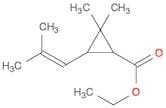
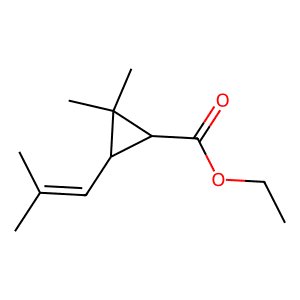
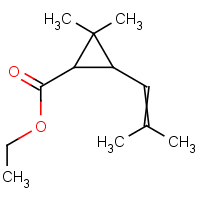
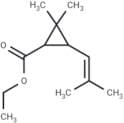
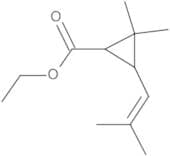
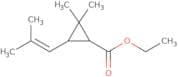
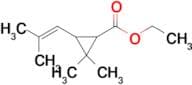
CAS 97-41-6
:Crisantemato di etile
Descrizione:
Crisantemato di etile, con il numero CAS 97-41-6, è un composto organico classificato come un estere. Deriva dall'acido crisantemico e dall'etanolo, risultando in una struttura che tipicamente presenta un piacevole aroma floreale, rendendolo utile nelle industrie delle fragranze e degli aromi. Crisantemato di etile è caratterizzato dalla sua relativa bassa volatilità e moderata solubilità nei solventi organici, mentre è meno solubile in acqua. Il composto è noto per la sua stabilità in condizioni normali, anche se può subire idrolisi in presenza di acidi o basi forti. Le sue applicazioni si estendono oltre la profumeria per includere potenziali usi in formulazioni agricole, in particolare come repellente o attrattivo per insetti grazie al suo profumo gradevole. I dati di sicurezza indicano che, come molti esteri, deve essere maneggiato con cura, poiché può causare irritazione al contatto con la pelle o gli occhi. In generale, Crisantemato di etile è apprezzato per le sue proprietà aromatiche e versatilità in varie applicazioni industriali.
Formula:C12H20O2
InChI:InChI=1S/C12H20O2/c1-6-14-11(13)10-9(7-8(2)3)12(10,4)5/h7,9-10H,6H2,1-5H3
InChI key:InChIKey=VIMXTGUGWLAOFZ-UHFFFAOYSA-N
SMILES:C(=C(C)C)C1C(C(OCC)=O)C1(C)C
Sinonimi:- Chrysanthemic acid ethyl ester
- Chrysanthemum Monocarboxylic Acid Ethyl Ester
- Chrysanthemumic acid ethyl ester
- Chrysanthemummonocarboxylic acid, ethyl ester
- Cyclopropanecarboxylic acid, 2,2-dimethyl-3-(2-methyl-1-propen-1-yl)-, ethyl ester
- Cyclopropanecarboxylic acid, 2,2-dimethyl-3-(2-methyl-1-propenyl)-, ethyl ester
- Cyclopropanecarboxylic acid, 2,2-dimethyl-3-(2-methylpropenyl)-, ethyl ester
- Ethyl 2,2-Dimethyl-3-(2-Methylprop-1-En-1-Yl)Cyclopropanecarboxylate
- Ethyl 2,2-Dimethyl-3-(2-methyl-1-propenyl)cyclopropanecarboxylate
- Ethyl 2,2-dimethyl-3-(1-isobutenyl)cyclopropane-1-carboxylate
- Ethyl Chrysanthemate (Primary)
- Ethyl Chrysanthemate, Mixed Isomers Cis And Trans
- Ethyl chrysanthemat
- Ethyl chrysanthemate
- Ethyl chrysanthemumate
- NSC 10819
- Primary ethyl chrysanthemate
- ethyl (1R,3R)-2,2-dimethyl-3-(2-methylprop-1-en-1-yl)cyclopropanecarboxylate
- ethyl (1R,3R)-2,2-dimethyl-3-(2-methylprop-1-enyl)cyclopropanecarboxylate
- ethyl (1R,3S)-2,2-dimethyl-3-(2-methylprop-1-en-1-yl)cyclopropanecarboxylate
- ethyl (1S,3R)-2,2-dimethyl-3-(2-methylprop-1-en-1-yl)cyclopropanecarboxylate
- Vedi altri sinonimi
Ordinare per
Purezza (%)
0
100
|
0
|
50
|
90
|
95
|
100
12 prodotti.
Ethyl 2,2-Dimethyl-3-(2-methyl-1-propenyl)cyclopropanecarboxylate
CAS:Formula:C12H20O2Purezza:95%Colore e forma:LiquidPeso molecolare:196.2860Tetramethrin Related Compound 1 (Mixture of Diastereomers)
CAS:Formula:C12H20O2Peso molecolare:196.29Ethyl 2,2-Dimethyl-3-(2-methyl-1-propenyl)cyclopropane-1-carboxylate
CAS:Formula:C12H20O2Purezza:>95.0%(GC)Colore e forma:Colorless to Light yellow to Light orange clear liquidPeso molecolare:196.29Ethyl chrysanthemate
CAS:Ethyl chrysanthemate (Ethyl chrysanthemumate) is an allelochemical compound used as an attractantFormula:C12H20O2Purezza:98.41%Colore e forma:Clear LiquidPeso molecolare:196.29Ethyl Chrysanthemate
CAS:Prodotto controllatoApplications Ethyl Chrysanthemate is an organic building block used in the synthesis of various chemical compounds, such as insecticide, Resmethrin (R144685). It is used in the preparation of trans-norchrysanthemates and trans-norpyrethrates, having insecticidal activity.
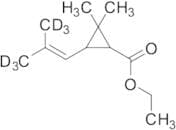
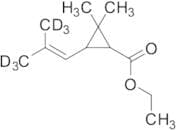
References Guorui, G., et al.: Youji Huaxue, 29, 589 (2009); Munoz, E., et al.: J. AOAC Int., 95, 1777 (2012);Formula:C12H20O2Colore e forma:NeatPeso molecolare:196.29Ethyl Chrysanthemate-D6
CAS:Prodotto controllatoFormula:C10D6H10O2Colore e forma:NeatPeso molecolare:174.27Chrysanthemum monocarboxylic acid ethyl ester
CAS:Chrysanthemum monocarboxylic acid ethyl ester is a chemical compound that belongs to the group of chrysanthemic acid derivatives. It is synthesized by reacting the carboxylic acid with an alcohol in the presence of hydrochloric acid and sodium ethoxide. Chrysanthemum monocarboxylic acid ethyl ester has been shown to have genotoxic effects, as well as fatty acids that can induce lysine residues. This drug also has a pharmaceutical use for tissue culture, which may be due to its ability to inhibit l-tartaric acid, an alkanoic acid.Formula:C12H20O2Purezza:Min. 95%Peso molecolare:196.29 g/molEthyl Chrysanthemumate
CAS:Formula:C12H20O2Purezza:95%(GC-MS);RGColore e forma:LiquidPeso molecolare:196.29Ethyl Chrysanthemate-D6
CAS:Prodotto controllatoFormula:C10D6H10O2Colore e forma:NeatPeso molecolare:174.27