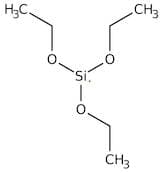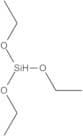
CAS 998-30-1
:Trietossisilano
- Kbe 03
- Nsc 124134
- Sit 8185
- Sit 8185.0
- T 1040
- Tries
- Triethoxysilan
- Triethoxysilane
- Trietoxisilano
- Silane, triethoxy-
Triethoxysilane, 96%
CAS:Triethoxysilane is raw material for synthesis of silane addition agent and silicon oil. It is used as a reducing agent. This Thermo Scientific Chemicals brand product was originally part of the Alfa Aesar product portfolio. Some documentation and label information may refer to the legacy brand. The
Formula:C6H15O3SiPurezza:96%Colore e forma:Clear colorless, LiquidPeso molecolare:163.27TRIETHOXYSILANE
CAS:Tri-substituted Silane Reducing Agent
Organosilanes are hydrocarbon-like and possess the ability to serve as both ionic and free-radical reducing agents. These reagents and their reaction by-products are safer and more easily handled and disposed than many other reducing agents. The metallic nature of silicon and its low electronegativity relative to hydrogen lead to polarization of the Si-H bond yielding a hydridic hydrogen and a milder reducing agent compared to aluminum-, boron-, and other metal-based hydrides. A summary of some key silane reductions are presented in Table 1 of the Silicon-Based Reducing Agents brochure.
Triethoxysilane; Silicon triethoxide; Triethoxysilylhydride
CAUTION: VAPORS CAUSE BLINDNESS — GOGGLES MUST BE WORNDISPROPORTIONATES IN PRESENCE OF BASE TO PYROPHORIC PRODUCTSContains trace Si–Cl for stabilityΔHcomb: -4,604 kJ/molΔHform: 925 kJ/molΔHvap: 175.4 kJ/molSurface tension: 22.3 mN/mVapor pressure, 20 °C: 20.2 mmCritical temperature: 244 °CDipole moment: 1.78 debyeHydrosilylates olefins in presence of PtUsed to convert alkynes to (E)–alkenes via hydrosilylation-desilylationReduces amides to amines in the presence of Zn(OAc)2Used in the reduction of phosphine oxides to phosphinesReduces esters in the presence of zinc hydride catalystReduces aldehydes and ketones to alcohols via the silyl ethers in presence of fluoride ionGives 1,2 reduction of enones to allyl alcoholsExtensive review of silicon based reducing agents: Larson, G.; Fry, J. L. "Ionic and Organometallic-Catalyzed Organosilane Reductions", Wipf, P., Ed.; Wiley, 2007Formula:C6H16O3SiPurezza:97%Colore e forma:LiquidPeso molecolare:164.28