Substrati fluorogenici
In questa categoria troverai una selezione completa di substrati fluorogenici progettati per la catalisi enzimatica. Questi substrati vengono utilizzati con vari tipi di enzimi e sono in grado di produrre colore e fluorescenza al momento della reazione. I substrati fluorogenici sono strumenti essenziali nella ricerca biochimica e biologia molecolare, permettendo la rilevazione e quantificazione dell'attività enzimatica con alta sensibilità e specificità. Sono ampiamente utilizzati in saggi per lo studio della cinetica enzimatica, lo screening di inibitori enzimatici e il monitoraggio dei processi cellulari. Da CymitQuimica, offriamo substrati fluorogenici di alta qualità per supportare le tue ricerche, garantendo risultati affidabili e precisi nei tuoi saggi enzimatici.
Trovati 297 prodotti di "Substrati fluorogenici"
Ordinare per
Purezza (%)
0
100
|
0
|
50
|
90
|
95
|
100
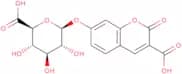
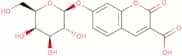
3-Carboxyumbelliferyl b-D-glucuronide
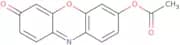
CAS:<p>3-Carboxyumbelliferyl b-D-glucuronide serves as a highly sensitive fluorogenic substrate for detecting b-glucuronidase activity. Upon enzymatic cleavage, it generates a fluorescent product enabling easy and accurate monitoring of enzyme activity in various applications, such as diagnostics, drug discovery, and research.</p>Purezza:Min. 95%Colore e forma:White to off-white solid.Peso molecolare:382.28 g/molResorufin acetate
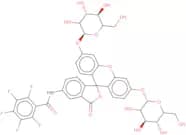
CAS:<p>Resorufin acetate is a fluorogenic substrate for esterase activity measurments in lipid metabolism studies. It is also used as a substrate for chymotrypsin, a digestive enzyme produced by the pancreas that aids in protein digestion in the small intestine.</p>Formula:C14H9NO4Purezza:Min. 95%Colore e forma:PowderPeso molecolare:255.23 g/mol5-(Pentafluorobenzoylamino)fluoroscein di-b-D-galactopyranoside
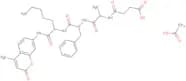
CAS:<p>5-(Pentafluorobenzoylamino)fluoroscein di-b-D-galactopyranoside, commonly referred as PFB-FDG or PFB-FDGal, is a cell-permeable enzyme substrate for β-galactosidase used in live cell imaging assays. After cleavage, 5-(pentafluorobenzoylamino)fluorescein (PFB-F) is released, generating a green fluorescence (Em ~520 nm)) of a higher intensity than fluorescein. Its main use is for bacterial detection (e.g. E. coli LacZ assays), but also for flow cytometry analytical assays.</p>Formula:C39H32F2NO16Purezza:Min. 95%Colore e forma:PowderPeso molecolare:865.67 g/molN-Succinyl-Ala-Phe-Lys 7-amido-4-methylcumarin acetate (salt)
CAS:Prodotto controllato<p>Fluorogenic substrate targeting plasmin</p>Formula:C34H43N5O10Purezza:Min. 95%Peso molecolare:681.7 g/mol4-Methylumbelliferyl-b-D-xylotrioside
CAS:<p>4-Methylumbelliferyl-b-D-xylotrioside is a fluorogenic substrate that reacts with an enzyme in the presence of oxygen to produce light. It is used in diagnostic applications, such as detecting the presence of a specific enzyme or protein. 4-Methylumbelliferyl-b-D-xylotrioside can also be used as a chromogenic substrate for the detection of DNA and RNA. This compound can be conjugated with other molecules for use in immunoassays and other diagnostic applications. 4-Methylumbelliferyl-b-D-xylotrioside has been shown to bind to bacterial cells and activate them, which leads to the production of light through bioluminescence.</p>Purezza:Min. 95%Peso molecolare:572.51 g/mol4-Methylumbelliferyl 3,4,6-tri-O-acetyl-2-deoxy-2-trifluoroacetamido-b-D-glucopyranoside
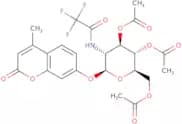
CAS:<p>4-Methylumbelliferyl 3,4,6-tri-O-acetyl-2-deoxy-2-trifluoroacetamido-b-D-glucopyranoside is a fluorogenic substrate specifically designed for the detection and quantification of hexosaminidase enzymes. Upon cleavage by the target enzyme, it generates a bright fluorescent signal facilitating the investigation of enzyme activity, screening of inhibitors, and diagnostics.</p>Purezza:Min. 95%Peso molecolare:559.44 g/mol4-Methylumbelliferyl 2-azido-2-deoxy-4,6-O-phenylmethylene-a-D-galactopyranoside
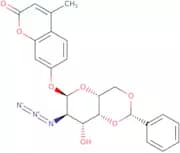
CAS:<p>4-Methylumbelliferyl 2-azido-2-deoxy-4,6-O-phenylmethylene-a-D-galactopyranoside is a fluorogenic substrate that reacts with beta D galactosidase to produce light. This product is useful for diagnostics, conjugate production, and other applications. 4MUF 2 -Gal provides a convenient means of detecting beta D galactosidase activity in cell culture media and can be used as a chromogenic substrate for the detection of enzymes involved in glycosylation reactions. It is also used to detect staining by bioluminescence. The compound can be used in food testing and environmental testing to measure the presence of beta D galactosidase.</p>Formula:C23H21N3O7Purezza:Min. 95%Peso molecolare:451.43 g/mol4-Methylumbelliferyl-phosphoethanolamine
<p>4-Methylumbelliferyl-phosphoethanolamine is a phosphorylated substrate that can be used in the detection of enzymes such as alkaline phosphatase, esterase, and lipase. This compound has been shown to be a fluorescent and chromogenic substrate for many diagnostic purposes. 4-Methylumbelliferyl-phosphoethanolamine is also used as a fluorogenic substrate for chemiluminescent reactions that are found in culture media and environmental testing.</p>Purezza:Min. 95%3-HTC
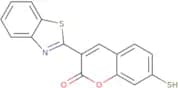
CAS:<p>3-HTC reacts reversibly with thiols and disulfides, and can be used to measure dynamic GSH/GSSH ratios in vitro as well as to monitor the reversible redox status of whole cell lysates.(λmax: 448 nm in its reduced thiolate form, and a λmax 370-410 nm for the oxidized mixed disulfide).</p>Formula:C16H9NO2S2Purezza:Min. 95%Peso molecolare:311.38 g/mol4-Methylumbelliferyl 3-O-(a-L-fucopyranosyl)-b-D-galactopyranoside
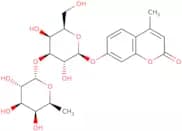
CAS:<p>4-Methylumbelliferyl 3-O-(α-L-fucopyranosyl)-β-D-galactopyranoside is an organic compound that is used as a radioactive marker for DNA. It can be synthesized in the laboratory and its use allows for the tracking of DNA molecules. The production of this marker is achieved by recombinant expression of the gene encoding the enzyme β-D-galactosidase, which hydrolyzes 4-methylumbelliferyl β-D-galactopyranoside to release 4-methylumbelliferone and α-L-fucopyranose. The enzyme uses UDP glucose as a cofactor to catalyse the reaction. This product has been isolated from Corynebacterium glutamicum, with recombinant expression vectors used to produce it in host cells such as Escherichia coli or Corynebacterium glutamicum. It has been found that</p>Formula:C22H28O12Purezza:Min. 95%Colore e forma:PowderPeso molecolare:484.45 g/molRef: 3D-EM06429
1mgPrezzo su richiesta2mgPrezzo su richiesta5mgPrezzo su richiesta10mgPrezzo su richiesta500µgPrezzo su richiesta4-Methylumbelliferyl 3,4,6-tri-O-acetyl-2-azido-2-deoxy-a-D-galactopyranoside
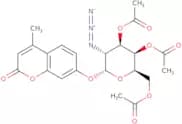
CAS:<p>4-Methylumbelliferyl 3,4,6-tri-O-acetyl-2-azido-2-deoxy-a-D-galactopyranoside is a fluorogenic substrate for the enzyme beta galactosidase. It is used in food testing, environmental testing, and diagnostics. 4MUF3A2DGAL is an enzyme substrate that provides high quality chemiluminescence and bioluminescence signals. This product has a CAS number of 124167-43-7 and is available in both high purity and conjugate forms.</p>Purezza:Min. 95%Peso molecolare:489.43 g/mol4-Methylumbelliferyl 2-acetamido-2-deoxy-4-O-(a-L-fucopyranosyl)-b-D-glucopyranoside
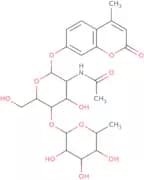
CAS:<p>4-Methylumbelliferyl 2-acetamido-2-deoxy-4-O-(alpha-L-fucopyranosyl)-beta-D-glucopyranoside is a fluorogenic substrate for alpha-L-fucosidase. After enzymatic cleaveage, free 4-methylumbelliferone (also known as hymecromone) is released, exhibiting blue fluorescence upon excitation with UV light. The strongest fluorescence of 4-methylumbelliferone requires deprotonation of the hydroxyl group (thus requires alkaline pH), with a maximal fluorescence intensity obtained with excitation at 350 to 370 nm and emission at 440 to 470 nm. The use of 4-methylumbelliferyl 2-acetamido-2-deoxy-4-O-(alpha-L-fucopyranosyl)-beta-D-glucopyranosideas a substrate for measuring the alpha-L-fucosidase activity is used for fucosidosis diagnosis (deficiency of the enzyme alpha-L-fucosidase) and glycoprotein metabolism disorder detection.</p>Formula:C24H31NO12Purezza:Min. 95 Area-%Colore e forma:PowderPeso molecolare:525.5 g/mol3-Carboxyumbelliferyl b-D-galactopyranoside
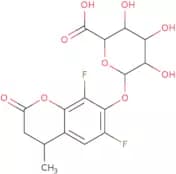
CAS:<p>3-Carboxyumbelliferyl b-D-galactopyranoside is a fluorescent probe that can be used to study protein synthesis in live cells. It binds to the active site of the enzyme peptidyl transferase, which catalyzes the covalent linkage of amino acids to form a polypeptide chain. 3CMBG is specific for the amino acid proline and is a substrate for peptidyl transferase. The fluorescence of 3CMBG increases when it is bound to peptidyl transferase, making it useful as a marker for protein synthesis.</p>Purezza:Min. 95%Peso molecolare:368.28 g/mol6,8-Difluoro-4-methylumbelliferyl b-D-glucuronide
CAS:<p>6,8-Difluoro-4-methylumbelliferyl b-D-glucuronide is a chemiluminescent substrate for the enzyme glucuronidase. The compound has been shown to be stable in the presence of a wide range of pHs and temperatures. It can be used in applications such as diagnostics, culture media and food testing. 6,8-Difluoro-4-methylumbelliferyl b-D-glucuronide has a high purity level and can be used as an indicator for other compounds such as acetaminophen or ibuprofen.</p>Purezza:Min. 95%Colore e forma:White To Off-White SolidPeso molecolare:388.27 g/mol4-Methylumbelliferyl b-L-arabinopyranoside
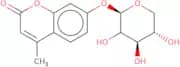
<p>4-Methylumbelliferyl b-L-arabinopyranoside is a chemiluminescent substrate that is used in the detection of various enzymes and other proteins. It can be used as a fluorogenic substrate, chromogenic substrate, or enzyme substrate. 4-Methylumbelliferyl b-L-arabinopyranoside has been shown to be an effective probe for detecting catalase, cytochrome c oxidase, and peroxidase activity. This product also has applications in diagnostics and food testing.</p>Purezza:Min. 95%Peso molecolare:308.28 g/mol4-Methylumbelliferyl 2,3,4,6-tetra-O-acetyl-a-D-glucopyranoside
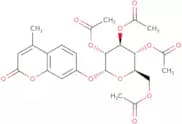
CAS:<p>4-Methylumbelliferyl 2,3,4,6-tetra-O-acetyl-a-D-glucopyranoside is a fluorescent marker for nucleic acid molecules. It can be applied to identify the metabolic pathways of bacteria in an ecosystem by using fluorescence microscopy. 4-Methylumbelliferyl 2,3,4,6-tetra-O-acetyl-a-D-glucopyranoside is also used to measure the activity of some enzymes in vitro. This compound has been shown to be effective against spittlebugs and other pests that feed on plant sap. The toxic effect of this compound is due to its ability to inhibit acetate synthesis and disrupt membrane transport systems.</p>Purezza:Min. 95%Peso molecolare:506.46 g/molResorufin oleate
<p>Resorufin oleate is a fluorogenic lipase substrate.</p>Purezza:Min. 95%Colore e forma:PowderPeso molecolare:477.64 g/mol6-Chloro-4-(trifluoromethyl)umbelliferyl b-D-cellotetraoside
<p>6-Chloro-4-(trifluoromethyl)umbelliferyl b-D-cellotetraoside is a fluorescent substrate that is used to measure the activity of the enzyme beta-glucuronidase. It is a chemiluminescent compound that emits light when hydrolyzed by an enzyme. 6-Chloro-4-(trifluoromethyl)umbelliferyl b-D-cellotetraoside has been shown to be a high quality and environmentally friendly product, as it does not cause any significant change in pH or turbidity in water samples. It has also been shown to be nontoxic and nonmutagenic at concentrations up to 400 ppm. This product can be used for a variety of purposes, including diagnostic tests for bacterial infections or food testing.</p>Purezza:Min. 95%Peso molecolare:913.15 g/mol4-Methylumbelliferyl a-L-idopyranoside
CAS:<p>4-Methylumbelliferyl alpha-L-idopyranoside is a fluorogenic substrate for alpha-L-iduronidase. After enzymatic cleaveage, free 4-methylumbelliferone (also known as hymecromone) is released, exhibiting blue fluorescence upon excitation with UV light. The strongest fluorescence of 4-methylumbelliferone requires deprotonation of the hydroxyl group (thus requires alkaline pH), with a maximal fluorescence intensity obtained with excitation at 350 to 370 nm and emission at 440 to 470 nm. The use of 4-methylumbelliferyl alpha-L-idopyranosideas a substrate for measuring the alpha-L-iduronidase activity is used for Mucopolysaccharidosis I diagnosis and Hurler syndrome screening.</p>Formula:C16H18O8Purezza:Min. 98 Area-%Colore e forma:White PowderPeso molecolare:338.31 g/molColchicine fluorescein
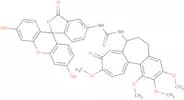
CAS:<p>Colchicine fluorescein is the fluorogenic form of colchicine. It is used for staining assembly of tubulin. Colchicine-site inhibitors (abbrevated as CBSIs) disrupt tubulin polymerization. Colchicine fluorescein serves as a probe to study the binding of colchicine to tubulin, as the colchicine binding site is a promising target for discovering novel antitumour agents.</p>Formula:C41H34N2O10SPurezza:Min. 90 Area-%Colore e forma:Orange PowderPeso molecolare:746.78 g/mol