Substrati fluorogenici
Trovati 284 prodotti per "Substrati fluorogenici".
Rhodamine 110 bis-(N-CBZ-L-aspartyl-L-glutamyl-L-valyl-L-aspartic acid amide
For fluorogenic detection of caspase 3
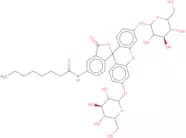
Purezza:Min. 95%Peso molecolare:974.96 g/mol5-Octanoylaminofluoroscein di-b-D-glactopyranoside
5-Octanoylaminofluoroscein di-b-D-glactopyranoside is a chemiluminescent substrate that can be used for the detection of peroxidase activity. It is a bifunctional substrate, which means it has two reactive groups: one at the 5 position and one at the 8 position. The 5-octanoylaminofluorescein reacts with hydrogen peroxide in a 1:1 ratio, emitting light at 490 nm. The 8-position amine reacts with 2,2'-azino-bis(3-ethylbenzthiazoline)6 sulphonic acid (ABTS) to produce an orange color product that acts as a chromogen. The substrate can be used in diagnostics, food testing, and enzyme substrates.
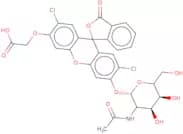
Purezza:Min. 95%Peso molecolare:797.8 g/mol6'-(O-(Carboxymethyl))-2',7'-dichlorofluoroscein 3'-(O-(N-acetyl-b-D-glucosamide))
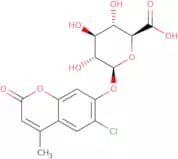
6'-(O-(Carboxymethyl))-2',7'-dichlorofluoroscein 3'-(O-(N-acetyl-b-D-glucosamide)) is a chemiluminescent substrate that can be used in the detection of ligands. This product has a CAS number of 44636-76-8 and is available at a purity level of 98%. It has been tested for bacterial contamination, as well as for adverse effects on culture media and environmental testing. 6'-(O-(Carboxymethyl))-2',7'-dichlorofluoroscein 3'-(O-(N-acetyl-b-D-glucosamide)) is an enzymatic substrate that can be used in diagnostic applications such as the detection of fluorescence, staining, and bioluminescence. It has also been shown to be useful in food testing.Purezza:Min. 95%Peso molecolare:662.44 g/mol6-Chloro-4-methylumbelliferyl b-D glucuronide
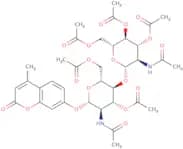
CAS:6-Chloro-4-methylumbelliferyl b-D glucuronide is a fluorogenic substrate for beta-glucuronidase that exhibits longer absorption/emission maxima (~385/500 nm) than typical 4MU-derived substrates.Formula:C16H15ClO9Purezza:Min. 97 Area-%Colore e forma:White PowderPeso molecolare:386.74 g/mol4-Methylumbelliferyl-b-D-cellobiose heptaacetate
CAS:4-Methylumbelliferyl-beta-D-cellobioside heptaacetate is a fluorogenic substrate for beta-D-glucosidase and can be used to detect this enzyme in the presence of other glycosidases. It is also used as a chromogenic substrate for beta-galactosidase, alpha-mannosidase, alpha-fucosidase, and alpha-N-acetylgalactosaminidase. 4MMB Cellobiose Haptaacetate is a conjugate that can be used to measure the activity of beta-glucuronidase and beta-xylosidase. This product is suitable for use in diagnostics, ligands, food testing, environmental testing, and culture media.Purezza:Min. 95%Peso molecolare:794.71 g/molHordenine
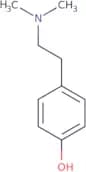
CAS:Produces a fluorogenic signal in the presence of peroxidaseFormula:C10H15NOPurezza:Min. 95%Colore e forma:Brown PowderPeso molecolare:165.23 g/mol4-Methylumbelliferyl 2,3,4-tri-O-benzoyl-b-D-galactopyranoside-6-sulfate
4-Methylumbelliferyl 2,3,4-tri-O-benzoyl-b-D-galactopyranoside-6-sulfate is a fluorogenic substrate for β-galactosidase and a chromogenic substrate for β-glucuronidase. It is used in food testing, environmental testing, and diagnostics.
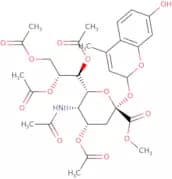
Purezza:Min. 95%Peso molecolare:730.69 g/mol4-Methylumbelliferyl N-acetyl-4,7,8,9-tetra-O-acetyl-a-D-neuraminic acid methyl ester
CAS:4-Methylumbelliferyl N-acetyl-4,7,8,9-tetra-O-acetyl-a-D-neuraminic acid methyl ester (4MU) is a chemiluminescence substrate. It is used in the detection of an enzyme involved in the synthesis of glycoproteins and glycolipids. The enzyme conjugates 4MU with a sugar molecule to form a fluorescent product. This product can be detected by its emission of light at 560 nm when illuminated with light at 450 nm.Purezza:Min. 95%Peso molecolare:649.6 g/mol4-Methylumbelliferyl acetate - 95%
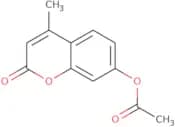
CAS:4-Methylumbelliferyl acetate is a fluorescent compound that can be used to measure the activity of cytochrome P450 enzymes. The fluorescence intensity of 4-methylumbelliferyl acetate increases when it reacts with substrates and inhibitors in vitro. This chemical has been shown to inhibit the enzyme cyclooxygenase in rat liver microsomes, which may lead to blood disorders. It also inhibits coumarin derivatives and human pathogens, such as erythromycin-resistant Staphylococcus aureus (MRSA). 4-Methylumbelliferyl acetate is used as a substrate for polymerase chain reaction (PCR) analysis because it is not susceptible to hydrolysis by esterases.Formula:C12H10O4Purezza:Min. 95%Colore e forma:PowderPeso molecolare:218.21 g/mol6,8-Difluoro-4-methylumbelliferyl 2-acetamido-3-O-(b-D-galactopyranosyl)-a-D-galactopyranoside
6,8-Difluoro-4-methylumbelliferyl 2-acetamido-3-O-(b-D-galactopyranosyl)-a-D-galactopyranoside is a chemiluminescent substrate that reacts with oxygen in the presence of luciferase to produce light. This product is an excellent replacement for luminol, especially in applications where aqueous solvents are not suitable. 6,8-Difluoro-4-methylumbelliferyl 2-acetamido-3-O-(b-D-galactopyranosyl)-a-D-galactopyranoside has been extensively tested and shown to be nonhazardous in a variety of different culture media. It is also nonhazardous to the environment, as it can be easily degraded by microorganisms.
Purezza:Min. 95%4-Methylumbelliferyl 2-acetamido-3,4,6-tri-O-acetyl-2-deoxy-b-D-galactopyranoside
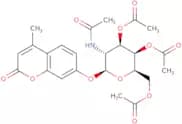
CAS:4-Methylumbelliferyl 2-acetamido-3,4,6-tri-O-acetyl-2-deoxy-b-D-galactopyranoside is a fluorescent marker that is used to measure the enzymatic activity of corynebacterium glutamicum. The enzyme catalyzes the conversion of 4-methylumbelliferyl glucopyranoside to 4-methylumbelliferone glucuronide. The production of 4 methylumbelliferone glucuronide can be quantified using fluorescence spectroscopy. This product can be used in research involving chronic inflammatory diseases and cancer.Purezza:Min. 95%Peso molecolare:505.47 g/mol3-Carboxyumbelliferyl b-D-galactoside BSA conjugate
3-Carboxyumbelliferyl b-D-galactoside BSA conjugate is a fluorogenic substrate that is used in chemiluminescent enzyme assays. The reaction of this compound with the enzyme β-galactosidase leads to an increase in the intensity of light emitted by the compound, which can be measured using a luminometer. This product is often used in diagnostics, such as food testing and environmental testing, as well as high quality research.Purezza:Min. 95%Rhodamine 110 bis-(L-aspartic acid amide) trifluoroacetic acid salt
CAS:Fluorogenic substrate targeting caspases 3 and 7
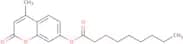
Purezza:Min. 95%Peso molecolare:788.56 g/mol4-Methylumbelliferyl nonanoate
CAS:4-Methylumbelliferyl nonanoate is a synthetic fluorogenic substrate for lipase. It is used to measure the activity of lipases in vitro. 4-Methylumbelliferyl nonanoate reacts with a lipid substrate, such as sodium taurocholate, to produce 4-methylumbelliferone and dodecanol. The fluorescent product can be detected by fluorimetric or spectrophotometric methods. This compound is activated by an enzyme preparation, such as proteolytic enzymes, and can be used to measure the activity of these enzymes in vitro.Formula:C19H24O4Purezza:Min. 99 Area-%Peso molecolare:316.40 g/molRef: 3D-M-5744
-Unit-ggPrezzo su richiesta5gPrezzo su richiesta10gPrezzo su richiesta25gPrezzo su richiesta50gPrezzo su richiesta100gPrezzo su richiestaCaspase substrate
CAS:Caspase substrates are a class of pharmacological agents that regulate apoptosis. Caspases are proteases that cleave specific proteins in the cell, leading to apoptosis. Pro-apoptotic proteins activate caspases, while anti-apoptotic proteins inhibit them. Caspase substrates can be either pro-caspase or anti-caspase, depending on the desired effect. They may also be used to regulate caspases without affecting their activity. The caspase substrate is cleaved by caspases and releases a polypeptide fragment that triggers apoptosis in some cells, but not others. For example, the Hl-60 cell line is resistant to the pro-apoptotic effects of the substrate because it contains an anti-apoptotic protein called Bcl-2. In contrast, myocardial cells contain pro-apoptotic proteins and are sensitive to the pro-apoptotic effects of the substrate. In
Purezza:Min. 95%Peso molecolare:821.75 g/mol6,8-Difluoro-4-methylumbelliferyl b-D-cellotrioside
6,8-Difluoro-4-methylumbelliferyl b-D-cellotrioside is a ligand that binds to active sites of enzymes such as beta-glucuronidase and beta-glucosidase. It is used in diagnostics for the detection of bacteria in culture media and food testing where it can be used as a chromogenic or fluorogenic substrate. 6,8-Difluoro-4-methylumbelliferyl b-D-cellotrioside is also used to detect the presence of bacteria and fungi in environmental samples. It has a high purity and conjugate with other molecules for use in fluorescence microscopy.Purezza:Min. 95%Colore e forma:White to off-white powder.Peso molecolare:698.57 g/molResorufin methyl ether
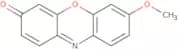
CAS:Fluorogenic substrate used to differentiate cytochrome P450 monooxygenases
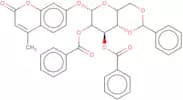
Formula:C13H9NO3Purezza:Min. 95%Colore e forma:PowderPeso molecolare:227.22 g/mol4-Methylumbelliferyl 2,3-di-O-benzoyl-4,6-O-benzylidene-b-D-galactopyranoside
4-Methylumbelliferyl 2,3-di-O-benzoyl-4,6-O-benzylidene-b-D-galactopyranoside is a fluorogenic substrate that is used in the detection of β-galactosidase activity. This product is a white to off white powder that has a purity of 99.2%. It has been given CAS number 53654–95–1 and it can be found in the Diagnostics section of Acros Organics.
Purezza:Min. 95%Peso molecolare:634.63 g/mol7-((4'-L-Alaninamido)-rac-(3'-octanoyloxy)butyloxy) coumarin trifluoroacetate salt
CAS:This Clips-O substrate 7-(4'-L-Alaninamido)-rac-(3'-octanoyloxy)butyloxy) coumarin allows the detection of three enzymatic activities (L-alanine aminopeptidase, C8-esterase and oxidation of 4-amino-3-hydroxybutyloxy either enzymatically or by exposure to sodium periodate) with one single substrate and give a positive fluorescent signal only in presence of all activities. The main virtues of Clips-O substrates are an increased stability towards non-enzymatic hydrolysis that results in a reduced background and high sensitivity.
Formula:C26H35F3N2O8Purezza:Min. 95.0 Area-%Peso molecolare:560.56 g/molRef: 3D-A-4475
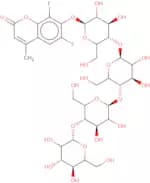
50mgPrezzo su richiesta100mgPrezzo su richiesta250mgPrezzo su richiesta500mgPrezzo su richiesta6,8-Difluoro-4-methylumbelliferyl b-D-cellotetraoside
6,8-Difluoro-4-methylumbelliferyl b-D-cellotetraoside is a chemiluminescent substrate for the detection of esterases. It is also used as an enzyme substrate in diagnostic applications and as a fluorogenic substrate in food testing. 6,8-Difluoro-4-methylumbelliferyl b-D-cellotetraoside has been shown to be an excellent ligand for use in immunoassays and can be conjugated to antibodies or antigens. 6,8-Difluoro-4-methylumbelliferyl b-D-cellotetraoside is chemically stable and has high purity and high quality.Purezza:Min. 95%Peso molecolare:860.71 g/mol