Substrati fluorogenici
In questa categoria troverai una selezione completa di substrati fluorogenici progettati per la catalisi enzimatica. Questi substrati vengono utilizzati con vari tipi di enzimi e sono in grado di produrre colore e fluorescenza al momento della reazione. I substrati fluorogenici sono strumenti essenziali nella ricerca biochimica e biologia molecolare, permettendo la rilevazione e quantificazione dell'attività enzimatica con alta sensibilità e specificità. Sono ampiamente utilizzati in saggi per lo studio della cinetica enzimatica, lo screening di inibitori enzimatici e il monitoraggio dei processi cellulari. Da CymitQuimica, offriamo substrati fluorogenici di alta qualità per supportare le tue ricerche, garantendo risultati affidabili e precisi nei tuoi saggi enzimatici.
Trovati 297 prodotti di "Substrati fluorogenici"
Ordinare per
Purezza (%)
0
100
|
0
|
50
|
90
|
95
|
100
4-Methylumbelliferyl a-L-fucopyranoside
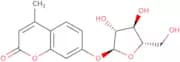
CAS:<p>Fluorogenic substrate for fucosidase</p>Formula:C16H18O7Purezza:Min. 95%Colore e forma:White PowderPeso molecolare:322.31 g/mol4-Methylumbelliferyl a-L-arabinofuranoside
CAS:<p>Fluorogenic substrate for ?-arabinofuranosidase</p>Formula:C15H16O7Purezza:Min. 95%Colore e forma:White PowderPeso molecolare:308.28 g/mol6-Chloro-4-(trifluoromethyl)umbelliferyl β-D-cellotrioside
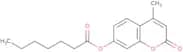
<p>6-Chloro-4-(trifluoromethyl)umbelliferyl b-D-cellotrioside is a fluorogenic substrate for cellulases and beta-glucosidases. After hydrolisis, the fluorophore TFMU is released generating a blue fluorescence.</p>Formula:C28H34ClF3O18Purezza:Min. 95%Colore e forma:White to off-white powder.Peso molecolare:751.01 g/mol4-Methylumbelliferyl heptanoate
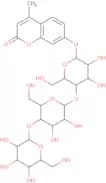
CAS:<p>Lipase targeting MOSCERDAM® substrate</p>Formula:C17H20O4Purezza:Min. 95%Colore e forma:White PowderPeso molecolare:288.34 g/mol4-Methylumbelliferyl b-D-cellotrioside
CAS:<p>Fluorogenic cellulose analogue</p>Formula:C28H38O18Purezza:Min. 95%Colore e forma:PowderPeso molecolare:662.6 g/mol4-Methylumbelliferyl b-D-ribofuranoside
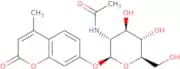
CAS:<p>The 4-Methylumbelliferyl b-D-ribofuranoside is a top-notch fluorogenic substrate for glycosidase activity detection. Upon hydrolysis by enzymes, it generates a strongly fluorescent 4-methylumbelliferone molecule, enabling rapid assay results and real-time monitoring of enzymatic reactions. This product is suitable for many biological research applications, such as in vitro analysis, diagnostic testing, and drug discovery. With its high sensitivity and specificity, it delivers consistent and accurate results, making it an essential tool for scientists and researchers.</p>Formula:C15H16O7Purezza:Min. 95%Colore e forma:White PowderPeso molecolare:308.28 g/mol4-Methylumbelliferyl 2-acetamido-2-deoxy-b-D-glucopyranoside
CAS:<p>Fluorogenic substrate for chitinase</p>Formula:C18H21NO8Purezza:Min. 99 Area-%Colore e forma:White Off-White PowderPeso molecolare:379.36 g/mol4-Methylumbelliferyl phosphate, free acid
CAS:<p>A sensitive fluorogenic substrate for fluorometric and UV-spectrophotometric assays of phosphatases. It is used for the detection of C. perfringens because acid phosphatase is a highly specific indicator for C. perfringens.</p>Formula:C10H9O6PPeso molecolare:256.15 g/molRef: 3D-M-5801
10gPrezzo su richiesta25gPrezzo su richiesta50gPrezzo su richiesta100gPrezzo su richiesta250gPrezzo su richiesta-Unit-ggPrezzo su richiesta4-Methylumbelliferyl N,N',N''-triacetyl-b-D-chitotrioside
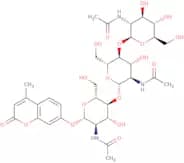
CAS:<p>4-Methylumbelliferyl N,N',N''-triacetyl-beta-D-chitotrioside is a fluorogenic substrate for chitinase. After enzymatic cleaveage, free 4-methylumbelliferone (also known as hymecromone) is released, exhibiting blue fluorescence upon excitation with UV light. The strongest fluorescence of 4-methylumbelliferone requires deprotonation of the hydroxyl group (thus requires alkaline pH), with a maximal fluorescence intensity obtained with excitation at 350 to 370 nm and emission at 440 to 470 nm. The use of 4-methylumbelliferyl N,N',N''-triacetyl-beta-D-chitotriosideas a substrate for measuring the chitinase activity is used for fungal infection assays.</p>Formula:C34H47N3O18Purezza:Min. 95.0 Area-%Colore e forma:White Off-White PowderPeso molecolare:785.75 g/mol4-Trifluoromethylumbelliferyl β-D-galactopyranoside
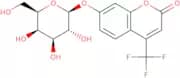
CAS:<p>4-Trifluoromethylumbelliferyl β-D-galactopyranoside is a fluorogenic substrate for beta-galactosidase	. Upon hydrolysis, the fluorogenic moiety (blueish) 4-trifluoromethylumbelliferone (also known as TFMU) is released. 4-Trifluoromethylumbelliferyl β-D-galactopyranoside is commonly used in bacterial detection and in LacZ gene expression assays.</p>Formula:C16H15F3O8Purezza:Min. 95%Colore e forma:PowderPeso molecolare:392.28 g/mol4-Methylumbelliferyl 6-deoxy-2,3,4,6-tetra-O-acetyl-6-thio-β-D-glucopyranoside
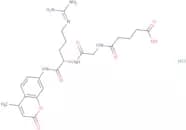
<p>4-Methylumbelliferyl 6-deoxy-2,3,4,6-tetra-O-acetyl-6-thio-beta-D-glucopyranoside is a fluorogenic substrate for beta-glucosidase. After enzymatic cleaveage, free 4-methylumbelliferone (also known as hymecromone) is released, exhibiting blue fluorescence upon excitation with UV light. The strongest fluorescence of 4-methylumbelliferone requires deprotonation of the hydroxyl group (thus requires alkaline pH), with a maximal fluorescence intensity obtained with excitation at 350 to 370 nm and emission at 440 to 470 nm. The use of 4-methylumbelliferyl 6-deoxy-2,3,4,6-tetra-O-acetyl-6-thio-beta-D-glucopyranosideas a substrate for measuring the beta-glucosidase activity is used for Gaucher disease diagnosis.</p>Formula:C24H26O11SPurezza:Min. 95%Colore e forma:White to off-white solid.Peso molecolare:522.52 g/molGlutaryl-glycyl-L-arginine 7-amido-4-methylcoumarin hydrochloride
CAS:<p>Glutaryl-glycyl-L-arginine 7-amido-4-methylcoumarin hydrochloride is a synthetic peptide substrate used as a fluorogenic substrate for aminopeptidase.</p>Formula:C23H30N6O7·HClPurezza:Min. 95%Colore e forma:PowderPeso molecolare:538.98 g/mol4-Methylumbelliferyl caprylate
CAS:<p>Fluorogenic substrate for esterase with C8 activity yielding a blue fluorescent solution upon cleavage. Used for the identification of Salmonella spp. based on the detection of caprylate esterase.</p>Formula:C18H22O4Purezza:Min. 98 Area-%Peso molecolare:302.37 g/molRef: 3D-M-5526
1gPrezzo su richiesta5gPrezzo su richiesta10gPrezzo su richiesta25gPrezzo su richiesta2500mgPrezzo su richiesta-Unit-ggPrezzo su richiesta4-Methylumbelliferyl acetate
CAS:<p>Fluorogenic substrate for carboxylesterase</p>Formula:C12H10O4Purezza:Min. 95%Colore e forma:White PowderPeso molecolare:218.21 g/mol4-Methylumbelliferyl nonanoate
CAS:<p>4-Methylumbelliferyl nonanoate is a synthetic fluorogenic substrate for lipase. It is used to measure the activity of lipases in vitro. 4-Methylumbelliferyl nonanoate reacts with a lipid substrate, such as sodium taurocholate, to produce 4-methylumbelliferone and dodecanol. The fluorescent product can be detected by fluorimetric or spectrophotometric methods. This compound is activated by an enzyme preparation, such as proteolytic enzymes, and can be used to measure the activity of these enzymes in vitro.</p>Formula:C19H24O4Purezza:Min. 99 Area-%Peso molecolare:316.40 g/molRef: 3D-M-5744
5gPrezzo su richiesta10gPrezzo su richiesta25gPrezzo su richiesta50gPrezzo su richiesta-Unit-ggPrezzo su richiesta4-Methylumbelliferyl b-D-glucuronide trihydrate
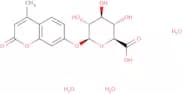
CAS:<p>Fluorogenic substrate for beta-glucuronidase GUS</p>Formula:C16H22O12Purezza:Min. 98 Area-%Colore e forma:White PowderPeso molecolare:406.34 g/mol4-Methylumbelliferyl butyrate
CAS:<p>Methylumbelliferyl butyrate is structurally based on 4-methylumbelliferone and is a MOSCERDAM® substrate. It targets the esterase enzyme.</p>Formula:C14H14O4Purezza:Min. 95%Colore e forma:White PowderPeso molecolare:246.26 g/mol4-Methylumbelliferyl β-D-cellohexaoside
CAS:<p>4-Methylumbelliferyl beta-D-cellohexaoside is a fluorogenic substrate for cellulase. After enzymatic cleaveage, free 4-methylumbelliferone (also known as hymecromone) is released, exhibiting blue fluorescence upon excitation with UV light. The strongest fluorescence of 4-methylumbelliferone requires deprotonation of the hydroxyl group (thus requires alkaline pH), with a maximal fluorescence intensity obtained with excitation at 350 to 370 nm and emission at 440 to 470 nm. The use of 4-methylumbelliferyl beta-D-cellohexaosideas a substrate for measuring the cellulase activity is used for detecting bacterial infection and gut microbiome analysis.</p>Formula:C46H68O33Purezza:Min. 95%Colore e forma:PowderPeso molecolare:1,149.01 g/mol4-Methylumbelliferyl 2-deoxy-2-sulfamino-a-D-glucopyranoside sodium salt - Moscerdam™ biochemical purity
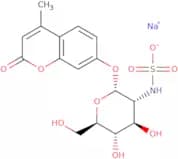
CAS:<p>4-Methylumbelliferyl 2-deoxy-2-sulfamino-a-D-glucopyranoside sodium salt (M3A or MU-GlcNS) is a fluorogenic substrate of heparin sulfamidase, used in the diagnosis of Mucopolysaccharidosis III type A (MPS III A). MPS III A, also known as Sanfilippo syndrome type A, is caused by the deficiency of heparan N-sulfatase. Heparin sulfamidase in the assay desulfates MU-GlcNS to 4-methylumbelliferyl 2-amino-2-deoxy-α-D-glucopyranoside (MU-GlcNH2). To release fluorometrically measurable 4-methylumbelliferone (MU) and by-product glucosamine, MU-GlcNH2 is further hydrolysed by an enzyme such as yeast α-glucosidase during a second incubation.</p>Formula:C16H18NO10SNaPurezza:Min. 95 Area-%Colore e forma:White PowderPeso molecolare:439.37 g/mol4-Methylumbelliferyl decanoate
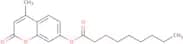
CAS:<p>Fluorogenic substrate for carboxylesterases</p>Formula:C20H26O4Purezza:Min. 98 Area-%Colore e forma:White PowderPeso molecolare:330.42 g/mol