Substrati fluorogenici
In questa categoria troverai una selezione completa di substrati fluorogenici progettati per la catalisi enzimatica. Questi substrati vengono utilizzati con vari tipi di enzimi e sono in grado di produrre colore e fluorescenza al momento della reazione. I substrati fluorogenici sono strumenti essenziali nella ricerca biochimica e biologia molecolare, permettendo la rilevazione e quantificazione dell'attività enzimatica con alta sensibilità e specificità. Sono ampiamente utilizzati in saggi per lo studio della cinetica enzimatica, lo screening di inibitori enzimatici e il monitoraggio dei processi cellulari. Da CymitQuimica, offriamo substrati fluorogenici di alta qualità per supportare le tue ricerche, garantendo risultati affidabili e precisi nei tuoi saggi enzimatici.
Trovati 297 prodotti di "Substrati fluorogenici"
Ordinare per
Purezza (%)
0
100
|
0
|
50
|
90
|
95
|
100
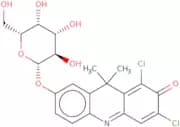
DDAO galactoside
CAS:<p>The DDAO molecule [7-hydroxy-9H-(1, 3-dichloro-9, 9 dimethylacridin-2-one] is used as a stain and a dye in molecular biology, due to its ability to bind intracellular and extracellular DNA. DDAO galactoside is a fluorogenic substrate for galactosidase.</p>Purezza:Min. 95%Colore e forma:PowderPeso molecolare:470.3 g/mol4-Methylumbelliferyl phosphate bis(cyclohexylammonium) salt
CAS:Sensitive fluorogenic substrate for fluorometric and UV-spectrophotometric assays of phosphatases. This may also be used for in-gel assaysFormula:C22H35N2O6PPurezza:Min 99%Colore e forma:White to off-white solid.Peso molecolare:454.50 g/molMonofluoresceinated mannitol
<p>Monofluoresceinated mannitol is a fluorescently labeled form of mannitol. It is used as a tracer for metabolism studies.</p>Formula:C27H24O12Purezza:Min. 95%Colore e forma:PowderPeso molecolare:540.46 g/molAc-Abu-Tle-Leu-Gln-AMC TFA salt
<p>A fluorogenic substrate for detection of enzymatic activity of the SARS-CoV-2 Mpro protease. The fluorophore 7-Amino-4-methylcoumarin (AMC) is linked to the tetrapeptide via a peptide bond at the C-terminal of the glutamine residue. Following the hydrolytic activity of the Mpro protease, the fluorogenic AMC group get released from the substrate, generating a fluorescent signal (Ex 380 nm / Em 455 nm).</p>Formula:C33H48N6O8(freebase)Purezza:Min. 95.0 Area-%Peso molecolare:656.77 g/molL-Lysyl-L-alanine 7-amido-4-methylcoumarin dihydrochloride
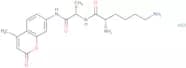
CAS:<p>L-Lysyl-L-alanine 7-amido-4-methylcoumarin dihydrochloride is a fluorogenic peptide substrate for aminopeptidase. This AMC peptide substrate is normally used to rapidly profile the N-terminal specificity of proteases.</p>Purezza:Min. 98.0 Area-%Colore e forma:Powder4-Methylumbelliferyl 2-deoxy-2-sulfamino-b-D-glucopyranoside sodium salt
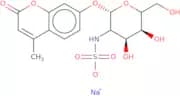
<p>4-Methylumbelliferyl 2-deoxy-2-sulfamino-beta-D-glucopyranoside sodium salt is a fluorogenic substrate for N-sulfoglucosamine sulfohydrolase. After enzymatic cleaveage, free 4-methylumbelliferone (also known as hymecromone) is released, exhibiting blue fluorescence upon excitation with UV light. The strongest fluorescence of 4-methylumbelliferone requires deprotonation of the hydroxyl group (thus requires alkaline pH), with a maximal fluorescence intensity obtained with excitation at 350 to 370 nm and emission at 440 to 470 nm. The use of 4-methylumbelliferyl 2-deoxy-2-sulfamino-beta-D-glucopyranoside sodium saltas a substrate for measuring the N-sulfoglucosamine sulfohydrolase activity is used for screening of Mucopolysaccharidosis IIIA (MPS IIIA) and diagnosis of Sanfilippo A syndrome.</p>Formula:C16H19NO10SNaPurezza:Min. 95%Colore e forma:PowderPeso molecolare:439.37 g/mol4-Methylumbelliferyl 2-acetamido-2-deoxy-α-D-glucopyranoside-6-sulfate potassium
CAS:<p>4-Methylumbelliferyl 2-acetamido-2-deoxy-alpha-D-glucopyranoside-6-sulfate potassium is a fluorogenic substrate for N-acetylglucosamine-6-sulfatase. After enzymatic cleaveage, free 4-methylumbelliferone (also known as hymecromone) is released, exhibiting blue fluorescence upon excitation with UV light. The strongest fluorescence of 4-methylumbelliferone requires deprotonation of the hydroxyl group (thus requires alkaline pH), with a maximal fluorescence intensity obtained with excitation at 350 to 370 nm and emission at 440 to 470 nm. The use of 4-methylumbelliferyl 2-acetamido-2-deoxy-alpha-D-glucopyranoside-6-sulfate potassiumas a substrate for measuring the N-acetylglucosamine-6-sulfatase activity is used for screening of Mucopolysaccharidosis IIID (MPS IIID) (a rare lysosomal storage disorder) and Sanfilippo D syndrome diagnosis.</p>Formula:C18H20KNO11SPurezza:Min. 95%Colore e forma:White PowderPeso molecolare:497.52 g/mol5-Dodecanoylaminofluorescein di-b-D-galactopyranoside
CAS:<p>5-Dodecanoylaminofluorescein di-b-D-galactopyranoside, commonly known as C12FDG, is a fluorogenic substrate for β-galactosidase. Fluorescein is released upon enzymatic cleavage by β-galactosidase. The intensity of its fluorescence is utilised to quantify β-galactosidase activity. C12FDG has been shown to be useful in identifying senescent cells that are associated with aging and cancer. It has also been used as a model system in some studies for studying disease activity, intracellular targets, and biological sample storage. It is also used to identify cancer tissues and radiation damage in the form of senescent cells. The chemical structure of 5DAFG is similar to that of the natural sugar galactose. 5DAFG binds to the plasma membrane of cells due to its lipophilic properties and then enters the cell through transport proteins on the cell surface called ATP binding cassette transporters.</p>Formula:C44H55NO16Purezza:Min. 95 Area-%Colore e forma:White PowderPeso molecolare:853.9 g/molFluorescein di-beta-D-galactopyranoside
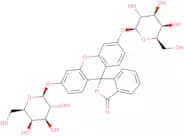
CAS:<p>Fluorogenic substrate for beta-galactosidase</p>Formula:C32H32O15Purezza:Min. 98 Area-%Colore e forma:Slightly Yellow PowderPeso molecolare:656.59 g/mol4-Methylumbelliferyl 2-acetamido-2-deoxy-b-D-glucopyranoside-6-sulfate sodium salt
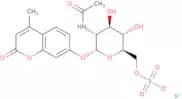
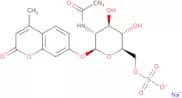
CAS:<p>4-Methylumbelliferyl 2-acetamido-2-deoxy-beta-D-glucopyranoside-6-sulfate sodium salt is a high-quality fluorogenic substrate specifically designed for the detection and quantification of various enzymes, including beta-glucosidases and sulfatases. Upon hydrolysis by the target enzyme, this substrate releases the highly fluorescent 4-methylumbelliferone, allowing for real-time monitoring and accurate measurement of enzyme activities in biochemical assays, diagnostic tests, and research applications. 4-Methylumbelliferyl 2-acetamido-2-deoxy-beta-D-glucopyranoside-6-sulfate sodium salt has excellent solubility in water, ensuring a consistent and reliable performance in different experimental conditions. This versatile substrate is an essential tool for researchers and industry professionals who require a sensitive and reproducible detection method for enzymes of interest.</p>Formula:C18H20NO11SNaPurezza:Min. 98 Area-%Colore e forma:White PowderPeso molecolare:481.41 g/mol4-Methylumbelliferyl a-L-fucopyranoside
CAS:<p>Fluorogenic substrate for fucosidase</p>Formula:C16H18O7Purezza:Min. 95%Colore e forma:White PowderPeso molecolare:322.31 g/mol4-Methylumbelliferyl a-L-arabinofuranoside
CAS:<p>Fluorogenic substrate for ?-arabinofuranosidase</p>Formula:C15H16O7Purezza:Min. 95%Colore e forma:White PowderPeso molecolare:308.28 g/mol6-Chloro-4-(trifluoromethyl)umbelliferyl β-D-cellotrioside
<p>6-Chloro-4-(trifluoromethyl)umbelliferyl b-D-cellotrioside is a fluorogenic substrate for cellulases and beta-glucosidases. After hydrolisis, the fluorophore TFMU is released generating a blue fluorescence.</p>Formula:C28H34ClF3O18Purezza:Min. 95%Colore e forma:White to off-white powder.Peso molecolare:751.01 g/mol4-Methylumbelliferyl heptanoate
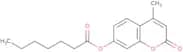
CAS:<p>Lipase targeting MOSCERDAM® substrate</p>Formula:C17H20O4Purezza:Min. 95%Colore e forma:White PowderPeso molecolare:288.34 g/mol4-Methylumbelliferyl b-D-ribofuranoside
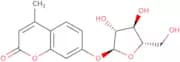
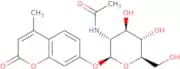
CAS:<p>The 4-Methylumbelliferyl b-D-ribofuranoside is a top-notch fluorogenic substrate for glycosidase activity detection. Upon hydrolysis by enzymes, it generates a strongly fluorescent 4-methylumbelliferone molecule, enabling rapid assay results and real-time monitoring of enzymatic reactions. This product is suitable for many biological research applications, such as in vitro analysis, diagnostic testing, and drug discovery. With its high sensitivity and specificity, it delivers consistent and accurate results, making it an essential tool for scientists and researchers.</p>Formula:C15H16O7Purezza:Min. 95%Colore e forma:White PowderPeso molecolare:308.28 g/mol4-Methylumbelliferyl 2-acetamido-2-deoxy-b-D-glucopyranoside
CAS:<p>Fluorogenic substrate for chitinase</p>Formula:C18H21NO8Purezza:Min. 99 Area-%Colore e forma:White Off-White PowderPeso molecolare:379.36 g/mol4-Methylumbelliferyl phosphate, free acid
CAS:<p>A sensitive fluorogenic substrate for fluorometric and UV-spectrophotometric assays of phosphatases. It is used for the detection of C. perfringens because acid phosphatase is a highly specific indicator for C. perfringens.</p>Formula:C10H9O6PPeso molecolare:256.15 g/molRef: 3D-M-5801
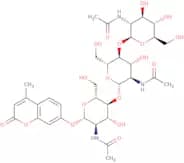
10gPrezzo su richiesta25gPrezzo su richiesta50gPrezzo su richiesta100gPrezzo su richiesta250gPrezzo su richiesta-Unit-ggPrezzo su richiesta4-Methylumbelliferyl N,N',N''-triacetyl-b-D-chitotrioside
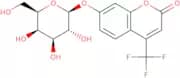
CAS:<p>4-Methylumbelliferyl N,N',N''-triacetyl-beta-D-chitotrioside is a fluorogenic substrate for chitinase. After enzymatic cleaveage, free 4-methylumbelliferone (also known as hymecromone) is released, exhibiting blue fluorescence upon excitation with UV light. The strongest fluorescence of 4-methylumbelliferone requires deprotonation of the hydroxyl group (thus requires alkaline pH), with a maximal fluorescence intensity obtained with excitation at 350 to 370 nm and emission at 440 to 470 nm. The use of 4-methylumbelliferyl N,N',N''-triacetyl-beta-D-chitotriosideas a substrate for measuring the chitinase activity is used for fungal infection assays.</p>Formula:C34H47N3O18Purezza:Min. 95.0 Area-%Colore e forma:White Off-White PowderPeso molecolare:785.75 g/mol4-Trifluoromethylumbelliferyl β-D-galactopyranoside
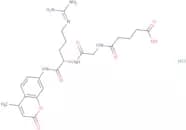
CAS:<p>4-Trifluoromethylumbelliferyl β-D-galactopyranoside is a fluorogenic substrate for beta-galactosidase	. Upon hydrolysis, the fluorogenic moiety (blueish) 4-trifluoromethylumbelliferone (also known as TFMU) is released. 4-Trifluoromethylumbelliferyl β-D-galactopyranoside is commonly used in bacterial detection and in LacZ gene expression assays.</p>Formula:C16H15F3O8Purezza:Min. 95%Colore e forma:PowderPeso molecolare:392.28 g/molGlutaryl-glycyl-L-arginine 7-amido-4-methylcoumarin hydrochloride
CAS:<p>Glutaryl-glycyl-L-arginine 7-amido-4-methylcoumarin hydrochloride is a synthetic peptide substrate used as a fluorogenic substrate for aminopeptidase.</p>Formula:C23H30N6O7·HClPurezza:Min. 95%Colore e forma:PowderPeso molecolare:538.98 g/mol