Substrati fluorogenici
In questa categoria troverai una selezione completa di substrati fluorogenici progettati per la catalisi enzimatica. Questi substrati vengono utilizzati con vari tipi di enzimi e sono in grado di produrre colore e fluorescenza al momento della reazione. I substrati fluorogenici sono strumenti essenziali nella ricerca biochimica e biologia molecolare, permettendo la rilevazione e quantificazione dell'attività enzimatica con alta sensibilità e specificità. Sono ampiamente utilizzati in saggi per lo studio della cinetica enzimatica, lo screening di inibitori enzimatici e il monitoraggio dei processi cellulari. Da CymitQuimica, offriamo substrati fluorogenici di alta qualità per supportare le tue ricerche, garantendo risultati affidabili e precisi nei tuoi saggi enzimatici.
Trovati 297 prodotti di "Substrati fluorogenici"
Ordinare per
Purezza (%)
0
100
|
0
|
50
|
90
|
95
|
100
6-Hexanoylamino-4-methylumbelliferyl b-D-galactopyranoside
6-Hexanoylamino-4-methylumbelliferyl b-D-galactopyranoside is a chromogenic substrate for beta-galactosidase.Purezza:Min. 95%4-Methylumbelliferyl b-D-xylobioside
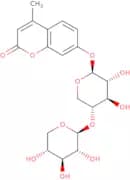
CAS:<p>4-Methylumbelliferyl beta-D-xylobioside is a fluorogenic substrate for xylanase. After enzymatic cleaveage, free 4-methylumbelliferone (also known as hymecromone) is released, exhibiting blue fluorescence upon excitation with UV light. The strongest fluorescence of 4-methylumbelliferone requires deprotonation of the hydroxyl group (thus requires alkaline pH), with a maximal fluorescence intensity obtained with excitation at 350 to 370 nm and emission at 440 to 470 nm. The use of 4-methylumbelliferyl beta-D-xylobiosideas a substrate for measuring the xylanase activity is used for detecting bacterial infection and gut microbiome analysis.</p>Formula:C20H24O11Purezza:Min. 95 Area-%Colore e forma:White PowderPeso molecolare:440.4 g/mol4-Methylumbelliferyl elaidate
CAS:<p>4-Methylumbelliferone is a fluorescent probe that can be used to study the metabolism of fatty acids in plants. It is also used as a marker for radiation and significant cytotoxicity. 4-Methylumbelliferone binds to the DNA termini, specifically at the 5' phosphate group, and inhibits phosphatase activity. This process increases levels of p-nitrophenyl phosphate (a substrate), which produces protocatechuic acid (an intermediate). The disulfide bond is then broken by hydrogen peroxide, leading to an increase in fluorescence. The optimum pH for this process is 7.5.</p>Formula:C28H40O4Purezza:Min. 95 Area-%Peso molecolare:440.63 g/mol4-Methylumbelliferyl b-D-glucuronide hydrate
CAS:<p>4-Methylumbelliferyl beta;-D-glucuronide (MUG) is commonly used as a substrate for detecting beta;-glucuronidase. MUG is used for identifying E. coli contamination in food, drinkingwater, clinical samples and for rapid bacterial identification in blood cultures. It is recommended in international normatives (ISO, DIN) as a fluorogenic substrate for detection of E. coli. MUG is also a tool assaying the glucuronidase gene in plants.</p>Formula:C16H18O10Purezza:(%) Min. 99%Colore e forma:White PowderPeso molecolare:352.29 g/mol4-Methylumbelliferyl myo-inositol-1-phosphate N-methyl-morpholine salt
CAS:<p>Please enquire for more information about 4-Methylumbelliferyl myo-inositol-1-phosphate N-methyl-morpholine salt including the price, delivery time and more detailed product information at the technical inquiry form on this page</p>Formula:C16H19O11P·C5H11NOColore e forma:PowderPeso molecolare:519.44 g/molRef: 3D-EM15809
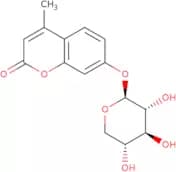
Prodotto fuori produzione4-Methylumbelliferyl-β-D-xylopyranoside
CAS:<p>4-Methylumbelliferyl-β-D-xylopyranoside is a fluorescent probe that has been used to visualize the enzyme activities of glycosidases, such as endoglycosidase H and α-amylase. It is also used as a tool in structural analysis of oligosaccharides. 4-Methylumbelliferyl-β-D-xylopyranoside has been shown to inhibit collagenase activity in mice, which may be due to its ability to inhibit protein synthesis and cell division.</p>Formula:C15H16O7Purezza:Min. 99.0 Area-%Peso molecolare:308.29 g/mol4-Methylumbelliferyl 2-acetamido-2-deoxy-b-D-galactopyranoside
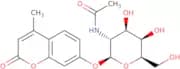
CAS:<p>Please enquire for more information about 4-Methylumbelliferyl 2-acetamido-2-deoxy-b-D-galactopyranoside including the price, delivery time and more detailed product information at the technical inquiry form on this page</p>Formula:C18H21NO8Purezza:Min. 98 Area-%Colore e forma:White PowderPeso molecolare:379.36 g/molRef: 3D-EM06390
Prodotto fuori produzione4-Methylumbelliferyl α-L-idopyranosiduronic acid 2-sulfate disodium salt
CAS:<p>4-Methylumbelliferyl alpha-L-idopyranosiduronic acid 2-sulfate disodium salt is a chromogenic substrate that is used in the detection of glycosidases. It reacts with enzymes such as alpha-amylase, beta-galactosidase, and beta-glucosidase to produce a fluorescent product. This product can be detected using a fluorometer or spectrophotometer. The CAS number for 4-methylumbelliferyl alpha-L-idopyranosiduronic acid 2-sulfate disodium salt is 1045020-74-3.</p>Formula:C16H14Na2O12SPurezza:Min. 99.0 Area-%Peso molecolare:476.32 g/molDDAO galactoside
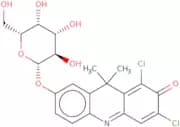
CAS:<p>The DDAO molecule [7-hydroxy-9H-(1, 3-dichloro-9, 9 dimethylacridin-2-one] is used as a stain and a dye in molecular biology, due to its ability to bind intracellular and extracellular DNA. DDAO galactoside is a fluorogenic substrate for galactosidase.</p>Purezza:Min. 95%Colore e forma:PowderPeso molecolare:470.3 g/molRef: 3D-ED29505
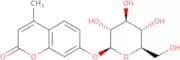
Prodotto fuori produzione4-Methylumbelliferyl β-D-glucopyranoside
CAS:<p>Fluorogenic substrate for β-glucosidase</p>Formula:C16H18O8Purezza:Min. 98 Area-%Colore e forma:PowderPeso molecolare:338.31 g/molRef: 3D-EM05983
Prodotto fuori produzione4-Methylumbelliferyl-N,N-diacetyl-beta-D-chitobioside
CAS:<p>4-Methylumbelliferyl-N,N-diacetyl-beta-D-chitobioside is a molecule that has been expressed in the yeast Pichia pastoris. It can be used as a fluorescent probe for chitinase activity and has been shown to be sensitive to tryptophan residues and aromatic residues in proteins. 4-Methylumbelliferyl-N,N-diacetyl-beta-D-chitobioside has also been used as a fluorescent probe for isozymes of glucose phosphate isomerase. The nature of the trisaccharide is unknown, but it appears to be hydrophobic.</p>Formula:C26H34N2O13Purezza:Min. 99.0 Area-%Peso molecolare:582.57 g/molL-Serine 7-amido-4-methylcoumarin hydrochloride
CAS:<p>L-Serine 7-amido-4-methylcoumarin hydrochloride is a fluorogenic peptide substrate for peptidases. This AMC peptide substrate is normally used to rapidly profile the N-terminal specificity of proteases.</p>Formula:C13H15ClN2O4Peso molecolare:298.72 g/mol4-Methylumbelliferyl b-D-xylopyranoside
CAS:<p>Please enquire for more information about 4-Methylumbelliferyl b-D-xylopyranoside including the price, delivery time and more detailed product information at the technical inquiry form on this page</p>Formula:C15H16O7Purezza:Min. 98 Area-%Colore e forma:PowderPeso molecolare:308.28 g/molRef: 3D-EM03180
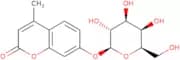
Prodotto fuori produzione4-Methylumbelliferyl b-D-galactopyranoside
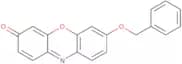
CAS:<p>Fluorogenic substrate for β-galactosidase</p>Formula:C16H18O8Purezza:Min. 95%Colore e forma:White PowderPeso molecolare:338.31 g/molResorufin benzyl ether
CAS:<p>Resorufin benzyl ether is a chemical compound that can be used as a substrate for cytochrome P450. It has been shown to inhibit the activity of epoxide hydrolase, an enzyme involved in the metabolism of endoperoxides. Resorufin benzyl ether has also been found to inhibit cytochrome P450 enzymes, which are responsible for oxidative metabolism of xenobiotics. This compound has been shown to have a high affinity for mouse monoclonal antibody and is used in immunoassays to detect mouse antibodies. Resorufin benzyl ether is used in biochemical assays and polymerase chain reactions (PCRs) as a fluorescence marker. In addition, this compound is used in model systems to study enzyme activities such as recombinant cytochrome p450 and protein oxidation by reactive oxygen species (ROS).</p>Purezza:Min. 95%Peso molecolare:303.31 g/molRef: 3D-ER31479
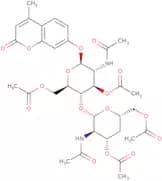
Prodotto fuori produzione4-Methylumbelliferyl 4-deoxy-b-D-chitobiose peracetate
CAS:<p>4-Methylumbelliferyl 4-deoxy-b-D-chitobiose peracetate is a chromogenic substrate used for the detection of β-galactosidase activity. It is an analog of 4-methylumbelliferone that can be hydrolyzed by β-galactosidase to produce fluorescence. This product is supplied as a white crystalline solid and can be stored at room temperature. This substrate has been shown to work well in culture media, food testing, and environmental testing.</p>Purezza:Min. 95%Colore e forma:Off-White PowderPeso molecolare:734.7 g/molRef: 3D-EM72460
Prodotto fuori produzione2'-(4-Methylumbelliferyl)-α-D-N-acetylneuraminic acid, sodium salt
CAS:<p>2'-(4-Methylumbelliferyl)-alpha-D-N-acetylneuraminic acid, sodium salt is a fluorogenic substrate for alpha-galactosidase. It is used in the analysis of cultured media and as a conjugate for enzyme substrates. This product has been shown to be useful in food testing, diagnostics, and environmental testing. 2'-(4-Methylumbelliferyl)-alpha-D-N-acetylneuraminic acid, sodium salt has been used as a chromogenic substrate for the detection of alpha-galactosidase activity. This product is also used as a bioluminescent substrate for the detection of bioluminescence.</p>Formula:C21H24NNaO11Purezza:Min. 96.5 Area-%Peso molecolare:489.42 g/mol