MAPK
Le MAPK sono una famiglia di chinasi proteiche coinvolte in una varietà di processi cellulari, tra cui crescita, proliferazione, differenziazione e risposte allo stress. La via di segnalazione MAPK è composta da diversi livelli, tra cui ERK, JNK e p38 MAPK, ciascuno con ruoli distinti nella funzione cellulare. La disregolazione della segnalazione MAPK è collegata al cancro, alle malattie infiammatorie e ai disturbi metabolici. Presso CymitQuimica, offriamo una vasta gamma di inibitori e attivatori delle MAPK per supportare la tua ricerca in biologia cellulare, trasduzione del segnale e meccanismi delle malattie.
Trovati 894 prodotti di "MAPK"
Ordinare per
Purezza (%)
0
100
|
0
|
50
|
90
|
95
|
100
Mitogen-activated protein kinase 1
CAS:<p>Mitogen-activated protein kinase 1 (MAPK1) activates the p38/NF-κB pathway and regulates cellular processes in sepsis-associated diseases.</p>Purezza:98%Colore e forma:SolidRTIL 13
CAS:RTIL 13 inhibits dynamin GTPase (IC50: 2.3 μM), targets its lipid binding domain, and suppresses endocytosis (IC50: 9.3 & 7.1 μM).Formula:C30H55BrN2O3Colore e forma:SolidPeso molecolare:571.685DS03090629
<p>DS03090629, an orally active MEK inhibitor, functions by competitively inhibiting MEK activity in the presence of ATP. This compound demonstrates strong binding affinity to both MEK and phosphorylated MEK, with dissociation constants (Kd) of 0.11 and 0.15 nM, respectively. It has shown efficacy in suppressing the proliferation of melanoma cell lines that overexpress BRAF mutations, achieving IC50 values of 74.3 and 97.8 nM for BRAF V600E and MEK1 F53L transfected A375 cells, respectively. DS03090629 is thus considered promising for anti-melanoma therapies.</p>Formula:C25H26ClN5O2Colore e forma:SolidPeso molecolare:463.96(S)-BAY-293
CAS:<p>(S)-BAY-293 is a potent pan-KRAS inhibitor for the study of primary non-small lung and pancreatic cancers.</p>Formula:C25H28N4O2SPurezza:98%Colore e forma:SolidPeso molecolare:448.58U0124
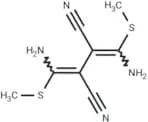
CAS:Inactive analog of U0126(MEK-1/2 inhibitor), used as a negative controlFormula:C8H10N4S2Purezza:98%Colore e forma:SolidPeso molecolare:226.32GNE-9815
CAS:GNE-9815 (3-(2-cyanopropan-2-yl)-N-[2-fluoro-4-methyl-5-(7-methyl-8-oxo-7,8-dihydropyrido[2,3-d]pyridazin-3-yl)phenyl]benzamide) is a high kinase-selectiveFormula:C26H22FN5O2Purezza:99.08% - 99.1%Colore e forma:SolidPeso molecolare:455.48Setidegrasib
CAS:KRAS G12D inhibitor 17, a quinazoline-linked prolinamide, degrades mutant KRAS protein; a PROTAC.Formula:C60H65FN12O7SColore e forma:SolidPeso molecolare:1117.3PROTAC K-Ras Degrader-1
CAS:PROTAC K-Ras Degrader-1 is a PROTAC degrader based on the Cereblon E3 ligase ligand, capable of degrading K-Ras.Formula:C53H62N10O10Purezza:98.05%Colore e forma:SolidPeso molecolare:999.12BAS 00489700
CAS:BAS 00489700 is a N-UTR interaction inhibitor. BAS 00489700 inhibits virus replication in cell culture.Formula:C19H16N2O4Purezza:99.78%Colore e forma:SolidPeso molecolare:336.34PROTAC MEK1 Degrader-1
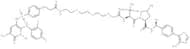
CAS:PROTAC MEK1 Degrader-1, a targeted protein degradation agent, combines a MEK1 inhibitor with a von Hippel-Lindau ligand to effectively inhibit ERK1/2Formula:C53H66FIN8O11S2Purezza:98%Colore e forma:SolidPeso molecolare:1201.17MEK1/2-IN-3
MEK1/2-IN-3 (Compound M15) is an inhibitor of MEK1, with an IC50 value of 10.29 nM. It effectively suppresses tumor cell proliferation and migration, induces apoptosis, and exhibits good liver microsomal stability. MEK1/2-IN-3 is applicable in the study of solid tumors.Formula:C28H23F3IN3O4Colore e forma:SolidPeso molecolare:649.4PROTAC SOS1 degrader-1
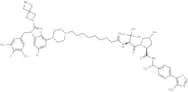
CAS:PROTAC SOS1 degrader-1: potent, DC50 98.4 nM, inhibits KRAS mutant cancer cells, low-toxic antitumor.Formula:C57H76O4ClFN10SColore e forma:SoildPeso molecolare:1050.54443KRASG12C IN-14
<p>KRASG12C IN-14 (compound 15), a potent inhibitor specifically designed for the KRAS G12C mutation, exhibits impressive efficacy in impeding CYPA-dependent KRAS-BRAF interaction and ERK phosphorylation in NCI-H358 cells, both with an IC 50 of 0.002 μM.</p>Formula:C51H65F4N9O9S2Colore e forma:SolidPeso molecolare:1088.24PDE4-IN-26
PDE4-IN-26 (Compound A5) is an orally active, highly selective inhibitor of PDE4. It exhibits anti-inflammatory properties by inhibiting p38 MAPK phosphorylation. In mouse models of acute lung injury and chronic obstructive pulmonary disease, PDE4-IN-26 reduces lung inflammation, damage, and fibrosis, while promoting sputum secretion and alleviating cough. It is useful for researching lung injury-related diseases.Formula:C22H18F2N4O3SColore e forma:SolidPeso molecolare:456.47SS47
CAS:SS47 is a PROTAC that degrades immunosuppressive HPK1 via proteasome; boosts BCMA CAR-T cell cancer therapy.Formula:C49H56N6O12SColore e forma:SolidPeso molecolare:953.07DB-10
DB-10 serves as a precursor to 3-nbutylphthalide (NBP). It is absorbed by cells in a temperature and energy-dependent manner through the pyrilamine cation transporter. DB-10 enhances cell survival and rapidly converts into an active form in vivo, increasing accumulation within the brain. This compound is applicable in ischemic stroke research.Colore e forma:Odour Solid12-Oxo phytodienoic acid
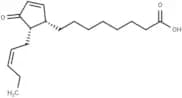
CAS:<p>12-oxo PDA boosts alkaloid production in E. californica, enhances B. dioica tendril curls, and blocks JA-induced cell death in A. fru mutants.</p>Formula:C18H28O3Purezza:98%Colore e forma:SolidPeso molecolare:292.41LYMTAC-2
<p>LYMTAC-2 is a lysosome-targeting chimera (LYMTAC) developed to degrade membrane-associated proteins through lysosomal membrane proteins (LMP) such as RNF152, LAPTM4a, and LAPTM5. It forms a ternary complex with target proteins like KRASG12D, facilitating their relocation to lysosomes and resulting in ubiquitin-dependent degradation. This compound has potential for studying membrane protein regulation and devising strategies to counter resistance in KRAS-driven signaling pathways.</p>Colore e forma:SolidPeso molecolare:1248.44FAM49B (190-198) mouse
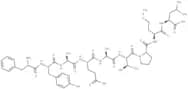
CAS:<p>FAM49B (190-198) mouse represents a peptide fragment of the mitochondria-localized protein FAM49B, which is instrumental in regulating mitochondrial fission, function, and integrity, in addition to influencing tumor progression. Beyond its role in mitochondrial dynamics, FAM49B serves as a negative regulator of T cell activation by inhibiting GTPase Rac activity and affecting cytoskeleton reorganization.</p>Formula:C49H71N9O14SColore e forma:SolidPeso molecolare:1042.2JNK3 inhibitor-8
JNK3 inhibitor-8: potent, selective, oral, BBB-penetrating, IC50: JNK3=21 nM, JNK2=2203 nM, JNK1>10,000 nM; potential in Alzheimer's research.Formula:C32H30FN7O3Colore e forma:SolidPeso molecolare:579.62