Autofagia
Gli inibitori dell'autofagia mirano al processo cellulare di autofagia, che comporta la degradazione e il riciclo dei componenti cellulari attraverso i lisosomi. L'autofagia è un meccanismo critico per mantenere l'omeostasi cellulare, ma la sua disfunzione è implicata in varie malattie, tra cui il cancro, la neurodegenerazione e le infezioni. Gli inibitori dell'autofagia possono bloccare questo processo, rendendoli strumenti preziosi per studiare il ruolo dell'autofagia nelle malattie e sviluppare strategie terapeutiche. Presso CymitQuimica, offriamo inibitori dell'autofagia per supportare la tua ricerca in biologia cellulare, oncologia e malattie neurodegenerative.
Trovati 1482 prodotti di "Autofagia"
Ordinare per
Purezza (%)
0
100
|
0
|
50
|
90
|
95
|
100
ACT-672125
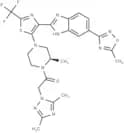
CAS:ACT-672125: Potent CXCR3 blocker, may treat autoimmunity, safe with dose-dependent efficacy in lung inflammation.Formula:C25H25F3N10O2SColore e forma:SolidPeso molecolare:586.59LC3B recruiter 1
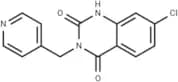
CAS:LC3B recruiter 1 (compound 33R) is an LC3B recruiting fragment. It directly interacts with LC3B, exhibiting a Kd value of 2.87 µM.Formula:C14H10ClN3O2Colore e forma:SolidPeso molecolare:287.701SW063058
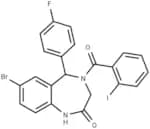
CAS:SW063058 is an autophagy inducer that specifically disrupts the interaction between Beclin 1 and Bcl-2 without affecting the interactions of Bcl-2 with pro-apoptotic members (such as Bax and BIM). By inhibiting the negative regulation of Beclin 1 (key to autophagy initiation) by Bcl-2, SW063058 enhances autophagic activity without inducing cytotoxicity, apoptosis, or other forms of cell death in vitro.Formula:C22H15BrFIN2O2Colore e forma:SolidPeso molecolare:565.17ATG12-IN-1
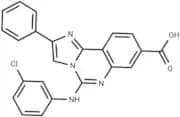
CAS:ATG12-IN-1 (compound 4) acts as an autophagy inhibitor targeting the ATG12-ATG3 protein-protein interaction (IC50= 9 μM), suitable for research in cancer studies.Formula:C23H15ClN4O2Colore e forma:SolidPeso molecolare:414.84LRRK2-IN-20
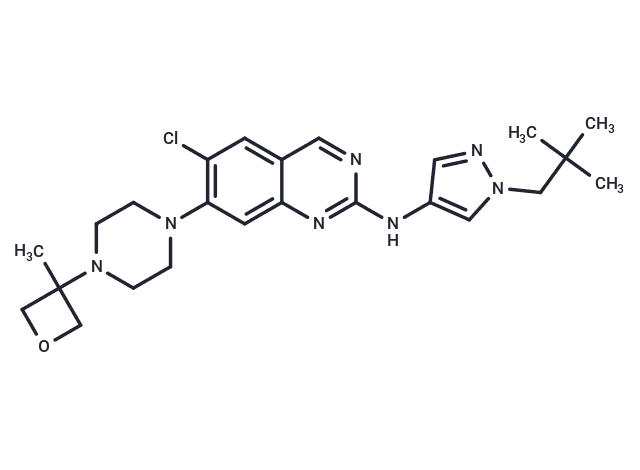
CAS:LRRK2-IN-20 (EX. 4.64) is a selective inhibitor of LRRK2 with a potency of pIC50 at 0.7921 nM. This compound is applicable in research studies focused on Parkinson's Disease (PD).Formula:C24H32ClN7OColore e forma:SolidPeso molecolare:470.01YOK-1304
CAS:YOK-1304, an autophagy-targeting chimera (AUTOTAC), induces self-oligomerization of p62.Formula:C28H35NO4Colore e forma:SolidPeso molecolare:449.58DC-LC3in-D5
CAS:DC-LC3in-D5 is a potent and selective covalent inhibitor of LC3A/B that disrupts autophagy by covalently binding to Lys49 on LC3B.Formula:C19H22Cl2N2O3Purezza:99.79%Colore e forma:SolidPeso molecolare:397.3CXCR2 antagonist 4
CXCR2 antagonist 4 inhibits CXCR2 (IC50: 0.13 μM) and CXCL8-induced calcium rise (IC50: 27 μM), promising for cancer research.Formula:C15H14F2N4OS2Colore e forma:SolidPeso molecolare:368.42LRRK2-IN-6
LRRK2-IN-6 is an oral, selective LRRK2 inhibitor crossing the blood-brain barrier, targeting GS (IC50: 4.6μM) and WT LRRK2 (IC50: 49μM).Formula:C23H24F2N4O2SColore e forma:SolidPeso molecolare:458.52Autophagy activator-1
CAS:<p>Autophagyactivator-1 (Compound B2) is an autophagy activator that induces autophagy by downregulating key members of the HSP70 family and activating the unfolded protein response.</p>Formula:C25H32O8Colore e forma:SolidPeso molecolare:460.517SYUIQ-5
CAS:SYUIQ-5 is a ligand for G-quadruplex structures. It plays a role in stabilizing G-quadruplexes and inducing senescence. Additionally, SYUIQ-5 inhibits the activity of the c-myc gene promoter. By displacing TRF2 from telomeres, SYUIQ-5 induces telomeric damage, which triggers autophagy (autophagy) in cancer cells.Formula:C20H22N4Colore e forma:SolidPeso molecolare:318.415CXCR2/CCR7 antagonist-1
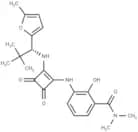
CAS:CXCR2/CCR7 antagonist-1 (compound 6) is a potent dual antagonist of CXCR2 and CCR7, with IC50 values of 0.0046 μM and 0.0014 μM, respectively. It is valuable for research in tumor metastasis and autoimmune diseases.Formula:C23H27N3O5Colore e forma:SolidPeso molecolare:425.48CXCR7 antagonist-1 hydrochloride
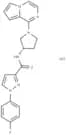
CAS:CXCR7 antagonist-1 hydrochloride blocks SDF-1 and I-TAC from CXCR7; may prevent cancer and inflammation.Formula:C21H20ClFN6OColore e forma:SolidPeso molecolare:426.87Autophagy-IN-7
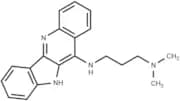
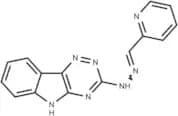
CAS:<p>Autophagy-IN-7 is an autophagy inhibitor for use in studying solid tumours.</p>Formula:C15H11N7Purezza:98.47%Colore e forma:SolidPeso molecolare:289.29CXCR4 antagonist 10
CAS:CXCR4 antagonist10 (compound 21) is an effective CXCR4 inhibitor with an IC50 value of 7.8 nM. It plays a significant role in cancer research.Formula:C18H18N4O4Colore e forma:SolidPeso molecolare:354.364-FPBUA
CAS:4-FPBUA, a semi-synthetic analog of lichen acid, enhances the functionality of cell-based blood-brain barriers (BBB) and increases the transport of β-amyloid (Aβ) in monolayer cells. Additionally, it acts as an inhibitor of mTOR, enhancing cellular autophagy (Autophagy) which can reverse BBB disruption in vivo, making it relevant for research in Alzheimer's disease.Formula:C31H23FO7Colore e forma:SolidPeso molecolare:526.51CXCR2 antagonist 6
CXCR2 antagonist 6: strong CXCR2 affinity (IC50=0.044 μM), hinders calcium mobilization (IC50=0.66 μM).Formula:C17H16F2N4OSColore e forma:SolidPeso molecolare:362.4SCH 563705
CAS:SCH 563705 is a CXCR2 and CXCR1 antagonist used in the study of acute respiratory syndrome, chronic obstructive pulmonary disease, and inflammation.Formula:C23H27N3O5Purezza:98.03%Colore e forma:SolidPeso molecolare:425.48CXCR4 antagonist 3
CXCR4 antagonist 3, aka compound 12a, has 11 nM IC50, shares TIQ15 traits, and is promising in HIV research.Formula:C22H31N5Colore e forma:SolidPeso molecolare:365.52CXCR4 modulator-1
CAS:CXCR4 modulator-1 (ZINC72372983) is potent (EC50=100nM) with uses in anti-inflammatory, anticancer, and anti-HIV research.Formula:C23H27N5O2Colore e forma:SolidPeso molecolare:405.49