Silani
Sottocategorie di "Silani"
Trovati 1234 prodotti di "Silani"
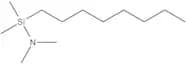
n-OCTYLDIMETHYL(DIMETHYLAMINO)SILANE
CAS:Alkyl Silane - Conventional Surface Bonding
Aliphatic, fluorinated aliphatic or substituted aromatic hydrocarbon substituents are the hydrophobic entities which enable silanes to induce surface hydrophobicity. The organic substitution of the silane must be non-polar. The hydrophobic effect of the organic substitution can be related to the free energy of transfer of hydrocarbon molecules from an aqueous phase to a homogeneous hydrocarbon phase. A successful hydrophobic coating must eliminate or mitigate hydrogen bonding and shield polar surfaces from interaction with water by creating a non-polar interphase. Although silane and silicone derived coatings are in general the most hydrophobic, they maintain a high degree of permeability to water vapor. This allows coatings to breathe and reduce deterioration at the coating interface associated with entrapped water. Since ions are not transported through non-polar silane and silicone coatings, they offer protection to composite structures ranging from pigmented coatings to rebar reinforced concrete. A selection guide for hydrophobic silanes can be found on pages 22-31 of the Hydrophobicity, Hydrophilicity and Silane Surface Modification brochure.
n-Octyldimethyl(dimethylamino)silane; DimethylaminooctyldimethylsilaneFormula:C12H29NSiPurezza:95%Colore e forma:Straw LiquidPeso molecolare:215.45METHACRYLOXYPROPYLTRIS(VINYLDIMETHYLSILOXY)SILANE, tech
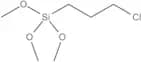
CAS:Formula:C19H38O5Si4Purezza:92%Colore e forma:Straw LiquidPeso molecolare:458.853-CHLOROPROPYLTRIMETHOXYSILANE, 98%
CAS:Halogen Functional Trialkoxy Silane
Silane coupling agents have the ability to form a durable bond between organic and inorganic materials to generate desired heterogeneous environments or to incorporate the bulk properties of different phases into a uniform composite structure. The general formula has two classes of functionality. The hydrolyzable group forms stable condensation products with siliceous surfaces and other oxides such as those of aluminum, zirconium, tin, titanium, and nickel. The organofunctional group alters the wetting or adhesion characteristics of the substrate, utilizes the substrate to catalyze chemical transformations at the heterogeneous interface, orders the interfacial region, or modifies its partition characteristics, and significantly effects the covalent bond between organic and inorganic materials.
3-Chloropropyltrimethoxysilane; 1-Chloro-3-(trimethoxysilyl)propane
Viscosity, 20 °: 0.56 cStγc of treated surfaces: 40.5 mN/mSpecific wetting surface: 394 m2/gVapor pressure, 100 °C: 40 mmAdhesion promoter for styrene-butadiene rubber, SBR, hot-melt adhesivesPowder flow control additive for dry powder fire extinguishing mediaFormula:C6H15ClO3SiPurezza:98%Colore e forma:Straw LiquidPeso molecolare:198.72TETRAKIS[(EPOXYCYCLOHEXYL)ETHYL]TETRAMETHYLCYCLOTETRASILOXANE, tech
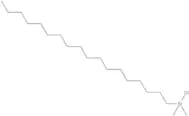
CAS:Formula:C36H64O8Si4Purezza:90%Colore e forma:Straw LiquidPeso molecolare:737.23n-OCTADECYLDIMETHYLCHLOROSILANE
CAS:Alkyl Silane - Conventional Surface Bonding
Aliphatic, fluorinated aliphatic or substituted aromatic hydrocarbon substituents are the hydrophobic entities which enable silanes to induce surface hydrophobicity. The organic substitution of the silane must be non-polar. The hydrophobic effect of the organic substitution can be related to the free energy of transfer of hydrocarbon molecules from an aqueous phase to a homogeneous hydrocarbon phase. A successful hydrophobic coating must eliminate or mitigate hydrogen bonding and shield polar surfaces from interaction with water by creating a non-polar interphase. Although silane and silicone derived coatings are in general the most hydrophobic, they maintain a high degree of permeability to water vapor. This allows coatings to breathe and reduce deterioration at the coating interface associated with entrapped water. Since ions are not transported through non-polar silane and silicone coatings, they offer protection to composite structures ranging from pigmented coatings to rebar reinforced concrete. A selection guide for hydrophobic silanes can be found on pages 22-31 of the Hydrophobicity, Hydrophilicity and Silane Surface Modification brochure.
n-Octadecyldimethylchlorosilane; Dimethyl-n-octadecylchlorosilane; Chlorodimethyloctadecylsilane; Chlorodimethylsilyl-n-octadecane
Contains 5-10% C18 isomersEmployed in bonded HPLC reverse phasesFormula:C20H43ClSiPurezza:97% including isomersColore e forma:Off-White SolidPeso molecolare:347.1Ref: 3H-SIO6615.0
25gPrezzo su richiesta2kgPrezzo su richiesta10kgPrezzo su richiesta750gPrezzo su richiesta160kgPrezzo su richiestaVINYLTRIMETHYLSILANE
CAS:Alkenylsilane Cross-Coupling Agent
The cross-coupling reaction is a highly useful methodology for the formation of carbon-carbon bonds. It involves two reagents, with one typically being a suitable organometallic reagent - the nucleophile - and the other a suitable organic substrate, normally an unsaturated halide, tosylate or similar - the electrophile.
Vinyltrimethylsilane; Ethenyltrimethylsilane; Trimethylsilylethene; Trimethylvinylsilane
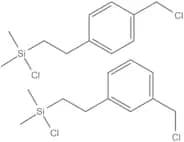
Viscosity, 20 °C: 0.5 cStΔHcomb: 4,133 kJ/molΔHfus: 7.7 kJ/molCopolymerization parameters- e,Q: 0.04, 0.029Forms polymers which can be fabricated into oxygen enrichment membranesPolymerization catalyzed by alkyllithium compoundsReacts w/ azides to form trimethylsilyl-substituted aziridinesUndergoes Heck coupling to (E)-β-substituted vinyltrimethylsilanes, which can then be cross-coupled furtherExtensive review of silicon based cross-coupling agents: Denmark, S. E. et al. "Organic Reactions, Volume 75" Denmark, S. E. ed., John Wiley and Sons, 233, 2011Formula:C5H12SiPurezza:97%Colore e forma:Straw LiquidPeso molecolare:100.24((CHLOROMETHYL)PHENYLETHYL)DIMETHYLCHLOROSILANE
CAS:Mixed m-, p-isomers
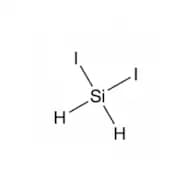
Formula:C11H16Cl2SiPurezza:97%Colore e forma:Straw LiquidPeso molecolare:247.24DIIODOSILANE, 95%
CAS:Formula:H2I2SiPurezza:95%Colore e forma:Pale Yellow To Pink LiquidPeso molecolare:283.911,4-BIS(TRIETHOXYSILYL)BENZENE
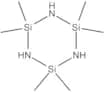
CAS:Formula:C18H34O6Si2Purezza:97%Colore e forma:LiquidPeso molecolare:402.641,1,3,3,5,5-HEXAMETHYLCYCLOTRISILAZANE
CAS:Bridging Silicon-Based Blocking Agent
Used as a protecting group for reactive hydrogens in alcohols, amines, thiols, and carboxylic acids. Organosilanes are hydrogen-like, can be introduced in high yield, and can be removed under selective conditions. They are stable over a wide range of reaction conditions and can be removed in the presence of other functional groups, including other protecting groups. The tolerance of silylated alcohols to chemical transformations summary is presented in Table 1 of the Silicon-Based Blocking Agents brochure.
Alkyl Silane - Conventional Surface Bonding
Aliphatic, fluorinated aliphatic or substituted aromatic hydrocarbon substituents are the hydrophobic entities which enable silanes to induce surface hydrophobicity. The organic substitution of the silane must be non-polar. The hydrophobic effect of the organic substitution can be related to the free energy of transfer of hydrocarbon molecules from an aqueous phase to a homogeneous hydrocarbon phase. A successful hydrophobic coating must eliminate or mitigate hydrogen bonding and shield polar surfaces from interaction with water by creating a non-polar interphase. Although silane and silicone derived coatings are in general the most hydrophobic, they maintain a high degree of permeability to water vapor. This allows coatings to breathe and reduce deterioration at the coating interface associated with entrapped water. Since ions are not transported through non-polar silane and silicone coatings, they offer protection to composite structures ranging from pigmented coatings to rebar reinforced concrete. A selection guide for hydrophobic silanes can be found on pages 22-31 of the Hydrophobicity, Hydrophilicity and Silane Surface Modification brochure.
Hexamethylcyclotrisilazane; Hexamethylcyclotrisilazane; 2,2,4,4,6,6-Hexamethylcyclotrisilazane
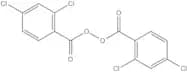
Viscosity, 20 °C: 1.7 cStΔHform: 553 kJ/molDielectric constant: 1000Hz: 2.57Dipole moment: 0.92 debyePolymerizes to polydimethylsilazane oligomer in presence of Ru/H2Modifies positive resists for O2 plasma resistanceSilylates diols with loss of ammoniaSimilar in reactivity to HMDS, SIH6110.0Summary of selective deprotection conditions is provided in Table 7 through Table 20 of the Silicon-Based Blocking Agents brochureFormula:C6H21N3Si3Purezza:97%Colore e forma:LiquidPeso molecolare:219.512,4-DICHLOROBENZOYL PEROXIDE, 50% in polydimethylsiloxane
CAS:Formula:C14H6Cl4O4Colore e forma:Off-White SolidPeso molecolare:380.03-THIOCYANATOPROPYLTRIETHOXYSILANE, 92%
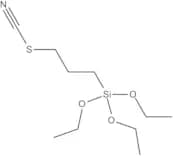
CAS:3-Thiocyanatopropyltriethoxysilane; 3-(triethoxysilyl)propylthiocyanate
Thiocyanate functional trialkoxy silaneSulfur functional coupling agentMasked isothiocyanate functionalityComplexing agent for Ag, Au, Pd, PtPotential adhesion promoter for goldFormula:C10H21NO3SSiPurezza:92%Colore e forma:Straw Yellowish LiquidPeso molecolare:263.43TRIETHYLCHLOROSILANE
CAS:Trialkylsilyl Blocking Agent
Used as a protecting group for reactive hydrogens in alcohols, amines, thiols, and carboxylic acids. Organosilanes are hydrogen-like, can be introduced in high yield, and can be removed under selective conditions. They are stable over a wide range of reaction conditions and can be removed in the presence of other functional groups, including other protecting groups. The tolerance of silylated alcohols to chemical transformations summary is presented in Table 1 of the Silicon-Based Blocking Agents brochure.
Triethylchlorosilane; Chlorotriethylsilane; TES-Cl
Stability of ethers intermediate between TMS and TBS ethersGood for 1°, 2°, 3° alcoholsCan be cleaved in presence of TBS, TIPS and TBDPS ethersUsed primarily for the protection of alcoholsCan be used to protect amines and carboxylic acidsSummary of selective deprotection conditions is provided in Table 7 through Table 20 of the Silicon-Based Blocking Agents brochureFormula:C6H15ClSiPurezza:97%Colore e forma:LiquidPeso molecolare:150.72Ref: 3H-SIT8250.0
2kgPrezzo su richiesta50gPrezzo su richiesta10kgPrezzo su richiesta750gPrezzo su richiesta180kgPrezzo su richiestaDIPHENYLMETHYLCHLOROSILANE
CAS:Phenyl-Containing Blocking Agent
Used as a protecting group for reactive hydrogens in alcohols, amines, thiols, and carboxylic acids. Organosilanes are hydrogen-like, can be introduced in high yield, and can be removed under selective conditions. They are stable over a wide range of reaction conditions and can be removed in the presence of other functional groups, including other protecting groups. The tolerance of silylated alcohols to chemical transformations summary is presented in Table 1 of the Silicon-Based Blocking Agents brochure.
Aromatic Silane - Conventional Surface Bonding
Aliphatic, fluorinated aliphatic or substituted aromatic hydrocarbon substituents are the hydrophobic entities which enable silanes to induce surface hydrophobicity. The organic substitution of the silane must be non-polar. The hydrophobic effect of the organic substitution can be related to the free energy of transfer of hydrocarbon molecules from an aqueous phase to a homogeneous hydrocarbon phase. A successful hydrophobic coating must eliminate or mitigate hydrogen bonding and shield polar surfaces from interaction with water by creating a non-polar interphase. Although silane and silicone derived coatings are in general the most hydrophobic, they maintain a high degree of permeability to water vapor. This allows coatings to breathe and reduce deterioration at the coating interface associated with entrapped water. Since ions are not transported through non-polar silane and silicone coatings, they offer protection to composite structures ranging from pigmented coatings to rebar reinforced concrete. A selection guide for hydrophobic silanes can be found on pages 22-31 of the Hydrophobicity, Hydrophilicity and Silane Surface Modification brochure.
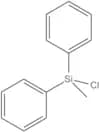
Diphenylmethylchlorosilane; Methyldiphenylchlorosilane; Chloro(methyl)diphenylsilane
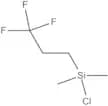
Viscosity: 5.3 cStΔHvap: 623.7 kJ/molSurface tension: 40.0 mN/mVapor pressure, 125 °C: 3 mmThermal conductivity: 0.112 W/m°Cα-Silylates esters, lactones; precursors to silyl enolatesC-Silylates carbamates as shown in the enantioselective example w/ a neryl carbamateStability versus other silyl ethers studiedSummary of selective deprotection conditions is provided in Table 7 through Table 20 of the Silicon-Based Blocking Agents brochureFormula:C13H13ClSiPurezza:97%Colore e forma:LiquidPeso molecolare:232.78(3,3,3-TRIFLUOROPROPYL)DIMETHYLCHLOROSILANE
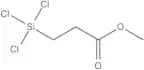
CAS:Formula:C5H10ClF3SiPurezza:97%Colore e forma:Straw LiquidPeso molecolare:190.672-(CARBOMETHOXY)ETHYLTRICHLOROSILANE, tech
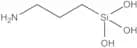
CAS:Formula:C4H7Cl3O2SiPurezza:95%Colore e forma:Straw LiquidPeso molecolare:221.543-AMINOPROPYLSILANETRIOL, 22-25% in water
CAS:3-Aminopropylsilanetriol, 3-trihydroxysilylpropylamine; 22-25% in water
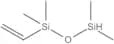
Monoamino functional water-borne silaneMainly oligomers; monomeric at concentrations <5%pH: 10.0-10.5No VOC primary amine coupling agentInternal hydrogen bonding stabilizes solutionSee WSA-7011 for greater hydrolytic stabilityFormula:C3H11NO3SiColore e forma:Yellow To Dark Amber LiquidPeso molecolare:137.21VINYL-1,1,3,3-TETRAMETHYLDISILOXANE
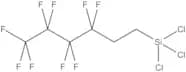
CAS:Formula:C6H16OSi2Purezza:97%Colore e forma:Straw LiquidPeso molecolare:160.36NONAFLUOROHEXYLTRICHLOROSILANE
CAS:Fluoroalkyl Silane - Conventional Surface Bonding
Aliphatic, fluorinated aliphatic or substituted aromatic hydrocarbon substituents are the hydrophobic entities which enable silanes to induce surface hydrophobicity. The organic substitution of the silane must be non-polar. The hydrophobic effect of the organic substitution can be related to the free energy of transfer of hydrocarbon molecules from an aqueous phase to a homogeneous hydrocarbon phase. A successful hydrophobic coating must eliminate or mitigate hydrogen bonding and shield polar surfaces from interaction with water by creating a non-polar interphase. Although silane and silicone derived coatings are in general the most hydrophobic, they maintain a high degree of permeability to water vapor. This allows coatings to breathe and reduce deterioration at the coating interface associated with entrapped water. Since ions are not transported through non-polar silane and silicone coatings, they offer protection to composite structures ranging from pigmented coatings to rebar reinforced concrete. A selection guide for hydrophobic silanes can be found on pages 22-31 of the Hydrophobicity, Hydrophilicity and Silane Surface Modification brochure.
Nonafluorohexyltrichlorosilane; 1-(Trichlorosilyl)nonafluorofluorohexaneFormula:C6H4Cl3F9SiPurezza:97%Colore e forma:Straw LiquidPeso molecolare:381.53


![TETRAKIS[(EPOXYCYCLOHEXYL)ETHYL]TETRAMETHYLCYCLOTETRASILOXANE, tech](/_next/image/?url=https%3A%2Fstatic.cymitquimica.com%2Fproducts%2F3H%2Fthumb-webp%2FSIT7281.5.webp&w=3840&q=75)