Building Blocks
Sottocategorie di "Building Blocks"
- Acidi boronici e derivati dell'acido boronico(5.774 prodotti)
- Building Blocks Chirali(1.237 prodotti)
- Building Blocks Idrocarburici(6.098 prodotti)
- Building Blocks organici(60.969 prodotti)
Trovati 205134 prodotti di "Building Blocks"
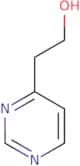
2-(Pyrimidin-4-yl)ethanol
CAS:Versatile small molecule scaffold
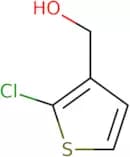
Formula:C6H8N2OPurezza:Min. 95%Peso molecolare:124.14 g/mol(2-Chlorothiophen-3-yl)methanol
CAS:Versatile small molecule scaffold
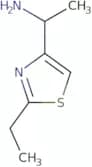
Formula:C5H5ClOSPurezza:Min. 95%Peso molecolare:148.61 g/mol1-(2-Ethyl-1,3-thiazol-4-yl)ethan-1-amine
CAS:Versatile small molecule scaffold
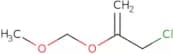
Formula:C7H12N2SPurezza:Min. 95%Peso molecolare:156.2 g/mol2-(Chloromethyl)-3,5-dioxahex-1-ene
CAS:2-(Chloromethyl)-3,5-dioxahex-1-ene is a synthetic compound that belongs to the group of piperidine compounds. It is a nucleophile and a primary amine that reacts with carbonyl compounds in an efficient method. This reaction is stereoselective and produces the corresponding 2-(chloromethyl)-3,5-dioxahex-1-enes. The chloride ion can be replaced by other nucleophiles such as methoxymethyl or amines. The malonate ester can also be used for this reaction.
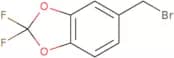
2-(Chloromethyl)-3,5-dioxahex-1-ene has been shown to react with phenylacetonitrile and chloride ions to produce alkylated products such as 2-(chloromethyl)-3,5-dioxahexanenitrile or 2-(chloromethyl)-4,6-dioxFormula:C5H9ClO2Purezza:Min. 95%Peso molecolare:136.58 g/mol5-(Bromomethyl)-2,2-difluoro-2H-1,3-benzodioxole
CAS:Versatile small molecule scaffold
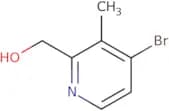
Formula:C8H5BrF2O2Purezza:Min. 95%Peso molecolare:251.02 g/mol(4-Bromo-3-methylpyridin-2-yl)methanol
CAS:Versatile small molecule scaffoldFormula:C7H8BrNOPurezza:Min. 95%Peso molecolare:202.05 g/mol2-[(3,4-Difluorophenyl)methyl]-2-methylpyrrolidine hydrochloride
CAS:Versatile small molecule scaffold
Formula:C12H16ClF2NPurezza:Min. 95%Peso molecolare:247.71 g/mol3-(Propan-2-yl)-3-azabicyclo[3.3.1]nonan-9-one
CAS:Versatile small molecule scaffoldFormula:C11H19NOPurezza:Min. 95%Peso molecolare:181.27 g/mol2-{[(Pyridin-2-ylmethyl)amino]methyl}phenol
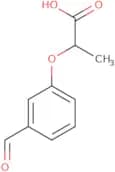
CAS:2-{[(Pyridin-2-ylmethyl)amino]methyl}phenol is a ligand that crystallizes in the monoclinic space group P21/c. The compound crystallizes with two molecules per asymmetric unit, and contains one water molecule per molecule. It has been shown to have cyclic voltammetry, which includes cyclic voltammetry and linear sweep voltammetry. 2-{[(Pyridin-2-ylmethyl)amino]methyl}phenol binds to the perchlorate ion and oxygen atoms coordinate to the nitrogen atoms of the ligand.Formula:C13H14N2OPurezza:Min. 95%Peso molecolare:214.26 g/mol2-(3-Formylphenoxy)propanoic acid
CAS:Versatile small molecule scaffold
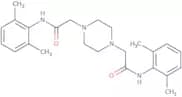
Formula:C10H10O4Purezza:Min. 95%Peso molecolare:194.18 g/molRanolazine Related Compound D
CAS:Versatile small molecule scaffold
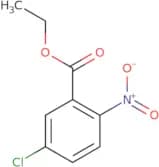
Formula:C24H32N4O2Purezza:Min. 95%Peso molecolare:408.54 g/molEthyl 5-chloro-2-nitrobenzoate
CAS:Versatile small molecule scaffold
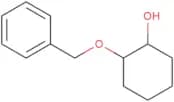
Formula:C9H8ClNO4Purezza:Min. 95%Peso molecolare:229.62 g/molrac-(1R,2R)-2-(Benzyloxy)cyclohexan-1-ol
CAS:Versatile small molecule scaffold
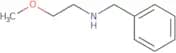
Formula:C13H18O2Purezza:Min. 95%Peso molecolare:206.28 g/molN-Benzyl-n-(2-methoxyethyl)amine
CAS:Versatile small molecule scaffold
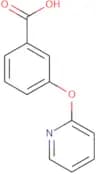
Formula:C10H15NOPurezza:Min. 95%Peso molecolare:165.23 g/mol3-(Pyridin-2-yloxy)benzoic acid
CAS:3-(Pyridin-2-yloxy)benzoic acid is an organic compound that belongs to the group of anilides. It has been shown to be toxic to plants by inhibiting their chlorophyll production and by causing phytotoxicity. 3-(Pyridin-2-yloxy)benzoic acid also inhibits the germination of seeds, primarily due to its inhibition of growth hormone activity. 3-(Pyridin-2-yloxy)benzoic acid can be used as a herbicide because it is highly effective against broadleaf plants, but not grasses. This compound is also relatively non-toxic to mammals and birds, but can cause skin irritation in humans.
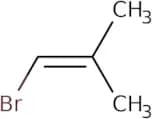
Formula:C12H9NO3Purezza:Min. 95%Peso molecolare:215.2 g/mol1-Bromo-2-methyl-1-propene
CAS:1-Bromo-2-methyl-1-propene is a brominated aliphatic solvent that is used as an intermediate in organic synthesis. The compound has been shown to be an efficient inhibitor of the enzyme pancreatic lipase, which is involved in the digestion of fats and oils. Autofluorescent properties are observed with this compound, which may be due to its ability to absorb light at wavelengths greater than 400 nm and reemit it at wavelengths less than 400 nm. 1-Bromo-2-methyl-1-propene also has antibacterial activity, with a kinetic energy of about 28 kcal/mol, which is slightly higher than that of penicillin G (19 kcal/mol). This property makes it a potential drug for preventing infections in patients undergoing surgery. 1-Bromo-2-methyl-1-propene can also inhibit lipofuscin production and has been shown to have therapeutic effects on age related macular degener
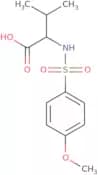
Formula:C4H7BrPurezza:Min. 95%Peso molecolare:135 g/mol(2S)-2-(4-Methoxybenzenesulfonamido)-3-methylbutanoic acid
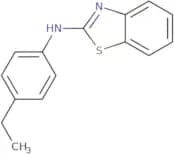
CAS:Versatile small molecule scaffoldFormula:C12H17NO5SPurezza:Min. 95%Peso molecolare:287.33 g/molN-(4-Ethylphenyl)-1,3-benzothiazol-2-amine
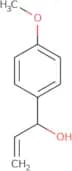
CAS:Versatile small molecule scaffoldFormula:C15H14N2SPurezza:Min. 95%Peso molecolare:254.4 g/mol1-(4-Methoxyphenyl)prop-2-en-1-ol
CAS:1-(4-Methoxyphenyl)prop-2-en-1-ol (1MPE) is a model compound that has been shown to inhibit the growth of cancer cells in vitro and in vivo. 1MPE inhibits the activity of human liver enzymes, such as cytochrome P450, which are involved in metabolizing xenobiotics and drugs. 1MPE also binds to the DNA repair enzyme topoisomerase II alpha and inhibits its activity. The binding of 1MPE with this enzyme prevents the relaxation of DNA, leading to cell death by apoptosis. 1MPE has been shown to have toxic effects on rat primary hepatocytes and rat liver microsomes. It also inhibits the growth of CD-1 mice transplanted with human colon tumor cells. In addition, 1MPE is excreted unchanged in urine samples from rats dosed orally with high doses of this drug.
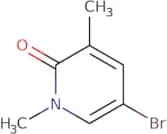
Formula:C10H12O2Purezza:Min. 95%Peso molecolare:164.2 g/mol5-Bromo-1,3-dimethylpyridin-2(1H)-one
CAS:Benzyne is a reactive intermediate that is formed by the tautomerization of 5-bromo-1,3-dimethylpyridin-2(1H)-one. It is an adduct between a bromine atom and a benzene ring. This compound has been shown to react with electron-rich olefins to form bicyclic compounds called diels-alder adducts. These reactions are often catalyzed by metals, such as palladium or nickel. Benzyne also reacts with triple bonds or other electron rich centers to form benzyne adducts, which are highly reactive and can be used as chemical probes for electron density in molecules.
Formula:C7H8BrNOPurezza:Min. 95%Peso molecolare:202.05 g/mol

![2-[(3,4-Difluorophenyl)methyl]-2-methylpyrrolidine hydrochloride](/_next/image/?url=https%3A%2Fstatic.cymitquimica.com%2Fproducts%2F3D%2Fthumb-webp%2FJHD93195.webp&w=3840&q=75)
![3-(Propan-2-yl)-3-azabicyclo[3.3.1]nonan-9-one](/_next/image/?url=https%3A%2Fstatic.cymitquimica.com%2Fproducts%2F3D%2Fthumb-webp%2FTCA06655.webp&w=3840&q=75)
![2-{[(Pyridin-2-ylmethyl)amino]methyl}phenol](/_next/image/?url=https%3A%2Fstatic.cymitquimica.com%2Fproducts%2F3D%2Fthumb-webp%2FNCA67168.webp&w=3840&q=75)