Building Blocks
Sottocategorie di "Building Blocks"
- Acidi boronici e derivati dell'acido boronico(5.784 prodotti)
- Building Blocks Chirali(1.244 prodotti)
- Building Blocks Idrocarburici(6.105 prodotti)
- Building Blocks organici(61.076 prodotti)
Trovati 205455 prodotti di "Building Blocks"
2-Cyano-6-hydroxybenzothiazole
CAS:2-Cyano-6-hydroxybenzothiazole is a molecule that is an intermediate in the synthesis of other compounds. This compound has been shown to have anti-inflammatory properties, with a molecular weight of 164.2 g/mol. It reacts with hydroxyl groups and nucleophilic attack to form new molecules, which can cause light emission. 2-Cyano-6-hydroxybenzothiazole has been shown to be fluorescent and can be used as a marker for hydroxyl group formation in mammalian tissue. 2-Cyano-6-hydroxybenzothiazole can also be found in the human serum and is involved in transcription processes by binding to DNA polymerase or RNA polymerase, forming polymers. The rate at which these polymers are formed depends on the concentration of 2-cyano-6-hydroxybenzothiazole and will vary depending on the light emission from a photomultiplFormula:C8H4N2OSPurezza:Min. 95%Colore e forma:Slightly Yellow Yellow PowderPeso molecolare:176.2 g/mol4,5-Dichloro-3-hydroxypyridine
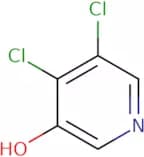
CAS:4,5-Dichloro-3-hydroxypyridine is a reactive chemical that is a building block in organic synthesis. It is used as a reactant in the preparation of other compounds and as a reagent for various reactions, such as those involving amines, alcohols, and thiols. 4,5-Dichloro-3-hydroxypyridine has been found to be useful in the synthesis of heterocyclic compounds with an aromatic ring. It can also be used as an intermediate in the synthesis of pharmaceuticals. This chemical is classified by CAS number 1261269-63-9 and has an MW of 138.2 g/mol.Formula:C5H3Cl2NOPurezza:Min. 95%Colore e forma:White PowderPeso molecolare:163.99 g/mol4-(Dimethylamino)benzaldehyde
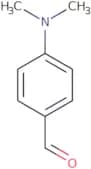
CAS:4-(Dimethylamino)benzaldehyde (4DMAB) is an analytical reagent used to identify sulfa drugs. It has been shown to react with sulfonamides by the formation of a complex ion, which can be detected by analytical methods such as electrochemical impedance spectroscopy or ultraviolet spectroscopy. 4DMAB has also been studied for its anticarcinoid properties. The carcinoid syndrome is characterized by a tumor that releases serotonin and other substances into the bloodstream, causing severe diarrhea, flushing, and bronchial spasms. Studies have shown that 4DMAB inhibits the release of serotonin in this condition. As a result, it may be effective against carcinoid syndrome.Formula:C9H11NOPurezza:Min. 95%Colore e forma:White Slightly Yellow PowderPeso molecolare:149.19 g/mol3,3'-Dithiobis-1-propanesulfonic acid disodium salt
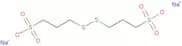
CAS:Brightening agent used for copper electroplatingFormula:C6H12O6S4·2NaPurezza:Min. 90 Area-%Colore e forma:White PowderPeso molecolare:354.39 g/mol2-Cyanopyrimidine
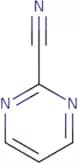
CAS:2-Cyanopyrimidine is a substrate molecule for hypoglycemic effect. It has been shown to inhibit the synthesis of proteins such as immunoglobulin E and other cytokines, which play a role in autoimmune diseases. 2-Cyanopyrimidine also acts as an inhibitor of protein genes, including those that are encoded by the polymerase chain reaction (PCR). 2-Cyanopyrimidine has been shown to be effective in treating eye disorders such as iritis and anterior uveitis. The mechanism of action is not fully understood but may be due to its ability to produce hypoglycemia and its effects on prostaglandin synthesis. 2-Cyanopyrimidine can cause a decrease in systolic blood pressure when used as pharmacological treatment.Formula:C5H3N3Purezza:Min. 95%Colore e forma:White PowderPeso molecolare:105.1 g/mol4-Bromo-2-fluoroaniline
CAS:4-Bromo-2-fluoroaniline is a sulfonated compound that can be synthesized from 2,4,6-trimethylbenzenamine and malonic acid. It is an acidic chemical that reacts with hydroxide solution to form a molecule with a chlorinated aromatic ring. 4-Bromo-2-fluoroaniline has been used in clinical studies as an oral anti-cancer agent in the treatment of malignant melanoma and breast cancer. This drug inhibits epidermal growth factor receptor (EGFR), which may lead to decreased cell proliferation, apoptosis, and tumor formation.Formula:C6H5BrFNPurezza:Min. 99%Colore e forma:PowderPeso molecolare:190.01 g/mol3,3'-Diaminobenzidine
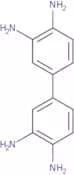
CAS:3,3'-Diaminobenzidine (DAB) is an organic compound derived from benzidine. It is the precursor to the synthetic fibre polybenzimidazole (PBI), which have high thermal and oxidative stability properties. DAB is water-soluble as the tetrahydrochloride salt and is used in immunohistochemical staining of nucleic acids and proteins. Research in Alzheimer's disease, Aβ protein amyloid plaques are targeted by a primary antibody, and subsequently by a secondary antibody, which is conjugated with a peroxidase enzyme. This will bind DAB as a substrate and oxidize it, producing an easily observable brown colour. 3,3’-Diaminobenzidine is also available as the tetrahydrochloride salt and the tetrahydrochloride hydrate.
Formula:C12H14N4Purezza:Min. 98 Area-%Colore e forma:PowderPeso molecolare:214.27 g/mol1,3-Benzenedialdehyde
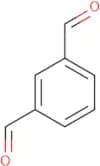
CAS:1,3-Benzenedialdehyde (1,3-BD) is a compound that is formed from the oxidation of benzene by copper chloride in a model system. It can be used as a substrate film to study covalent linkages. The electrochemical impedance spectroscopy (EIS) technique has been used to determine the stability of 1,3-BD in reaction solution. The EIS results show that 1,3-BD is stable and its complexes are relatively stable. This compound also reacts with malonic acid to form 1,2-benzenediol and 2-methylmalonic acid. The molecular structure of 1,3-BD has been determined using X-ray crystallography and it was found that nitrogen atoms are present on the molecule. Chemical reactions have not been observed with 1,3-BD when subjected to heat or light.
Formula:C8H6O2Purezza:Min. 95%Colore e forma:PowderPeso molecolare:134.13 g/mol4-Chloro-3-methoxy-2-methylpyridine N-oxide
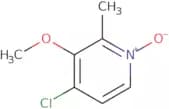
CAS:The compound 4-Chloro-3-methoxy-2-methylpyridine N-oxide is an organic compound with a neutral chemical nature. It is a byproduct of the production of methylpyridine, which is achieved through the reaction between phosphorus oxychloride and toluene. The toxicological properties of this substance are unknown.Formula:C7H8ClNO2Purezza:Min. 95%Colore e forma:PowderPeso molecolare:173.6 g/mol2-Benzoylbenzoic acid
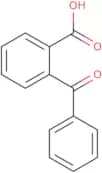
CAS:2-Benzoylbenzoic acid is an organic compound with the chemical formula C6H5CO2. It is a white solid that is soluble in water, ethanol, and ether. 2-Benzoylbenzoic acid is stable at room temperature, but decomposes when heated to above 200°C. This compound can be used as a catalyst for the synthesis of polymers.
2-Benzoylbenzoic acid is used as a raw material for the production of ferrocenecarboxylic acid and ethylene diamine. The activity index of 2-benzoylbenzoic acid was found to be high (0.7) when it was tested against Streptococcus mutans and Staphylococcus aureus.Formula:C14H10O3Purezza:Min. 95%Colore e forma:White PowderPeso molecolare:226.23 g/mol1-Bromo-2-iodobenzene
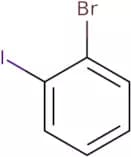
CAS:1-Bromo-2-iodobenzene is an aryl halide that is used in analytical chemistry as a model system for copper chloride. It is also used to study the interaction of 5-HT1A receptors with aromatic hydrocarbons and has been shown to be effective in treating cervical cancer. The light emission from 1-Bromo-2-iodobenzene can be used as a probe for asymmetric synthesis, and it can also be used in metathesis reactions to isolate yield. 1-Bromo-2-iodobenzene binds to lysine residues on proteins and blocks the activity of enzymes by forming covalent bonds with amino acid residues in the active site.Formula:C6H4BrIPurezza:Min. 98%Colore e forma:Yellow Clear LiquidPeso molecolare:282.9 g/molDimethylolurea
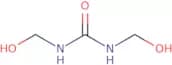
CAS:Dimethylolurea is a formaldehyde releaser that has clinical relevance as a nutrient solution. Dimethylolurea has been shown to release formaldehyde, which may be used to treat bowel diseases and inflammatory bowel disease. Dimethylolurea can also induce an immune response in the human body. This chemical is not soluble in water but it is soluble in ethanol and methanol, which are often used as solvents for this drug. The reaction mechanism of dimethylurea is unclear. It may be due to intramolecular hydrogen transfer or metal hydroxides. As with other drugs, the surface methodology of dimethylurea depends on the size of the microcapsules.Formula:C3H8N2O3Purezza:Min. 95%Colore e forma:White PowderPeso molecolare:120.11 g/mol2',6'-Dimethoxyacetophenone
CAS:2',6'-Dimethoxyacetophenone is a synthetic flavonoid that has been shown to be an anticarcinogenic. This compound is synthesized by cyclodehydration of 2,6-dimethoxybenzaldehyde with hydrochloric acid in the presence of magnesium chloride as a catalyst. The resulting product is then converted to 2',6'-dimethoxyacetophenone by acidic hydrolysis. 2',6'-Dimethoxyacetophenone can also be obtained through Wittig reaction of chlorides and magnesium or via phosphoranes synthesis using magnesium and cyanide as starting materials. This compound can also be produced by benzoylation of styrene followed by chalcone synthesis.Formula:C10H12O3Purezza:Min. 95%Colore e forma:PowderPeso molecolare:180.2 g/mol2,4-Dimethoxybenzylamine
CAS:Tak-659 is an amide compound that inhibits the serine protease activity of a number of enzymes, including cathepsin B and L. Tak-659 has been shown to have inhibitory effects on inflammation in animal models by inhibiting the production of inflammatory cytokines. Tak-659 has also been shown to impair protein synthesis in gram-negative bacteria, such as Escherichia coli and Pseudomonas aeruginosa. The mechanism for this inhibition is not entirely clear but may be due to tak-659 binding to the ribosomal RNA near the peptidyl transferase center, blocking the entry of amino acids into the ribosome. Tak-659 binds with high affinity to adenosine receptors and has been shown to reduce levels of inflammatory cytokines in mouse tumor cells.
Formula:C9H13NO2Purezza:Min. 95%Colore e forma:Colorless Clear LiquidPeso molecolare:167.21 g/mol3,3-Diphenylpropionic acid
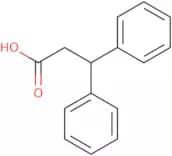
CAS:3,3-Diphenylpropionic acid is a synthetic compound that is used to treat high blood pressure. It is an ester of hydrochloric acid and 3,3-diphenylpropionic acid. 3,3-Diphenylpropionic acid lowers blood pressure by inhibiting the activity of angiotensin II, which causes constriction and shrinking of the blood vessels. The safety profile for this drug has been evaluated in a number of studies in which it was shown that there were no significant adverse effects on the heart or other organs. This drug also has a beneficial effect on diabetic neuropathy and metabolic rate. 3,3-Diphenylpropionic acid is not active against bacteria or fungi but has been shown to be effective against amines by binding to them and preventing their interaction with DNA.Formula:C15H14O2Purezza:Min. 95%Colore e forma:White PowderPeso molecolare:226.27 g/mol3,5-Dihydroxytoluene
CAS:3,5-Dihydroxytoluene is a natural compound that is structurally related to p-hydroxybenzoic acid. It has been shown to be an efficient fluorescent probe for the detection of quillaja saponaria in wastewater treatment plants. 3,5-Dihydroxytoluene also reacts with orcinol to produce a disulfide bond and can undergo polymerization reactions with nucleophiles such as amines and thiols. It is not active against aerobacter aerogenes, but has been shown to have high values against carcinoma cell lines.Formula:C7H8O2Purezza:Min. 97.5 Area-%Colore e forma:White Off-White PowderPeso molecolare:124.14 g/mol6-Chloro-5-fluoroindole
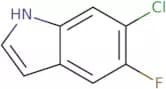
CAS:6-Chloro-5-fluoroindole is a chemical compound that has been shown to be an effective inhibitor of 5-HT2C receptors. 6-Chloro-5-fluoroindole was synthesized in 1972 by the reaction of formamide with chloroacetyl chloride, and it was found to have anti-cancer effects in 1979. 6-Chloro-5-fluoroindole binds to 5HT2C receptors and prevents the activation of G proteins. This inhibition leads to cancer cell death because the receptor is involved in many important signalling pathways. 6CI5FI is used as a research tool for studying the function of this receptor.Formula:C8H5ClFNPurezza:Min. 95%Colore e forma:PowderPeso molecolare:169.58 g/molThianaphthene
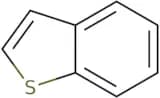
CAS:Used in raloxifene synthesis and preparation of 2-thianapthenylphenyllithiumFormula:C8H6SPurezza:Min. 94 Area-%Colore e forma:Brown White Yellow PowderPeso molecolare:134.2 g/mol1-Cyano-2-hydroxy-3-butene
CAS:1-Cyano-2-hydroxy-3-butene is a mitochondrial toxin that causes apoptosis in liver cells. It has been shown to cause liver lesions in CD1 mice. 1-Cyano-2-hydroxy-3-butene reduces the mitochondrial membrane potential, which leads to a decrease in ATP production and an increase in reactive oxygen species (ROS) production. This toxin also inhibits the transcriptional activity of nuclear receptors and induces the expression of cytochrome P450 2E1, leading to increased detoxification enzyme activity. 1-Cyano-2-hydroxy-3-butene is activated by mitochondria, which leads to its ability to cause apoptosis of liver cells.Formula:C5H7NOPurezza:Min. 95%Colore e forma:Colorless PowderPeso molecolare:97.12 g/mol3-(9-((6-(2,5-Dioxopyrrolidin-1-yloxy)-6-oxohexyl)(tosyl)carbamoyl)acridinium-10-yl)propane-1-sulfonate
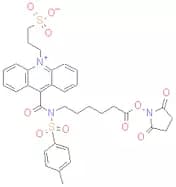
CAS:3-(9-((6-(2,5-Dioxopyrrolidin-1-yloxy)-6-oxohexyl)(tosyl)carbamoyl)acridinium-10-yl)propane-1-sulfonate is a fine chemical that is used as a versatile building block for complex compounds. It can be used in the synthesis of research chemicals or reagents, or as a speciality chemical. 3-(9-((6-(2,5-Dioxopyrrolidin-1-yloxy)-6-oxohexyl)(tosyl)carbamoyl)acridinium-10-yl)propane sulfonate can be reacted with other compounds to form useful scaffolds and reaction components. This compound has CAS number 866366–12–3.Formula:C34H35N3O10S2Purezza:Min. 95%Colore e forma:PowderPeso molecolare:709.79 g/mol