


Building Blocks
Questa sezione contiene prodotti fondamentali per la sintesi di composti organici e biologici. Building blocks sono i materiali di partenza essenziali utilizzati per costruire molecole complesse attraverso varie reazioni chimiche. Svolgono un ruolo critico nella scoperta di farmaci, nella scienza dei materiali e nella ricerca chimica. Presso CymitQuimica, offriamo una gamma diversificata di building blocks di alta qualità per supportare le tue ricerche innovative e progetti industriali, assicurandoti di avere i componenti essenziali per una sintesi di successo.
Sottocategorie di "Building Blocks"
- Acidi boronici e derivati dell'acido boronico(5.756 prodotti)
- Building Blocks Chirali(1.242 prodotti)
- Building Blocks Idrocarburici(6.095 prodotti)
- Building Blocks organici(61.051 prodotti)
Trovati 199813 prodotti di "Building Blocks"
Ordinare per
Purezza (%)
0
100
|
0
|
50
|
90
|
95
|
100
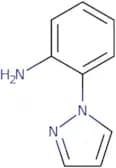
1-(2-Aminophenyl)-1H-pyrazole
CAS:<p>1-(2-Aminophenyl)-1H-pyrazole is a chemical compound that is used in the synthesis of other compounds. It can be produced by various reactions from benzyl chloride and ammonia. The reactivity of 1-(2-aminophenyl)-1H-pyrazole has been studied using single crystal X-ray diffraction. This technique was used to determine the structure and reaction pathway of this molecule as well as to study its catalytic properties. 1-(2-Aminophenyl)-1H-pyrazole is a ligand that binds to metal ions, such as aluminium, in order to form complexes with different functional groups.</p>Formula:C9H9N3Purezza:Min. 95%Peso molecolare:159.19 g/molN-[2-(1-Hydroxyethyl)phenyl]propanamide
CAS:<p>Versatile small molecule scaffold</p>Formula:C11H15NO2Purezza:Min. 95%Peso molecolare:193.24 g/mol2-(5-Chlorothiophen-2-yl)-2-oxoacetic acid
CAS:<p>Versatile small molecule scaffold</p>Formula:C6H3ClO3SPurezza:Min. 95%Peso molecolare:190.6 g/mol3-(Chloromethyl)-5H,6H,8H-[1,2,4]triazolo[3,4-c][1,4]oxazine hydrochloride
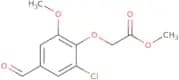
CAS:<p>Versatile small molecule scaffold</p>Formula:C6H9Cl2N3OPurezza:Min. 95%Peso molecolare:210.06 g/molMethyl (2-chloro-4-formyl-6-methoxyphenoxy)acetate
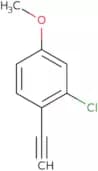
CAS:<p>Versatile small molecule scaffold</p>Formula:C11H11ClO5Purezza:Min. 95%Peso molecolare:258.65 g/mol2-Chloro-1-ethynyl-4-methoxybenzene
CAS:<p>Versatile small molecule scaffold</p>Formula:C9H7ClOPurezza:Min. 95%Peso molecolare:166.6 g/mol4,5-Dihydroxy-2,3-dihydro-1H-isoindole-1,3-dione
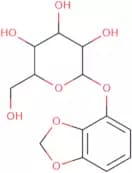
CAS:4,5-Dihydroxy-2,3-dihydro-1H-isoindole-1,3-dione is a molybdenum compound with a hydroxyl group. It has been shown to inhibit the growth of bacteria that are resistant to penicillin by binding to the penicillin-binding proteins in their cell wall. 4,5-Dihydroxy-2,3-dihydro-1H-isoindole-1,3-dione has been found to be an effective inhibitor of polymer film formation when used in conjunction with 3 chloroperoxybenzoic acid. This compound also has been shown to have anti bacterial properties against Escherichia coli and Pseudomonas aeruginosa. 4,5-Dihydroxy -2,3 -dihydro -1H -isoindole -1,3 -dione may also have environmental applications due itsFormula:C8H5NO4Purezza:Min. 95%Peso molecolare:179.13 g/mol(2S,3R,4S,5S,6R)-2-(1,3-Dioxaindan-4-yloxy)-6-(hydroxymethyl)oxane-3,4,5-triol
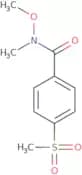
CAS:<p>Versatile small molecule scaffold</p>Formula:C13H16O8Purezza:Min. 95%Peso molecolare:300.26 g/mol4-Methanesulfonyl-N-methoxy-N-methylbenzamide
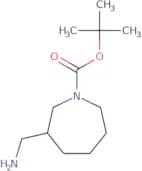
CAS:<p>Versatile small molecule scaffold</p>Formula:C10H13NO4SPurezza:Min. 95%Peso molecolare:243.28 g/moltert-butyl 3-(aminomethyl)azepane-1-carboxylate
CAS:<p>Versatile small molecule scaffold</p>Formula:C12H24N2O2Purezza:Min. 95%Peso molecolare:228.3 g/mol2-{[3-(Dimethylamino)propyl]sulfanyl}aniline
CAS:<p>Versatile small molecule scaffold</p>Formula:C11H18N2SPurezza:Min. 95%Peso molecolare:210.34 g/mol3-Boc-3-azabicyclo[3.2.1]octan-8-amine
CAS:<p>Versatile small molecule scaffold</p>Formula:C12H22N2O2Purezza:Min. 95%Peso molecolare:226.32 g/mol2-Bromo-3,3,3-trifluoro-1-propene
CAS:Prodotto controllato<p>2-Bromo-3,3,3-trifluoro-1-propene is a chemical compound that has been synthesized in an asymmetric reaction. The reactant is bromopropane and the product is 2,2,2-trifluoropropene. The methylene group on the propene molecule is activated by the nucleophilic attack of a fluoride ion from hydrogen fluoride to form a cavity with a highly strained bond. The kinetic study of this reaction revealed that the activation energy for the reaction is 42 kJ/mol. Palladium-catalyzed coupling reactions are catalyzed by palladium and require nonpolar solvents such as toluene or dichloromethane. This type of reaction has been shown to be exothermic with an isolated yield of 1%.</p>Formula:C3H2BrF3Purezza:Min. 95%Colore e forma:Colorless PowderPeso molecolare:174.95 g/mol

![N-[2-(1-Hydroxyethyl)phenyl]propanamide](/_next/image/?url=https%3A%2Fstatic.cymitquimica.com%2Fproducts%2F3D%2Fthumb-webp%2FGWB64243.webp&w=3840&q=75)

![3-(Chloromethyl)-5H,6H,8H-[1,2,4]triazolo[3,4-c][1,4]oxazine hydrochloride](/_next/image/?url=https%3A%2Fstatic.cymitquimica.com%2Fproducts%2F3D%2Fthumb-webp%2FDXC56271.webp&w=3840&q=75)
![2-{[3-(Dimethylamino)propyl]sulfanyl}aniline](/_next/image/?url=https%3A%2Fstatic.cymitquimica.com%2Fproducts%2F3D%2Fthumb-webp%2FBAA13477.webp&w=3840&q=75)
![3-Boc-3-azabicyclo[3.2.1]octan-8-amine](/_next/image/?url=https%3A%2Fstatic.cymitquimica.com%2Fproducts%2F3D%2Fthumb-webp%2FFDC76351.webp&w=3840&q=75)
