Building Blocks
Sottocategorie di "Building Blocks"
- Acidi boronici e derivati dell'acido boronico(5.784 prodotti)
- Building Blocks Chirali(1.242 prodotti)
- Building Blocks Idrocarburici(6.105 prodotti)
- Building Blocks organici(61.061 prodotti)
Trovati 205399 prodotti di "Building Blocks"
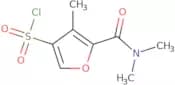
5-(Dimethylcarbamoyl)-4-methylfuran-3-sulfonyl chloride
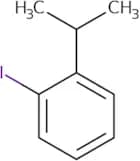
CAS:Versatile small molecule scaffoldFormula:C8H10ClNO4SPurezza:Min. 95%Peso molecolare:251.69 g/mol2-Iodocumene
CAS:2-Iodocumene is a chemical that belongs to the group of unsymmetrical carbonyl compounds. It is an intermediate in the synthesis of saccharin and other organic chemicals, as well as in the production of pharmaceuticals. 2-Iodocumene can be used as a ligand in metal-catalyzed cross-coupling reactions between organometallic reagents and various types of electrophiles. This compound has been shown to react with iron at room temperature to form an active catalyst for the regioselective cleavage of C-C bonds. The mechanistic studies have revealed that 2-iodocumene acts as an electron acceptor and a nucleophile, which allows it to act as a bifunctional catalyst during these reactions. The reaction rate depends on steric hindrance, which may be due to the presence of carbonyl groups or cyclic structures. The mechanism is supported by computational studies using density functional
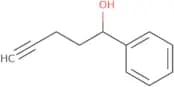
Formula:C9H11IPurezza:Min. 95%Peso molecolare:246.09 g/mol1-Phenylpent-4-yn-1-ol
CAS:1-Phenylpent-4-yn-1-ol is a ketone that can be synthesized by the desulfonylation of 1,3-dibromopropane. It is a radical that has been shown to have potential in the synthesis of polymers and pharmaceuticals. This compound undergoes sequential desulfonylative coupling with alcohols such as phenylethyl alcohol to produce phenylethylphenol. The use of 1-phenylpent-4-yn-1-ol in this process makes it an environmentally friendly alternative to other more toxic reagents.
Formula:C11H12OPurezza:Min. 95%Peso molecolare:160.21 g/mol2',3',5',6'-Tetrahydrospiro[indoline-3,4'-pyran]-2-one
CAS:Versatile small molecule scaffold
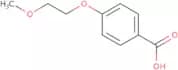
Formula:C12H13NO2Purezza:Min. 95%Peso molecolare:203.24 g/mol4-(2-Methoxy-ethoxy)-benzoic acid
CAS:Versatile small molecule scaffold
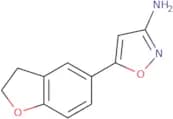
Formula:C10H12O4Purezza:Min. 95%Peso molecolare:196.2 g/mol5-(2,3-Dihydro-1-benzofuran-5-yl)-1,2-oxazol-3-amine
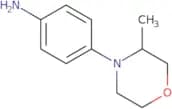
CAS:Versatile small molecule scaffoldFormula:C11H10N2O2Purezza:Min. 95%Peso molecolare:202.2 g/mol4-(3-Methylmorpholin-4-yl)aniline
CAS:Versatile small molecule scaffold
Formula:C11H16N2OPurezza:Min. 95%Peso molecolare:192.26 g/mol4H,5H,6H,7H-Pyrazolo[1,5-a]pyridine
CAS:This molecule is a synthetic, physicochemical drug that is used to treat women with metastatic breast cancer. It binds to glutamate receptors and blocks the metabotropic glutamate receptor. Pyrazolo[1,5-a]pyridine has been shown to be effective in clinical trials in treating melanotic lesions. The drug has been shown to have a dose-dependent effect on the central nervous system and can lead to death due to cardiac arrest.
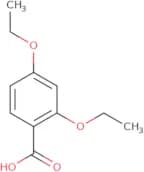
Formula:C7H10N2Purezza:Min. 95%Peso molecolare:122.17 g/mol2,4-Diethoxybenzoic acid
CAS:2,4-Diethoxybenzoic acid is a chemical compound which is found in the essential oil of the plant Dalbergia sissoo. It has been shown to have anti-inflammatory properties and to be a potential therapeutic agent. 2,4-Diethoxybenzoic acid is an acetylated phenolic compound that is used in the production of heartwood extractions. It can act as a mathematical component and can be used in the synthesis of natural products such as isoflavanones. 2,4-Diethoxybenzoic acid has been shown to have antioxidant properties and to inhibit lipid peroxidation at high concentrations.
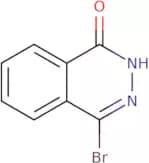
Formula:C11H14O4Purezza:Min. 95%Peso molecolare:210.23 g/mol4-Bromophthalazin-1(2H)-one
CAS:Versatile small molecule scaffold
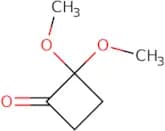
Formula:C8H5BrN2OPurezza:Min. 95%Peso molecolare:225.04 g/mol2,2-Dimethoxycyclobutan-1-one
CAS:Versatile small molecule scaffold
Formula:C6H10O3Purezza:Min. 95%Peso molecolare:130.14 g/mol1-Chloro-4-methoxyphthalazine
CAS:1-Chloro-4-methoxyphthalazine is a new member of the family of phthalonitriles. It has been shown that this compound is electron rich and can be oxidized to give a radical anion, which can then be used for C-C bond formation. The elimination of chlorine from 1-chloro-4-methoxyphthalazine can take place electrochemically, following the mechanism of the reversible transfer reaction. This chemical property allows 1-chloro-4-methoxyphthalazine to act as an electron source in electrochemical reactions.
Formula:C9H7ClN2OPurezza:Min. 95%Peso molecolare:194.62 g/mol4-(2-{7-Thia-2,4,5-triazatricyclo[6.4.0.0,2,6]dodeca-1(12),3,5,8,10-pentaen-3-ylsulfanyl}acetamido)benzoic acid
CAS:Versatile small molecule scaffold
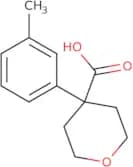
Formula:C17H12N4O3S2Purezza:Min. 95%Peso molecolare:384.4 g/mol4-m-Tolyl-tetrahydro-pyran-4-carboxylic acid
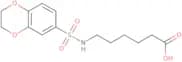
CAS:Versatile small molecule scaffoldFormula:C13H16O3Purezza:Min. 95%Peso molecolare:220.27 g/mol6-(2,3-Dihydro-1,4-benzodioxine-6-sulfonamido)hexanoic acid
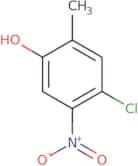
CAS:Versatile small molecule scaffoldFormula:C14H19NO6SPurezza:Min. 95%Peso molecolare:329.37 g/mol4-Chloro-2-methyl-5-nitrophenol
CAS:4-Chloro-2-methyl-5-nitrophenol is a white solid with an alkaline reaction. It is used in the production of sulfonated dyes, as well as in the manufacture of certain drugs and pesticides. 4-Chloro-2-methyl-5-nitrophenol can be made industrially by the elimination of toluene under acidic conditions. This product also reacts with nitric acid to form a radical intermediate that adds to a phenyl group, forming a nitro group at position 2 on the ring structure, yielding 4-(2'-methylpropyl)-phenylamine. This compound can also be made by reacting 2,4,5-trichlorophenol with phosphorus pentachloride or thionyl chloride. The resulting chlorinated compound is then oxidized to produce 4-(2'-methylpropyl)-phenylamine and HCl gas.
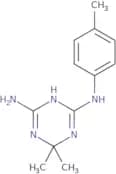
Formula:C7H6ClNO3Purezza:Min. 95%Peso molecolare:187.58 g/mol6,6-Dimethyl-4-N-(4-methylphenyl)-1,6-dihydro-1,3,5-triazine-2,4-diamine
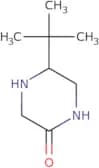
CAS:Versatile small molecule scaffoldFormula:C12H17N5Purezza:Min. 95%Peso molecolare:231.3 g/mol5-tert-Butylpiperazin-2-one
CAS:Versatile small molecule scaffold
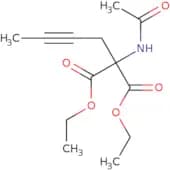
Formula:C8H16N2OPurezza:Min. 95%Peso molecolare:156.23 g/mol1,3-Diethyl 2-(but-2-yn-1-yl)-2-acetamidopropanedioate
CAS:Versatile small molecule scaffoldFormula:C13H19NO5Purezza:Min. 95%Peso molecolare:269.29 g/mol3,4-Diaminobenzenesulphonamide
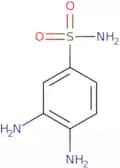
CAS:3,4-Diaminobenzenesulphonamide is a chemical compound that is used as an intermediate in organic synthesis and non-apoptotic cell death. 3,4-Diaminobenzenesulphonamide reacts with iron chloride to form ferroptosis, an environmental pollutant. It can also be used for the treatment of various cancers. 3,4-Diaminobenzenesulphonamide binds to the iron in the cell and causes cell death by forming reactive oxygen species that induce ferroptosis. 3,4-Diaminobenzenesulphonamide is also a non-apoptotic cell death agent that inhibits mitochondrial membrane potential and leads to cellular necrosis.
Formula:C6H9N3O2S·2ClHPurezza:Min. 95%Peso molecolare:260.14 g/molRef: 3D-CAA36020
Prodotto fuori produzione

![2',3',5',6'-Tetrahydrospiro[indoline-3,4'-pyran]-2-one](/_next/image/?url=https%3A%2Fstatic.cymitquimica.com%2Fproducts%2F3D%2Fthumb-webp%2FEMA87629.webp&w=3840&q=75)
![4H,5H,6H,7H-Pyrazolo[1,5-a]pyridine](/_next/image/?url=https%3A%2Fstatic.cymitquimica.com%2Fproducts%2F3D%2Fthumb-webp%2FUAA07857.webp&w=3840&q=75)

![4-(2-{7-Thia-2,4,5-triazatricyclo[6.4.0.0,2,6]dodeca-1(12),3,5,8,10-pentaen-3-ylsulfanyl}acetamido…](/_next/image/?url=https%3A%2Fstatic.cymitquimica.com%2Fproducts%2F3D%2Fthumb-webp%2FEMA86359.webp&w=3840&q=75)